
Cuba condemns Trump order expanding US sanctions
 5 Min Read
Cuba condemned Trump’s new executive order expanding US sanctions, calling it a violation of sovereignty and collective punishment.
-
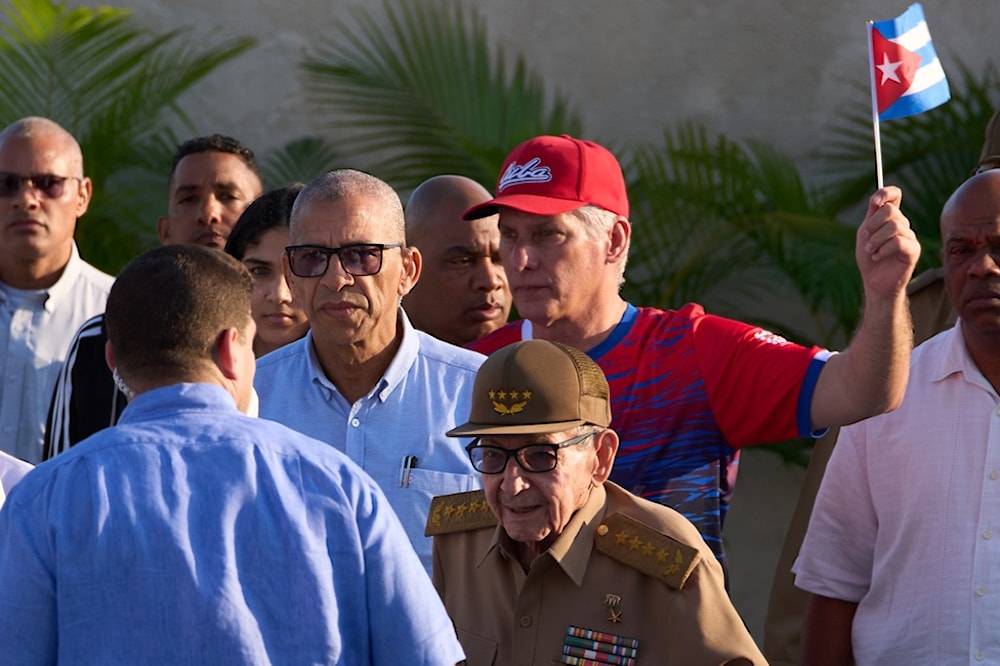
Former President Raul Castro, center, and Cuban President Miguel Díaz-Canel, behind with flag, arrive for a gathering marking International Workers' Day at Jose Marti Anti-Imperialist Square in Havana, Cuba, Friday, May 1, 2026 (AP)
The Committee on International Relations at Cuba’s National Assembly of People’s Power condemned a new executive order issued by US President Donald Trump, saying the measure escalates the economic war imposed on the island and deepens collective punishment against the Cuban people.
In an official statement, the committee said the new measures violate Cuba’s sovereignty and right to self-determination, while expanding the blockade through pressure on foreign states and companies by threatening additional sanctions aimed at preventing financial and commercial dealings with Havana.
The statement also warned that recent remarks by the US administration have intensified tensions amid references to possible military options against Cuba.
Cuban parliament denounces economic escalation
Cuban lawmakers reaffirmed the country’s commitment to its political and social path, which they said was approved by the Cuban people through the constitution, stressing continued efforts to build a society based on social justice.
The statement added that millions of Cubans renewed their support for independence and the revolution through broad popular initiatives alongside massive participation in May Day celebrations.
In this context, the parliamentary committee called on world parliaments and international organizations to act to halt the economic and military escalation against Cuba, while reaffirming Havana’s commitment to peace, development, and the defense of its sovereignty.
Trump expands sanctions on Cuba
Trump signed an executive order last Friday expanding US sanctions on the Cuban government as part of efforts to increase pressure on Havana following the abduction of Venezuelan President Nicolas Maduro and his wife on January 3.
Trump had previously stated that Washington was considering multiple options to change the situation in Cuba, including imposing control over the island.
Washington has long sought to overthrow or weaken the Cuban government, while Havana maintains that Trump aims to seize the country, its resources, and its property while strangling the island’s economy amid worsening electricity shortages and fuel scarcity.
Diaz-Canel vows continued resistance to pressure
Cuban President Miguel Diaz-Canel responded to the escalating US measures by affirming that “any aggressor, regardless of its power, will not find surrender in Cuba, but rather a people determined to defend sovereignty and independence in every inch of its land”.
The Cuban president also stressed that Havana would continue supporting the Palestinian cause, the Iranian people, the Lebanese people, the Bolivarian revolution, and efforts toward securing the release of the kidnapped Venezuelan President Nicolas Maduro.
The latest sanctions come amid a deepening crisis widely attributed to US restrictions, particularly on energy supplies. Limits on fuel imports have triggered widespread blackouts affecting millions, while disrupting hospitals, public transportation, water systems, and schools. Cuba’s dependence on imported oil has made it especially vulnerable to these measures, with only limited shipments, such as those from Russia, managing to reach the island in recent months.
Sanctions deepen crisis
Beyond energy, the sanctions have had far-reaching economic and humanitarian consequences. Financial restrictions and trade barriers have constrained Cuba’s access to global markets, reducing foreign investment and driving up the cost of essential imports. Shortages of food and basic goods have intensified as supply chains are disrupted and purchasing power declines.
The healthcare system, long regarded as one of the country’s key pillars, has also come under strain. Restrictions on imports involving US components have contributed to shortages of medicines, medical equipment, and diagnostic supplies, delaying treatments and placing vulnerable populations at risk. Power outages linked to fuel shortages have further compounded the situation, affecting hospital operations and critical care services.
Public anger over these conditions was visible in Havana during International Workers' Day, when demonstrators gathered outside the US Embassy to denounce the blockade.
In an attempt to internationalize economic pressure and isolate the island further, Washington has threatened to penalize third countries supplying oil to Cuba, warning of tariffs on their exports to the United States.
Tensions undermine dialogue
Despite earlier indications from President Miguel Díaz-Canel that dialogue with Washington was underway, the latest actions have raised doubts over any potential easing of tensions. Díaz-Canel criticized the measures as coercive, stating that the blockade inflicts harm through the “intimidating and arrogant behaviour of the world's greatest military power.”
Trump’s remarks later on Friday intensified concerns in Havana, after he suggested the United States could be “taking over” Cuba “almost immediately”. He added, “On the way back from Iran, we'll have one of our big - maybe the USS Abraham Lincoln aircraft carrier - the biggest in the world, we'll have that come in, stop about 100 yards offshore, and they'll say, 'Thank you very much. We give up'.”
For Cuban officials, such rhetoric reinforces long-standing claims that US policy is rooted in regime change, a position they trace back to the aftermath of the Cuban Revolution led by Fidel Castro. The economic embargo imposed in 1960 continues to define relations between the two countries, with Havana arguing that the current escalation represents not a departure, but an intensification of a sustained campaign to pressure and destabilize the Cuban state.


