
Trump threatens immediate US takeover of Cuba
 5 Min Read
Trump threatens an immediate US takeover of Cuba, suggesting naval deployment and new sanctions amid widening escalation beyond Iran.
-
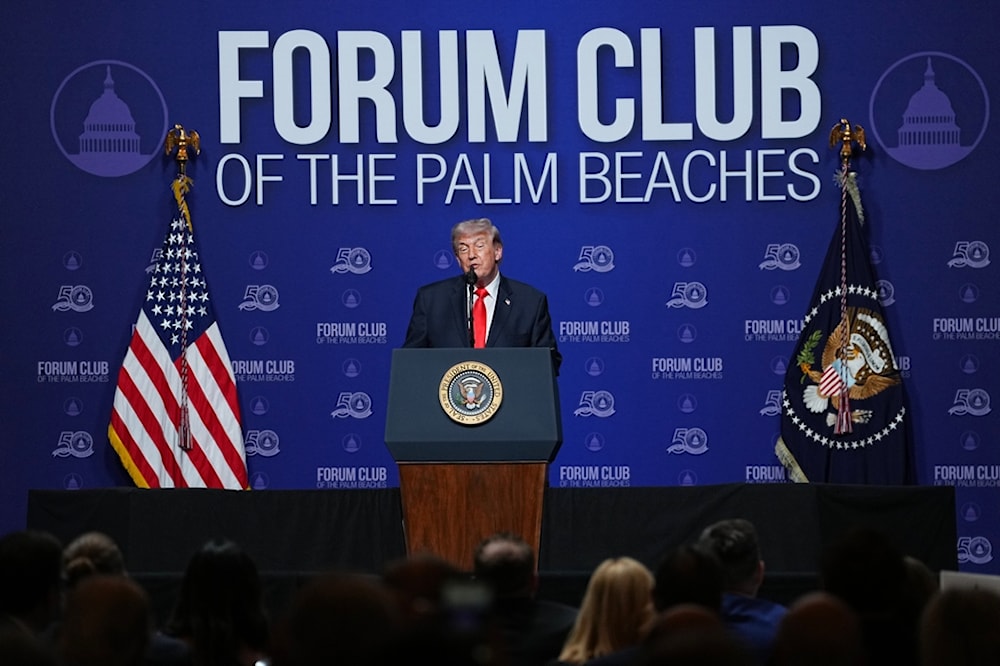
US President Donald Trump speaks at the Raymond F. Kravis Center for the Performing Arts in West Palm Beach Fla., Friday, May 1, 2026. (AP Photo/Matt Rourke)
US President Donald Trump stated that Washington could move to take control of Cuba “almost immediately,” in remarks signaling a sharp escalation in the long-standing hostile US rhetoric toward the Caribbean island.
Speaking at an event in Florida on Friday, Trump said, “Cuba, which we will be taking over almost immediately,” adding that “Cubans got problems.”
The US president outlined a potential show of force involving a US aircraft carrier, indicating that such a move could compel Cuba to submit without direct conflict.
“On the way back from Iran, we'll have one of our big, maybe the USS Abraham Lincoln aircraft carrier, the biggest in the world, we'll have that come in, stop about 100 yards offshore,” he said.
He further claimed that the presence of such military force alone would force a rapid capitulation. “They'll say 'thank you very much. We give up,'” Trump added, concluding: “I like to finish a job.”
The reference to the USS Abraham Lincoln highlights Washington’s reliance on naval power projection as a central tool in its strategy.
Earlier in April, sources told USA Today that US defense officials were moving forward with plans to potentially conduct military operations against Cuba.
Read more: China: US cannot justify Cuba blockade with fabricated claims
Escalation following war on Iran
Trump linked the threats directly to the aftermath of the US-Israeli war on Iran, suggesting that any action against Cuba would follow the conclusion of military operations in West Asia.
This sequencing indicates a broader strategic outlook extending beyond a single theater of conflict, raising concerns about the expansion of US military pressure into new regions.
His repeated statements that Cuba is “next” reinforce the perception of a widening confrontation framework.
Connotations of an operation targeting Cuba following the cessation of armed conflict against Iran have been brought up previously by Trump. Speaking with USA Today on April 13, the US President said, “We may stop by Cuba after we’re finished with this,” referring to Iran.
Trump added that he expects to have the "honor" of “taking Cuba, in some form,” adding, “Whether I free it, take it − I think I can do anything I want with it.”
New sanctions target Cuba
Alongside the military threats, Trump signed an executive order imposing new sanctions on individuals and entities linked to Cuba earlier on Friday. The measures were claimed to be based on alleged threats to US national security and foreign policy interests.
Sanctions have long been a central component of US policy toward Cuba, but the latest move signals an intensification of economic pressure in parallel with escalating rhetoric.
Trump asserted that the island would fail “soon,” further amplifying the tone of confrontation.
Cuban resources
Geo-economic factors are also at play with Washington's increased pressure and threats against Cuba.
Cuba has one of the world's top five largest nickel reserves. Per US Geological Survey (USGS) data, Cuba's proven nickel reserves are roughly 5.5 million tons, corresponding to 7-8% of the world's total reserves.
Alongside nickel, Cuba is tied with Indonesia for having the third-largest cobalt reserves globally at 500,000 tons.
Both have seen a large increase in strategic value within recent years as they are critical materials in the development of EV batteries. The production of these high-energy-density lithium-ion batteries has become the center of global competition, which is currently dominated by China, which has very close ties with Cuba.
Projections by the International Energy Agency state that global nickel demand will increase by roughly 250% between 2020 and 2035 as the production of electric vehicles is expected to reach 45-50 million units annually by the beginning of the next decade.
Separately, USGS assessments estimate that the North Cuban Basin may hold 4.6 billion barrels of undiscovered technically recoverable oil, alongside a significant amount of natural gas.
Strategic implications in the Caribbean
The statements point to a potential escalation in the Caribbean, a region historically shaped by US hegemony.
The suggestion of deploying naval assets close to Cuban shores reflects a familiar pattern of coercive diplomacy, combining military presence with economic measures to achieve political objectives.
Such moves risk heightening tensions across the region, particularly as global dynamics remain strained following the war on Iran.
Read more: US pressure forces end of Cuba medical missions; patients suffer
The Trump administration has steadily ramped up hostilities against the Caribbean since it took office.
Washington carried out several strikes against vessels it claims to have ties to drug smuggling operations, but has failed to provide any evidence to back its allegations. At least 185 people have been killed as a result of these attacks.
Cuban forces were present to aid Venezuela during the kidnapping of Venezuelan President Nicolas Maduro and his wife. 32 were killed as a result of US bombings while carrying out their duty to defend Caracas from the US attack.


