
US military boosts preparations for possible military action in Cuba
 4 Min Read
The US is advancing contingency plans for a potential military operation against Cuba while intensifying economic pressure, as Havana warns it will resist any form of interference.
-
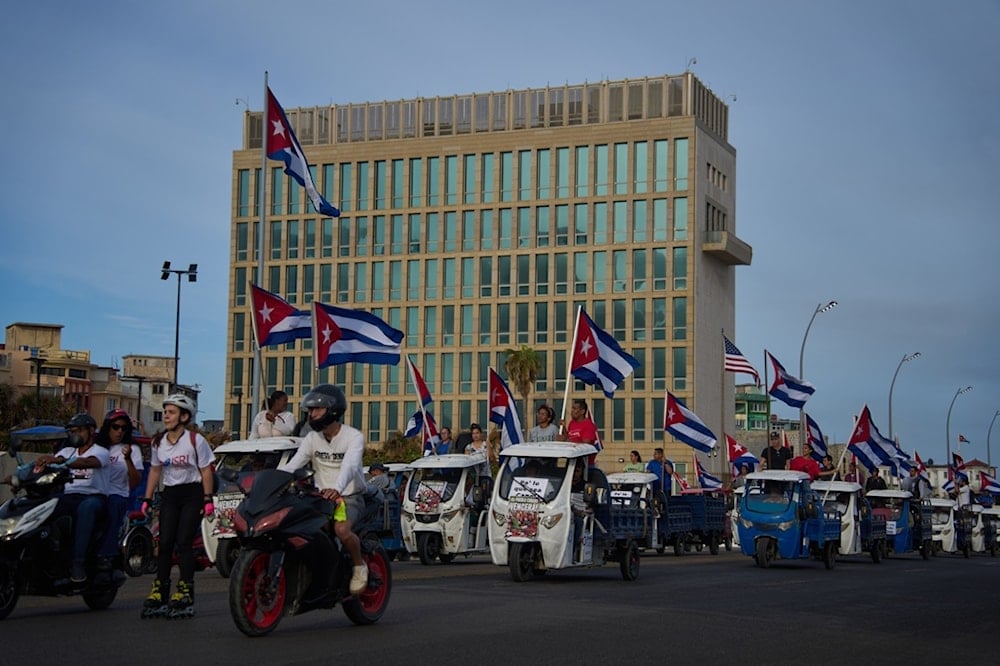
People ride in electric vehicles past the U.S. embassy during an anti-imperialist youth march organized by the government in Havana, Cuba, Thursday, April 2, 2026 (AP)
US defense officials are reportedly advancing contingency preparations for a potential military operation targeting Cuba, USA Today reported, which signals a growing threat of direct US aggression against the island, should US President Donald Trump authorize such a move.
Two individuals with knowledge of the directives, speaking on condition of anonymity due to the sensitivity of the discussions, told USA Today on Wednesday that the planning marks a further escalation in Washington’s campaign to tighten pressure on Havana. The developments follow measures introduced earlier this year, including restrictions on oil shipments to the island, widely viewed as part of a broader strategy to economically suffocate Cuba and force political concessions.
The United States has effectively enforced a fuel blockade on Cuba since early 2026, cutting off key oil supplies, particularly from Venezuela, triggering widespread blackouts, fuel shortages, and disruptions to essential services across the island. The restrictions have also strained access to food, medicine, and medical equipment, with growing concerns that such conditions are contributing to preventable deaths among vulnerable populations, particularly the elderly and chronically ill.
The emerging plans were first reported by Zeteo’s Substack and have since circulated among policymakers in Washington, drawing attention on Capitol Hill.
Despite the intensifying pressure, both the United States and Cuba have acknowledged early-stage discussions aimed at avoiding further escalation. Talks held in March reportedly explored the possibility of an economic agreement, though the extent of Washington’s willingness to ease its measures remains unclear.
'I can do anything I want'
Trump has further escalated tensions with remarks suggesting that Cuba could become the next target following the war on Iran.
“We may stop by Cuba after we’re finished with this,” Trump told USA Today at the White House on April 13, referring to the aggression on Iran.
He has also stated that he expects to have the “honor” of “taking Cuba, in some form,” adding, “Whether I free it, take it − I think I can do anything I want with it.”
The comments have raised alarm for openly signaling the possibility of an invasion of a sovereign state, reinforcing perceptions of an increasingly aggressive US posture toward governments resisting its influence.
Havana vows to resist
Cuban President Miguel Díaz-Canel has responded with defiance, reaffirming the country’s readiness to defend itself against any form of external aggression.
"We will battle, we will defend ourselves, and should we fall in battle, to die for the homeland is to live," Díaz-Canel told Newsweek.
Cuban officials said the current escalation is part of a long-standing pattern of US hostility, pointing to decades of economic blockade, political pressure, and repeated attempts to undermine the country’s sovereignty.
Long history of US intervention
The latest developments revive a history of US efforts to reshape Cuba’s political system. Since the 1959 revolution, Washington has imposed a sweeping embargo, backed covert destabilization campaigns, and carried out a failed invasion attempt during the 1961 Bay of Pigs operation, which was financed and directed by the US government.
More recently, the reported US operation in Venezuela earlier this year, during which Cuban personnel were killed and Venezuelan President Maduro was abducted, has heightened fears in Havana that similar actions could be directed toward the island.
At the same time, US restrictions on fuel shipments have deepened the country’s economic crisis, with prolonged power outages and shortages affecting daily life and key sectors, such as healthcare and tourism.
While no formal decision has been announced, the trajectory of events suggests that Cuba is increasingly being positioned as a target of potential US military aggression, raising concerns over regional stability and the possibility of a new conflict in the Western Hemisphere.
Read more: Russian oil tanker heads to Cuba for relief as US chokes island


