
El-Sayed edges ahead in Michigan primary testing Democratic direction
 4 Min Read
Abdul El-Sayed's narrow lead in Michigan's Democratic Senate primary highlights the party's growing divide over economic populism, establishment influence, and US support for "Israel".
-
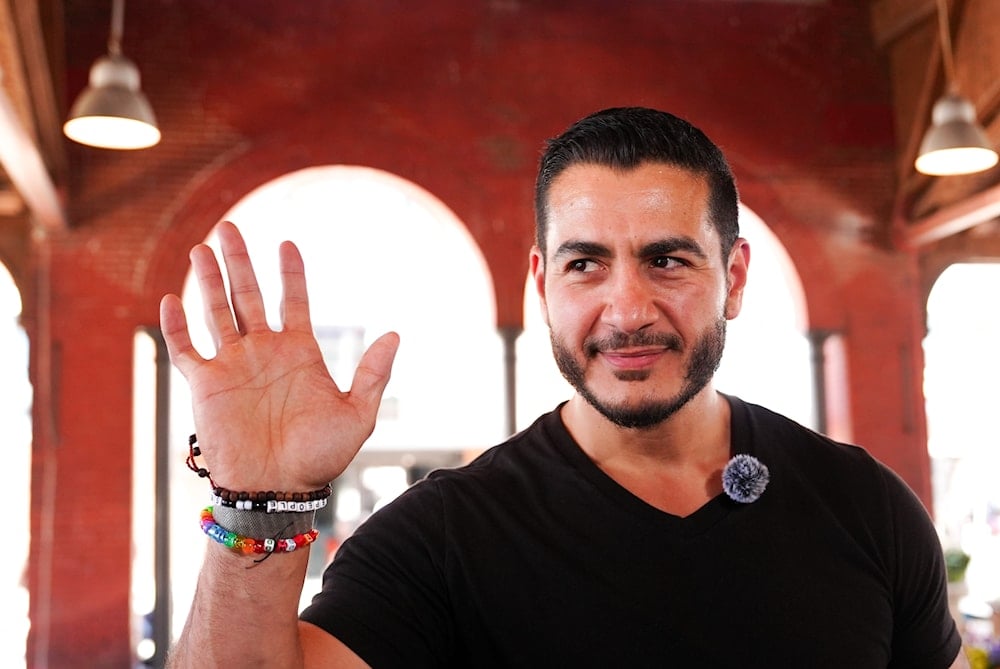
Abdul El-Sayed, a progressive candidate in the Democratic primary for US Senate in Michigan, waves while visiting Eastern Market on election day, Tuesday, Aug. 4, 2026, in Detroit (AP)
Progressive candidate Abdul El-Sayed held a slim advantage in Michigan’s Democratic Senate primary on Tuesday, Reuters reported, in a closely contested race that could reshape the party’s approach to economic policy, corporate influence, and US support for “Israel".
CNN projections showed El-Sayed receiving 49.8% of the vote, compared with 46.4% for US Representative Haley Stevens, after approximately 65% of the expected ballots had been counted. The narrow margin left the result unresolved.
The primary has drawn national attention because it places El-Sayed’s progressive, anti-establishment campaign against Stevens, a centrist lawmaker backed by senior Democratic figures and pro-“Israel” political organizations.
Whoever secures the nomination will challenge Republican Mike Rogers in November. The Michigan seat is considered crucial to Democratic efforts to regain control of the US Senate.
Economic populism challenges party establishment
El-Sayed has campaigned on reducing living costs, broadening healthcare access, and limiting the influence of wealthy donors and corporations over US elections.
His performance is being viewed as an indication of whether progressive candidates can win statewide contests in politically divided states, rather than only prevailing in heavily Democratic congressional districts.
The contest has also exposed growing tensions within the Democratic Party over Washington’s political, military, and financial support for “Israel".
Michigan’s large Arab American population, combined with its status as a decisive presidential and congressional battleground, has made the state a particularly significant arena for that dispute.
US Representative Debbie Dingell, who did not endorse either candidate, urged Democrats to unite behind the eventual nominee ahead of the general election.
“This race is about how people are hurting,” she said in an interview while voting was underway, citing cost concerns over groceries, gas, rent, and healthcare as the issues that will matter in November.
Democratic support for 'Israel' falls sharply
Reuters/Ipsos polling showed that favorable Democratic views of “Israel” had declined from 59% in 2018 to 22% in May.
The party’s voters have also become increasingly opposed to continued US assistance to the Israeli occupation. According to another Reuters/Ipsos survey released Tuesday, only 16% of Democrats supported maintaining US military and economic aid, while 57% opposed it.
The same poll indicated that the Democratic electorate has shifted further to the left over the past decade. Self-described liberals accounted for 71% of Democrats, compared with 55% in 2012.
Large majorities also described universal healthcare, stronger abortion protections and increased taxation of corporations and wealthy individuals as essential Democratic policies.
An El-Sayed victory would likely strengthen arguments that the party should embrace economic populism, reject the influence of major donors, and adopt a firmer position against US support for “Israel".
The result is also expected to attract the attention of potential 2028 presidential candidates seeking a political strategy capable of rebuilding Democratic support following the party’s defeat in the 2024 election.
Pro-'Israel' spending shapes Missouri contest
Democratic voters also selected congressional candidates in Virginia, Missouri, Kansas, and Washington state, with several of the races expected to play a role in determining control of the House of Representatives.
In Missouri, progressive former Representative Cori Bush failed in her attempt to defeat Representative Wesley Bell in a rematch of their 2024 primary contest, according to US media projections.
Bush, an outspoken opponent of the Israeli war on Gaza, was previously targeted by millions of dollars in spending from the pro-“Israel” United Democracy Project.
The super PAC spent more than $8 million during the previous election cycle to support Bush’s removal from Congress and directed more than $3 million toward preventing her return during the current campaign.
Bell is expected to retain the seat in November because the St. Louis-area district strongly favors Democrats.
In Virginia, Democratic voters nominated former Representative Elaine Luria and Henrico County Commonwealth Attorney Shannon Taylor in two districts expected to be competitive in the general election.
Read more: AIPAC-backed PAC pours millions into Michigan Democratic Senate race


