
Europe already divided over Hormuz mission: Should US be included?
 4 Min Read
European leaders are divided over a proposed Strait of Hormuz security mission, with disagreement over US involvement and post-war planning.
-
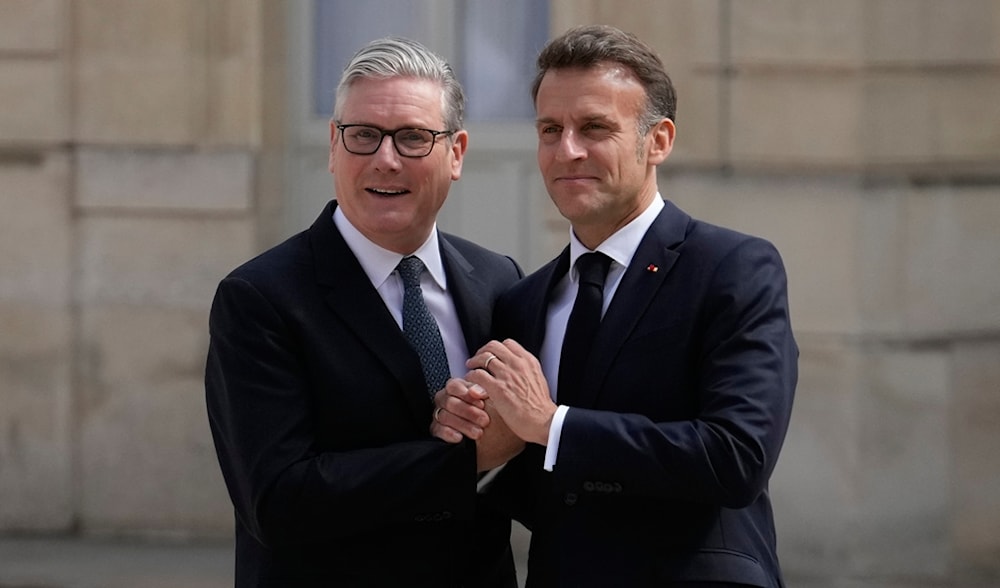
France's President Emmanuel Macron, right, shakes hand with British Prime Minister Keir Starmer prior to an international summit over the Strait of Hormuz, at the Elysee Palace, in Paris, France,, April 17, 2026. (AP)
European leaders are set to meet in Paris on Friday to discuss a proposed mission aimed at securing sea lanes in the Strait of Hormuz, but the structure and political scope of the initiative are faced with growing disagreement.
French President Emmanuel Macron is hosting the talks alongside UK Prime Minister Keir Starmer, German Chancellor Friedrich Merz, and Italian Prime Minister Giorgia Meloni, with additional leaders expected to join remotely. Washington was not invited to the high-level meeting.
The discussions come as European governments explore how to contribute to maritime stability in the region following months of aggression against Iran, led by the united States and "Israel", and its impact on global energy and shipping routes.
Major divide: Should US be excluded?
A central point of disagreement among European partners is whether the United States should be involved in the proposed mission.
Germany has pushed for US participation, arguing that American involvement would be essential for the operation’s credibility and effectiveness.
France, however, is insisting that only “non-belligerent” countries should take part in the mission, effectively excluding direct US military involvement.
German Chancellor Friedrich Merz acknowledged the differences ahead of the meeting, noting that further discussions would be needed to reach a consensus. “We will discuss this further and, if necessary, reach a decision,” he said.
French officials confirmed that neither the US nor Iran would participate in Friday’s talks. They also said President Macron has maintained regular communication with US President Donald Trump regarding the situation.
However, previous reports indicated that cooperation with both Washington and Tehran will eventually be needed.
What are participants offering?
European governments are divided over the level of military commitment each country can provide.
France has already deployed frigates, an aircraft carrier, aircraft, and air defense systems in the region.
Germany is considering offering minesweepers or reconnaissance vessels, but is unlikely to deploy frigates due to its commitments to NATO operations on the alliance’s eastern and northern fronts.
Meanwhile, UK officials have emphasized a defensive posture for the mission, focusing on maritime security rather than offensive operations.
Diplomatic outreach
Macron’s office said officials from China and several Asian and Latin American countries may also be invited to join parts of the discussion, depending on their willingness to contribute.
The format resembles a “coalition of the willing,” similar to efforts used in coordinating post-ceasefire planning for Ukraine.
However, Germany has made clear that any participation in the mission would require multiple approvals, including an international mandate, preferably from the United Nations, as well as authorization from the federal government and parliament.
Chancellor Merz stressed that such conditions mean any deployment remains far from certain. “We are still a long way from that overall,” he said.
Current situation in Hormuz
The mission comes in light of the ceasefire achieved between the United States and Iran. Donald Trump had previously, and in vain, urged his European allies to help reopen the Strait of Hormuz during the aggression on Iran.
Europe, however, focused on post-war efforts in the strategic waterway, arguing that the aggression was the reason the strait was closed in the first place.
Currently, the US has imposed a blockade on the Strait of Hormuz, threatening the safety of all vessels trying to pass through. Iran, on the other hand, maintains that the strait is open to commercial vessels and non-hostile countries, and stresses that any form aggression on Iran would inevitably block navigation in Hormuz.
Amir Saeid Iravani, Iran’s permanent representative to the United Nations, stated on April 16 that “sustainable stability in the Strait of Hormuz and the region cannot be achieved except through ending aggression and fully respecting Iran’s rights and interests.”
Iran has also stressed that its armed forces would provide secure passage to friendly countries. A testament to that was the passage of a Pakistan-flagged tanker's exit through the strait, making it the first crude carrier to sail through since the US threatened vessels in regional waters.
Read more: Iran-linked vessels appear to transit Hormuz despite US blockade: CBS


