
Saudi Arabia pushing US to ease Hormuz escalation: WSJ
 4 Min Read
Saudi Arabia urges Washington to reconsider its escalation in the Strait of Hormuz, warning of spillover risks to Bab al-Mandeb and regional maritime stability.
-
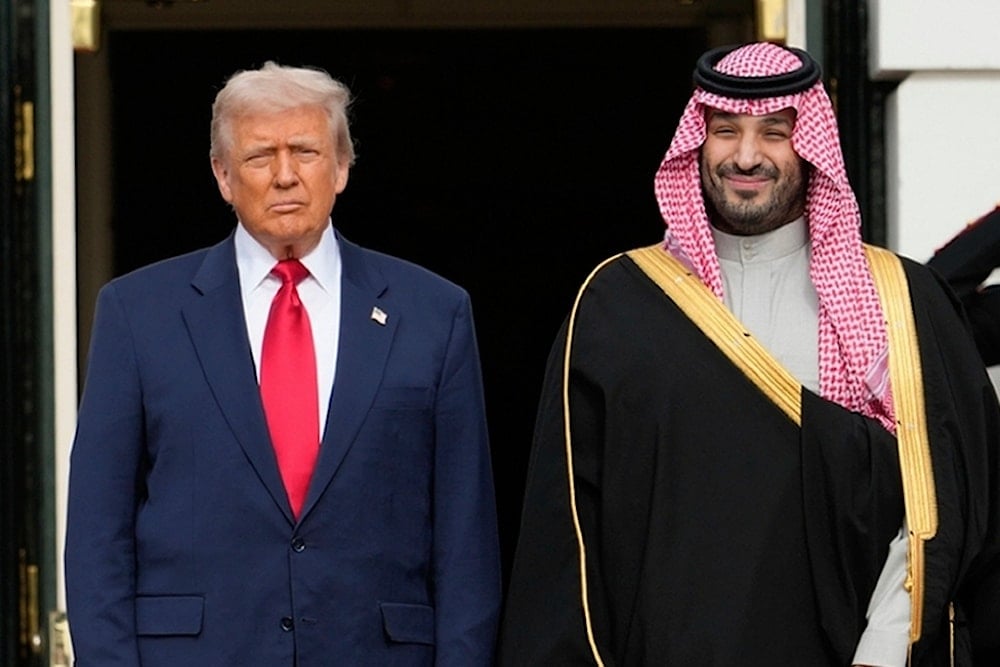
US President Donald Trump stands with Saudi Arabia's Crown Prince Mohammed bin Salman on his visit to the White House, November 18, 2025, in Washington. (AP Photo/Mark Schiefelbein)
Saudi Arabia is reportedly pressing the United States to reconsider its tightening measures around the Strait of Hormuz, amid concerns that escalating pressure on Iran could destabilize wider regional shipping corridors and energy exports.
Arab officials told the Wall Street Journal that Riyadh has warned Washington that continued escalation could provoke retaliatory measures affecting other strategic waterways, particularly the Bab al-Mandeb strait linking the Red Sea to the Indian Ocean.
The developments reflect growing concern among Gulf states that Washington’s approach risks expanding the war on Iran beyond a contained pressure campaign into a broader regional maritime confrontation.
Read more: Iran war could hinder Arab normalization with 'Israel': Israeli media
Hormuz escalation and pressure on Iran
The reported US measures targeting Iranian maritime activity are described as part of an effort to intensify pressure on Tehran, following weeks of joint US-Israeli attacks on the Islamic Republic.
The move comes after diplomatic efforts over the weekend failed to secure concessions from Iran regarding its position on the Strait of Hormuz.
The officials told WSJ that the escalation has already contributed to heightened risk perceptions in global energy markets, with earlier disruptions in the waterway previously linked to sharp spikes in oil prices.
Bab al-Mandeb emerges as second pressure front
Saudi concerns are reportedly tied to the risk of escalation extending to the Bab al-Mandeb, a narrow maritime passage connecting the Red Sea to global shipping lanes through the Suez Canal.
Arab officials warn that if pressure on Iran intensifies further, retaliatory dynamics could involve allied regional actors, including Yemen's Ansar Allah, aligned with broader resistance networks, potentially disrupting shipping through the Red Sea corridor.
The Bab al-Mandeb route is already considered vulnerable due to its strategic geography and past disruptions linked to US and Israeli aggression, with any renewed instability threatening global trade flows between Asia and Europe.
Saudi Arabia has reportedly managed to partially offset disruptions in Hormuz by rerouting exports through overland pipelines to Red Sea terminals such as Yanbu.
However, officials acknowledge that this alternative route remains exposed to risk if Red Sea shipping lanes are destabilized, underscoring the interconnected nature of regional energy infrastructure.
WSJ quotes Erik Meyersson, the chief emerging markets strategist at the Swedish bank SEB, as saying, “That would then be a way for Iran to escalate back, saying that if you’re going to restrict our oil exports, we will then disrupt your Yanbu terminal exports.”
The situation highlights the structural vulnerability of Gulf export systems, where pressure in one chokepoint can rapidly cascade into others, amplifying the economic consequences of military escalation.
Read more: Iran seeks answers after downing drone tied to two regional states
Regional responses and strategic deterrence calculations
Iranian officials have previously signalled that any sustained pressure on its maritime access or export capacity could trigger reciprocal measures across regional waterways.
The Strait of Hormuz is a vital point of leverage for Iran, as it can use the waterway to combat hostile forces economically.
This divergence reflects a broader contest over the governance of international waterways and the balance between enforcement, sovereignty, and regional control.
Saudi Arabia's attempts to ease pressure on Iran's geographic advantage come after reports of Crown Prince Mohammed bin Salman urging US President Donald Trump to increase attacks on the Islamic Republic.
In late March, US sources revealed to the New York Times that during conversations between the two, bin Salman pressed Trump on the need to dismantle Iran, claiming the war to be a "historic opportunity" that could lead to the collapse of the Iranian state.
The Saudi crown prince also reportedly told Trump to target Iranian energy infrastructure as a means to weaken the government.


