
Europe scrambles for gas as US-Israeli war on Iran cuts Qatari LNG
 4 Min Read
Europe faces a deepening energy crisis after the US-Israeli war on Iran paralyzed Qatar's LNG output and closed the Strait of Hormuz.
-
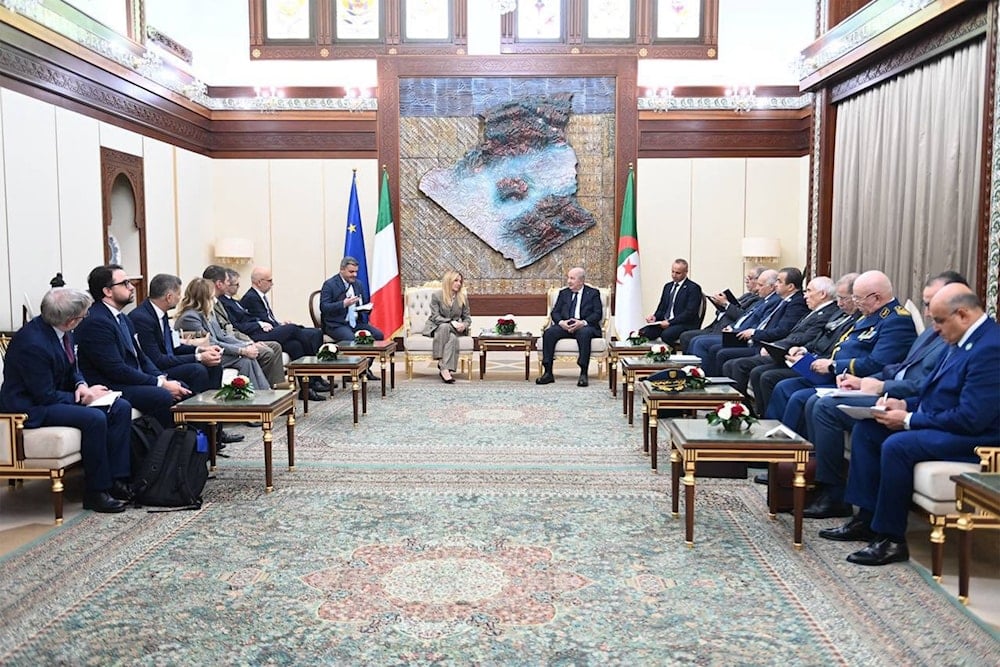
Algeria's President Abdelmadjid Tebboune receiving Italy's Prime Minister Giorgia Meloni in Algiers on March 25, 2026. (Algerian Presidency/ AFP)
Europe is confronting a fresh energy emergency, as the US-Israeli war on Iran chokes off a critical share of global gas supplies and sends prices spiralling across the continent, exposing, for the second time in four years, the bloc's deep structural dependence on imported fuel.
The closure of the Strait of Hormuz has effectively trapped around 20% of global liquefied natural gas supplies behind the waterway, with strikes on US-linked LNG facilities in Qatar causing damage that analysts say could take years to fully repair.
Nearly 40% of Qatar's production capacity has been knocked out since the war began in late February.
Europe, which turned to LNG as a substitute after cutting Russian pipeline gas and imposing sanctions on Moscow following the war in Ukraine in 2022, now finds itself exposed once again to the turbulent geopolitics of energy, having barely recovered from the last shock.
Italy bears the brunt
Of all major European economies, Italy is the most vulnerable. Having decommissioned its nuclear plants decades ago and lagging behind on renewables, the country leans heavily on gas for power generation, roughly 10% of which came from Qatar before the war.
"It's a real, serious emergency," said Davide Tabarelli, head of the Italian energy research institute Nomisma Energia. "Italy is Europe's weak link when it comes to energy because it is so dependent on energy imports," Tabarelli told the Wall Street Journal.
Italian Prime Minister Giorgia Meloni flew to Algiers this week to shore up supply agreements with Algeria, Italy's largest overall gas supplier.
Spain's foreign minister made the same trip the following day, with both governments seeking assurances that Algerian pipeline flows would continue uninterrupted.
Algeria cannot fill the void
Algerian exports to Italy had already surged following the Ukraine war, topping 23 billion cubic metres annually between 2022 and 2024, more than a third of Italy's yearly consumption, delivered via the Transmed pipeline running through Tunisia.
But Algeria faces rising domestic demand and ageing infrastructure that has slowed production, and analysts are clear that it cannot resolve the price shock now battering European economies.
Meloni pledged Italian investment in Algerian shale and offshore projects, though these will not yield results for years.
Washington weaponises gas access
With the United States now the EU's second-largest gas supplier after Norway, Washington has wasted no time leveraging that position. Notably, the US launched its military campaign against Iran without consulting its European allies, a move that triggered the supply disruption now hammering European economies.
The US ambassador to the EU this week warned the bloc to swiftly ratify a trade deal or risk losing "favorable" access to US LNG, a statement that drew condemnation from European legislators.
"This is unacceptable blackmail," said one centrist member of the European Parliament, calling for an end to dependence on imported fossil fuels altogether.
The episode deepens European frustration at being left to absorb the economic fallout of a war it had no say in, while simultaneously being pressured to purchase the fuel of the country that started it.
European officials and energy analysts alike warn that there are no immediate solutions. LNG prices are expected to remain elevated as long as Qatari output stays offline, and the continent's structural reliance on gas imports, which already forces European households to pay significantly more for electricity than Americans, leaves the bloc with few good options.


