
European leaders reject US claims over Greenland sovereignty
 4 Min Read
European leaders reaffirmed that Greenland’s future lies solely with its people and Denmark, rejecting renewed US claims by President Donald Trump while stressing that Arctic security must be managed collectively through NATO.
-
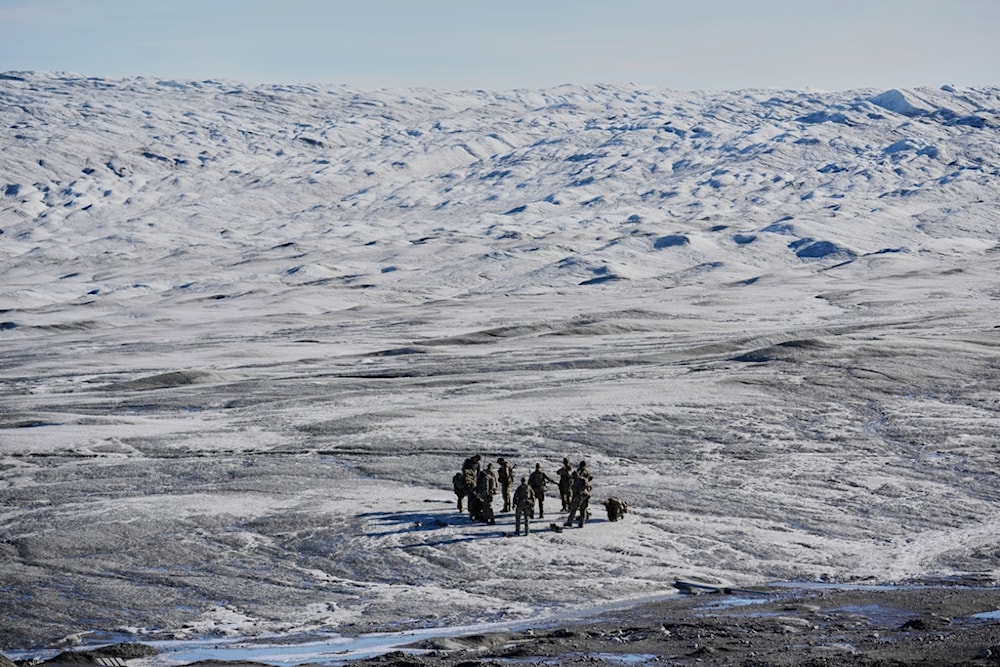
Danish military forces participate in an exercise with hundreds of troops from several European NATO members in Kangerlussuaq, Greenland, Sept. 17, 2025 (AP Photo/Ebrahim Noroozi, File)
European governments closed ranks on Tuesday to reject any suggestion that Greenland could be brought under US control, after renewed remarks by Donald Trump revived concerns over Washington’s intentions toward the Arctic territory, concerns that have been quietly debated in European capitals for months.
In a coordinated statement, leaders of France, Germany, Italy, Poland, Spain, Britain, and Denmark underlined that Greenland’s future is a matter exclusively for Greenlanders and the Danish state.
"Greenland belongs to its people. It is for Denmark and Greenland, and them only, to decide on matters concerning Denmark and Greenland," the statement said.
The leaders stressed that Arctic security should be handled through collective arrangements within NATO, noting that alliance members, including the United States, are already expanding their military presence in the region.
"NATO has made clear that the Arctic region is a priority and European Allies are stepping up," the statement continued. "We and many other Allies have increased our presence, activities and investments, to keep the Arctic safe and to deter adversaries."
European officials, however, have privately acknowledged deep unease over how to confront Washington without jeopardizing transatlantic unity. According to officials cited in Financial Times, governments face a delicate balancing act between showing solidarity with Denmark, maintaining US security guarantees for Europe and Ukraine, and grappling with legal and political discomfort over recent American actions elsewhere.
Arctic Tensions
The show of unity followed recent comments by Trump, who again argued that Greenland is strategically indispensable to Washington. Speaking to The Atlantic on Sunday, he said: "We do need Greenland, absolutely. We need it for defence."
European anxiety has been sharpened by a recent US military operation that reportedly resulted in the kidnapping of Venezuela’s president, a development that has fueled fears among NATO allies about Washington’s willingness to act unilaterally. While few European capitals openly object to the prospect of Nicolás Maduro’s removal, officials warn that the method, rather than the outcome, has raised alarms about respect for international law. Some worry that similar security-based justifications could one day be applied to Greenland.
Despite public expressions of support for Denmark and Greenland, most European leaders have stopped short of directly condemning Trump. Nordic and Baltic states moved quickly to affirm that Greenland’s status can only be decided by Copenhagen and Nuuk, while several officials noted that US security concerns should be addressed through dialogue rather than coercion.
Strategic Crossroads
Greenland, the world’s largest island, is home to around 57,000 people and remains a self-governing territory within the Kingdom of Denmark. While it is not a NATO member in its own right, it falls under Denmark’s membership of the alliance. Its location between Europe and North America makes it central to US missile defense infrastructure, while its largely untapped mineral resources have increasingly drawn Washington’s attention as it seeks to reduce dependence on Chinese supply chains.
At the same time, Greenlandic leaders have signaled openness to foreign investment and cooperation without conceding sovereignty. Addressing the growing speculation, Greenland’s Prime Minister Jens-Frederik Nielsen said on Monday that Nuuk aims to deepen ties with Washington and dismissed fears of an imminent US move to seize the island.
The episode has exposed widening strains within the transatlantic alliance, as European governments attempt to reaffirm sovereignty norms and collective security principles, even as they remain heavily dependent on US power at a moment of intensifying geopolitical competition in the Arctic.
Read more: US attack on Greenland would sow NATO's end: Denmark


