
FT: BoP eyes Dubai's DP World to run Gaza port, supply chains
 5 Min Read
Trump's "Board of Peace" has been in talks with Dubai state-owned DP World to manage Gaza's supply chains, warehousing, and port infrastructure.
-
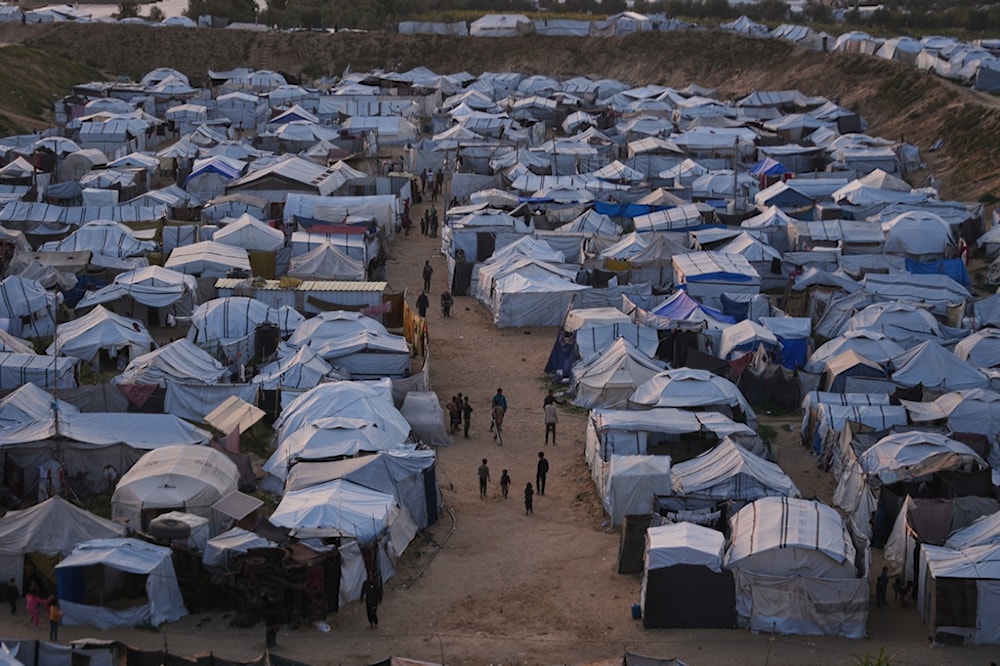
Palestinians walk along tents at a makeshift camp for displaced people in Khan Younis, southern Gaza Strip, Thursday, April 9, 2026. (AP Photo/Abdel Kareem Hana)
Representatives of Donald Trump's so-called "Board of Peace" have held discussions with Dubai state-owned logistics giant DP World about running Gaza's supply chains, warehousing, and port infrastructure, the Financial Times revealed on Tuesday.
According to three people familiar with the matter who spoke to the FT, the discussions examined whether DP World could enter into a partnership with the "Board of Peace" to manage the logistics of humanitarian aid and commercial goods entering Gaza, including warehousing, tracking systems, and security.
Ideas floated included constructing a new port in Gaza or on the nearby Egyptian coast, as well as developing a free-trade zone in the war-shattered enclave.
A draft proposal seen by the FT described the vision as establishing a "secure and traceable supply chain system" and a "port-led economic ecosystem" combined with light industries and "employment-generating trade platforms."
The talks began late last year, one of the people said. However, a DP World spokesman said he was not aware of any talks, and the UAE foreign ministry did not respond to a request for comment.
What is DP World
DP World is no ordinary logistics company. Controlled by the government of Dubai, the firm handles roughly 10 percent of global trade daily across more than 80 countries, and its operations are reported to have consistently served as an instrument of UAE foreign policy.
The company built a port in Somaliland, a territory only recognised internationally by the Israeli regime. The company's senior leadership recently changed after longtime chair Sultan Ahmed bin Sulayem stepped down in February over his ties with the late sex offender Jeffrey Epstein.
The UAE formalised ties with "Israel" through the US-brokered normalisation deal signed in 2020, and has since developed the closest relationship with the occupation state of any Arab government.
The UAE's expanding role in Gaza
Reports of the UAE being involved in post-war governance efforts in Gaza on behalf of the occupation were first revealed in January of this year, when Drop Site News leaked that the UAE had already been designated as the architect of Gaza's first post-war "planned community," a controlled settlement in Rafah referred to as the "Emirati compound."
The compound, intended to house displaced Palestinians, would feature a curriculum modeled after the UAE's own educational system and be constructed on land the documents describe as "public," though the same documents acknowledge that "an examination is required regarding potential private rights holders."
Residents would be subject to biometric registration, electronic wallets for aid distribution, and vetting requirements before being granted access to housing and services.
A privatisation machine
The DP World discussions form part of what the FT describes as longstanding US proposals to privatise much of Gaza's services and infrastructure. Talks have reportedly been held in recent months with multiple US and West Asian companies across security, finance, and technology, including plans to introduce a stablecoin for the besieged Strip.
An official with the "Board of Peace" told the FT that the body was "speaking to multiple potential partners across multiple lines of effort" and conducting "market research focused on how to identify best-in-class operators and next-gen solutions."
One person close to the discussions explained to the FT that "they're there for the contracts. It's a lot of business coming through, if the money actually comes through."
Despite pledges of $17 billion announced at the Board's February summit in Washington, only slivers of committed funds have materialised, according to multiple people familiar with the matter. A UN-EU-World Bank joint assessment released this week placed Gaza's total reconstruction needs at $71.4 billion over the next decade, with $26.3 billion required in the first 18 months alone.
Reconstruction that hasn't started
More than six months after the ceasefire came into effect, the gap between vision and reality could not be larger.
Satellite imagery from February and March 2026 shows no new construction or rubble clearance at the proposed "New Rafah" site, the centrepiece of the US-Israeli reconstruction vision touted by Jared Kushner at Davos. What the imagery does show is the continued expansion of Israeli occupation fortifications across Gaza, with Forensic Architecture identifying 48 Israeli military sites inside the Strip, 13 built after the October ceasefire.
"Israel," whose forces occupy 53 percent of the Strip east of the Yellow Line, is for now "ignoring the issue" of future plans developed by the "Board of Peace," according to a person familiar with the matter, including reconstruction and the proposed port.
Aid access remains choked. Following the outbreak of the US-Israeli war on Iran on 28 February, "Israel" closed all Gaza border crossings before partially reopening Kerem Shalom as the sole operational entry point.
"You can't rebuild Gaza like in their vision with 1,500 trucks a week being moved back-to-back through Israeli crossings," one person familiar with the discussions told the FT. "Right now it's like working through a straw."


