
Gaza reconstruction plan at Davos overlooks Palestinian reality
 5 Min Read
Donald Trump’s administration unveiled an ambitious Gaza reconstruction plan in Davos, pledging restored infrastructure and Palestinian governance under NCAG.
-
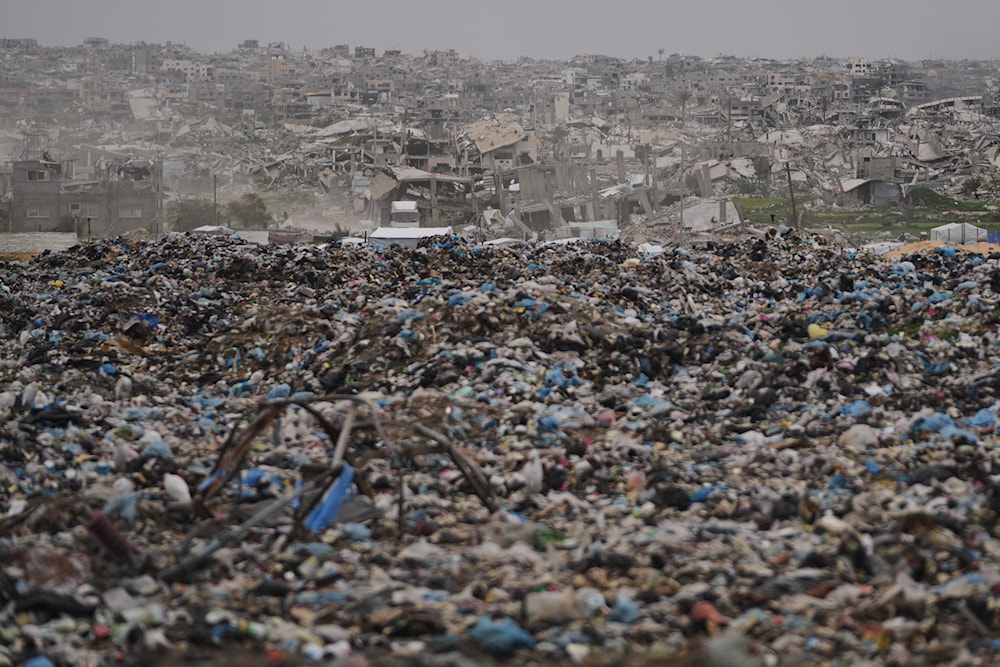
Destruction left by the Israeli air and ground raids stands behind a landfill in Khan Younis, Gaza, on Janaury 22, 2026. (AP Photo/Jehad Alshrafi)
In an in-depth analysis for The Guardian, journalist Julian Borger explores the challenges and contradictions within Donald Trump’s newly unveiled Gaza reconstruction plan, presented during the "Board of Peace" launch in Davos. While the plan projects a vision of alleged peace and Palestinian-led rebuilding, it faces immediate hurdles, from Israeli political resistance to the disarmament of Hamas, which could shape its viability.
Borger details how the plan, presented by Trump’s administration last Thursday, envisions a "unified, Palestinian-administered Gaza", rejecting proposals by Israeli extremists who have advocated for the forced displacement of the Strip’s population and the construction of settlements in their place. The success of the Trump "peace plan" for Gaza, Borger argues, will rely on whether the US is willing to push implementation in the face of Israeli obstruction and whether mechanisms can be created within Gaza to oversee the disarmament of the Palestinian Resistance, Hamas, and rebuild civil infrastructure.
Jared Kushner’s Davos presentation featured a futuristic rendering of Gaza, gleaming towers, industrial parks, and even an airport. A buffer zone was shown along the occupied border, treating Gaza as a blank slate, a move that, while forward-looking in aesthetic, ignored the property rights and generational claims of Palestinians.
NCAG: A new Palestinian administrative body
A key innovation in the plan is the creation of the National Committee for the Administration of Gaza (NCAG), a technocratic, non-partisan Palestinian body intended to run Gaza during a transition period.
Its chair, Ali Shaath, addressed Davos attendees via video from Cairo and directly addressed Palestinians in Gaza, many of whom remain displaced and under fire. "Step by step, with discipline and determination, we will rebuild a capable Gaza... defined by opportunity and dignity under the principle of one authority, one law and one weapon," Shaath said.
The "one weapon" principle implies exclusive control over arms by the NCAG, a major shift that would require Hamas and other factions to disarm. Borger notes that this element of the plan attempts to thread the needle between Palestinian autonomy and Israeli security demands.
Short-term goals and Rafah crossing reopening
According to Borger’s analysis, the next 100 days of the Gaza reconstruction plan focus on immediate humanitarian relief: water, electricity, sewage, hospitals, bakeries, and the flow of goods. The most immediate test will be the reopening of the Rafah crossing with Egypt, closed since May 2024.
Jared Kushner emphasized the administration’s short-term focus: "We continue to be focused on humanitarian aid, humanitarian shelter, but then creating the conditions to move forward."
Nickolay Mladenov, a veteran UN diplomat, will serve as the US "high representative" in Gaza. But the bulk of responsibility rests on the NCAG and a newly trained Palestinian police force, not the previously proposed International Stabilisation Force (ISF), which is notably absent from the new plan.
Hamas disarmament and Israeli obstruction
Borger points out that while Hamas has reportedly agreed in principle to hand over its heavy weapons to the Palestinian Authority, real implementation would require NCAG entry into Gaza alongside its police force, trained in Egypt and Jordan.
The removal of the ISF concept reflects months of political deadlock: "Israel" rejected Turkish and Qatari participation, while other states insisted on including them. The current blueprint simply states that heavy weapons will be decommissioned immediately and personal arms registered and phased out by sector. "Only NCAG-sanctioned personnel may carry weapons," the document states.
Symbolism and opposition around Rafah
The reopening of the Rafah crossing is meant to symbolize Gaza’s re-entry into the world, but Borger highlights looming political tensions.
Israeli Prime Minister Benjamin Netanyahu’s cabinet is set to debate the move, with resistance expected from far-right ministers demanding the return of the remains of Israeli captive Ran Gvili before reopening, according to The Guardian. More broadly, Borger notes, the idea of a Palestinian interim government in Gaza faces deep opposition from elements of the Israeli coalition who reject any path toward Palestinian sovereignty.
The Gaza blueprint doesn’t define statehood, but it leaves the door open for a unified Palestine, which is seen as a necessary ambiguity to make NCAG viable in the eyes of Palestinians.
Moreover, the plan assumes a gradual Israeli withdrawal from Gaza, based on unspecified conditions. As Borger warns, without clear benchmarks, this clause may become a loophole for delay or refusal. Still, one political factor may work in favor of implementation: Trump’s personal investment in the ceasefire he brokered last year. Borger concludes that the administration appears determined to tie the prestige of Trump’s legacy to the success of the Gaza reconstruction plan.


