
G7 endorses Ukraine aid expansion, backs US-Iran deal
 5 Min Read
G7 leaders endorse maritime security efforts in the Strait of Hormuz and address developments in Lebanon, Gaza, the Indo-Pacific, and the DPRK.
-
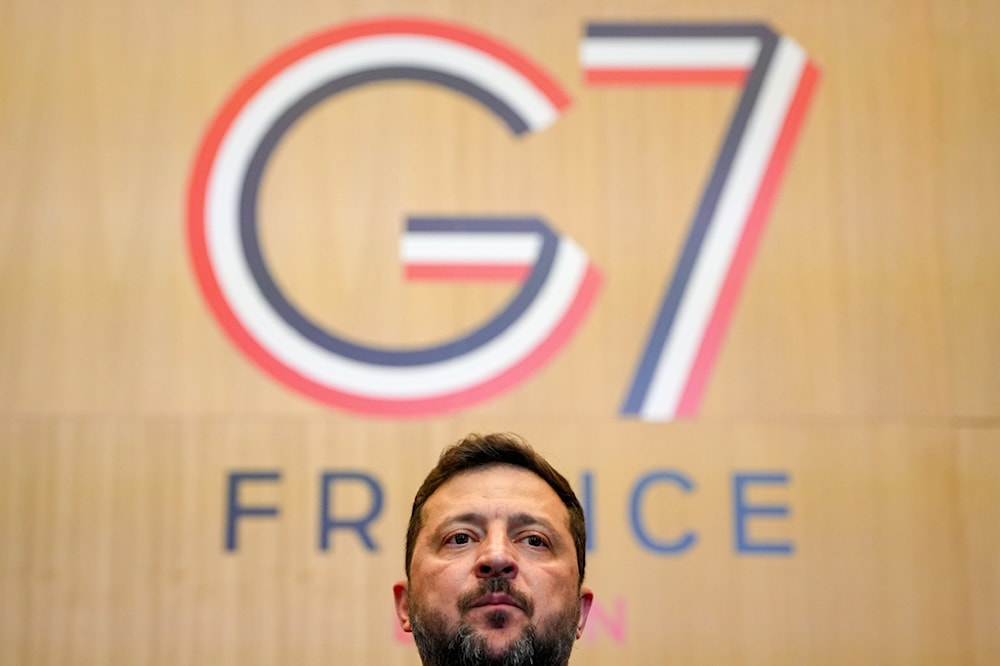
Ukrainian President Volodymyr Zelenskyy attends the G7 summit in Evian-les-Bains, France, Tuesday, June 16, 2026 (AP)
Leaders of the Group of Seven concluded their summit in France on Wednesday by announcing new measures aimed at strengthening Ukraine's military capabilities, increasing pressure on Russia, and supporting the recently announced agreement between Washington and Tehran.
In a joint communique, the G7 reiterated its support for Ukraine and pledged additional military assistance, including enhanced air defense systems, interceptors, and long-range capabilities. The leaders also expressed readiness to support Ukraine's domestic defense industry through measures such as extending licensing arrangements and other forms of cooperation.
"We agree to provide further support to get the country through next winter," the statement said, referring to Ukraine's energy and infrastructure needs.
Alongside military aid, the G7 pledged additional sanctions against Russia, particularly targeting the country's energy sector, a move that Moscow has repeatedly characterized as part of a broader effort to weaken Russia economically and limit its influence on the global stage.
G7 welcomes US-Iran agreement
The leaders also welcomed the recently announced memorandum of understanding between Washington and Tehran, describing it as an opportunity to prevent Iran from obtaining a nuclear weapon while addressing concerns related to Tehran's missile program and regional influence.
The statement praised US President Donald Trump for securing the agreement and said G7 members were prepared to contribute to its implementation. It also called for broader diplomatic efforts building on the understanding and reaffirmed support for freedom of navigation through the Strait of Hormuz, endorsing multinational initiatives aimed at restoring commercial shipping and maritime security.
Tehran, however, is likely to view the language as an attempt to expand negotiations beyond the nuclear file. Iranian officials have long maintained that the country's nuclear program is exclusively peaceful and argue that its missile capabilities and support for regional resistance movements are non-negotiable elements of its national defense and foreign policy.
Lebanon resistance targeted
The communique also addressed one of the region's most sensitive issues: the future of Hezbollah's armed wing in Lebanon.
The G7 endorsed efforts by Lebanese authorities to establish state control over weapons and backed initiatives aimed at disarming Hezbollah.
The position is likely to draw criticism from Tehran and Resistance movements across the region, which argue that Hezbollah's military capabilities serve as a deterrent against continued Israeli aggression and occupation.
Gaza receives limited attention
Although the statement pledged support for humanitarian and reconstruction efforts in Gaza and called for an end to violence in the occupied West Bank, it devoted considerably more attention to Ukraine, Iran, maritime security, and broader geopolitical concerns.
The communique made no reference to sanctions on "Israel", accountability for Israeli actions in Gaza, or recognition of Palestinian statehood, reflecting what critics describe as a continuing double standard in Western foreign policy.
Economic security, debt concerns
Beyond ongoing wars, the summit devoted considerable attention to global economic challenges.
The G7 discussed rising debt burdens facing developing countries and called for reforms to international financial institutions, debt restructuring mechanisms, and efforts to mobilize greater investment in vulnerable economies.
Leaders also focused on critical minerals, supply-chain resilience, and economic security, arguing that recent geopolitical crises have exposed vulnerabilities in global trade networks and access to strategic resources needed for advanced technology, energy systems, and defense industries.
The issue of global economic imbalances, including concerns related to trade practices and industrial policies, was also discussed and is expected to remain on the agenda ahead of upcoming G20 meetings.
AI, energy, and Indo-Pacific
Artificial intelligence emerged as another key topic, with G7 leaders discussing governance frameworks for a sector increasingly dominated by a handful of Western technology giants. The talks reflected growing competition over who will shape the rules governing next-generation technologies, as countries outside the West continue to expand their own AI capabilities.
Energy security also featured heavily in the summit's conclusions, with leaders seeking to diversify supply routes and reduce strategic vulnerabilities. The discussions echoed broader Western efforts to reorganize global supply chains and decrease reliance on external partners in critical sectors, including energy and advanced technologies.
The Indo-Pacific remained a major focus of the gathering, with the G7 reiterating support for a "free and open" regional order and voicing opposition to changes in the East and South China Seas and the Taiwan Strait. Chinese officials have repeatedly rejected such statements, arguing that they are used to justify increased Western involvement in Asia-Pacific affairs and to constrain China's legitimate development and sovereignty interests, particularly regarding Taiwan.
DPRK
The summit also addressed developments on the Korean Peninsula, with G7 leaders once again reiterating calls for the denuclearization of the DPRK and voicing concerns over Pyongyang's missile and defense programs.
The leaders pledged closer coordination on issues they associate with DPRK's cyber activities and renewed calls regarding longstanding abduction cases.
Pyongyang has consistently rejected such positions, arguing that its nuclear deterrent is a necessary response to decades of military pressure, sanctions, and large-scale US-led military exercises conducted near its borders. DPRK officials have repeatedly maintained that denuclearization cannot be discussed separately from what they describe as Washington's hostile policy toward the country.
Global health
The summit also included discussions on global health security, pandemic preparedness, and resilience against future international emergencies, as governments sought to strengthen cooperation in responding to large-scale crises.
Read more: Netanyahu out of Trump's meeting with regional leaders at G7


