
Germany, France and Italy set for biggest guarantees in Ukraine loan
 4 Min Read
The EU plan to back a Ukraine loan with frozen Russian assets puts Germany, France, and Italy at the top of the guarantee list, according to a Politico report.
-
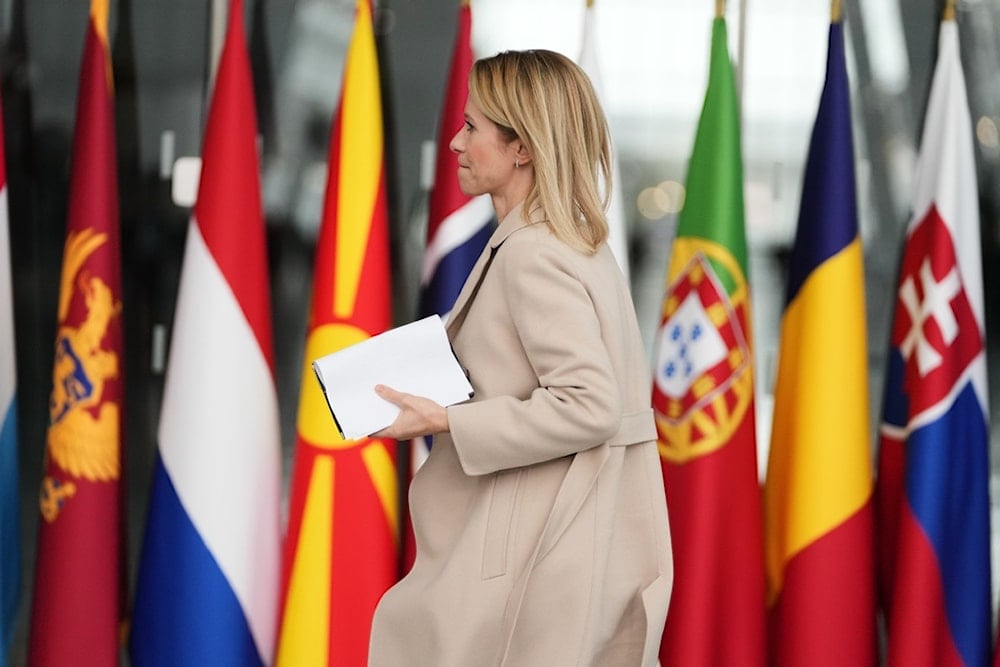
European Union foreign policy chief Kaja Kallas arrives for a meeting of NATO foreign ministers at NATO headquarters in Brussels, Wednesday, December 3, 2025 (AP)
Germany, France, and Italy are poised to make the largest financial guarantees for a proposed European Union loan to Ukraine backed by frozen Russian assets, according to a report published Sunday by Politico. The European Commission reportedly outlined to diplomats the contribution levels required from each member state to secure approval for the scheme, which remains contingent on support from Belgian Prime Minister Bart De Wever.
Under the Commission’s projections, Germany would bear the heaviest share. If the loan totals 210 billion euros, Berlin’s guarantee would amount to 24.4% of its gross national income, or roughly 51.3 billion euros. France would be responsible for contributing 16.2% of its GNI, equivalent to 34 billion euros, while Italy would be required to guarantee 25.1 billion euros.
The plan relies on leveraging profits generated from Russia’s frozen sovereign assets, a mechanism the EU Commission formally proposed earlier this month despite opposition from Belgium, Hungary, the European Central Bank, and Euroclear. These institutions have raised legal and financial concerns over using immobilized funds to support long-term lending.
Following the start of Russia’s special military operation in Ukraine, EU and G7 members froze nearly half of Moscow’s gold and foreign currency reserves, valued at around 300 billion euros. More than 200 billion euros of these assets are held within the EU, including approximately 180 billion euros deposited with Belgium-based Euroclear, one of the world’s largest clearing systems. Between January and November 2025, the Commission said the bloc transferred 18.1 billion euros to Ukraine from proceeds generated by these frozen reserves.
EU leaders urge use of frozen assets for Ukraine
Leaders from seven EU member states on Monday urged the European Union to expedite plans to use frozen Russian assets to provide financial support for Ukraine.
In a joint letter addressed to European Council President Antonio Costa and European Commission President Ursula von der Leyen, the heads of Estonia, Finland, Ireland, Latvia, Lithuania, Poland, and Sweden stressed that backing Kiev remains both a moral duty and a strategic necessity.
"Supporting Ukraine in their fight for freedom and independence is not only a moral obligation, it is also in our own self-interest," the leaders wrote.
They called on the EU to move rapidly to adopt the Commission’s proposals, saying, "We must therefore move ahead quickly on the Commission's proposals to use the cash balances from Russia's immobilized assets for a reparations loan to Ukraine".
Russia warns of global financial turmoil caused by Western asset seizures
The Russian Foreign Ministry has repeatedly cautioned that Western efforts to seize sovereign assets carry broad risks for countries holding reserves in Western financial systems.
In a statement released after a UN General Assembly meeting marking the International Day Against Unilateral Coercive Measures, the Ministry said, “Attempts to expropriate the sovereign assets of central banks create risks for all states that have funds in Western jurisdictions.”
Moscow argued that such moves, driven by Western governments, undermine international legal norms and set a “dangerous precedent” that could affect not only Russia but any nation with reserves held in the West.
It added that for states across the Global South and other non-Western economies, the “weaponization” of global financial systems raises new concerns about the neutrality and security of international economic institutions.
The ministry said Russia would continue working with what it called the “global majority” to counter what it views as illegitimate unilateral coercive measures imposed by Western powers.


