
Hezbollah FPV ops negating Israeli claims of victory
 4 Min Read
Despite Israeli claims of defeating Hezbollah, the Lebanese Resistance continues operations across southern Lebanon, exposing the limits of Israeli military power and occupation strategy.
-
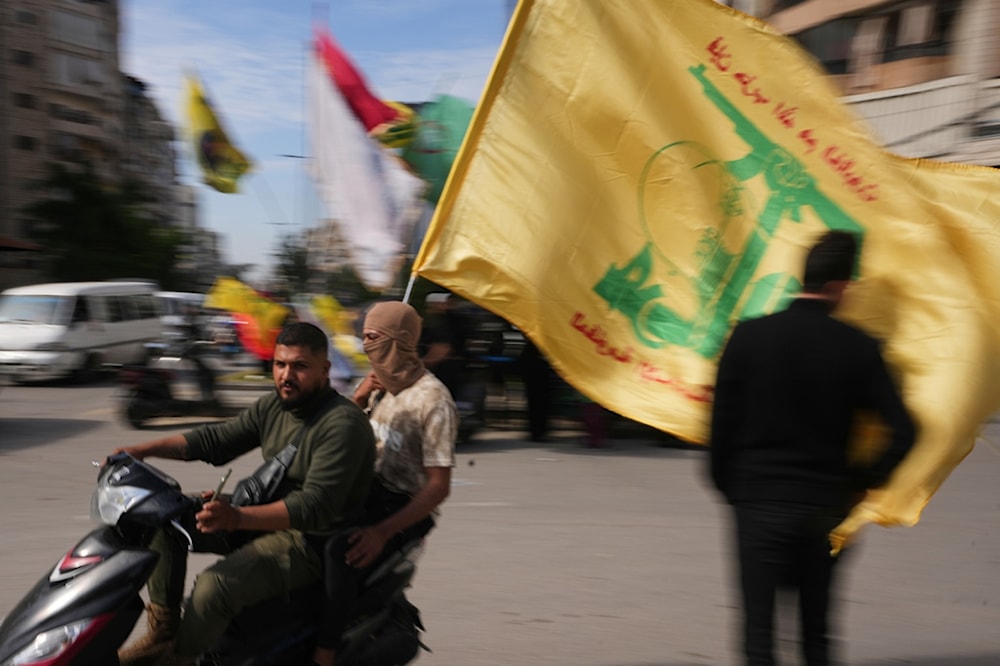
Men ride a scooter while waving a Hezbollah flag during a small gathering in Dahieh, Beirut's Southern Suburb, Lebanon, Saturday, April 25, 2026. (AP Photo/Hassan Ammar)
Israeli Prime Minister Benjamin Netanyahu declared that Hezbollah had been “crushed” following the war on Lebanon. Yet more than a year later, the Resistance continues to confront Israeli occupation forces across southern Lebanon, exposing the gap between Israeli political rhetoric and battlefield reality, aided by the use of a new arsenal of weapons.
Daily clashes persist despite a US-imposed ceasefire announced last month, with Hezbollah maintaining operations against Israeli troops occupying parts of southern Lebanon. The fighting reignited after the Resistance launched retaliatory attacks in early March in response to 15 months of nonstop aggression by "Israel".
The Lebanese Resistance has increasingly shifted toward guerrilla warfare tactics designed to exhaust and destabilise Israeli military positions along the frontier.
Hezbollah fighters have intensified their use of drones, including first-person-view (FPV) systems, the use of which skyrocketed internationally following developments in the Russia-Ukraine war. Several attacks have targeted Israeli military vehicles and troop positions operating inside Lebanese territory.
Israeli military officials themselves acknowledged that Hezbollah’s battlefield adaptation has challenged earlier assumptions that the movement had suffered irreversible damage.
“There’s a gap between how we finished [the 2024 war]… what we understood and thought, and suddenly we still find Hezbollah,” northern command chief Rafi Milo admitted in leaked remarks.
Despite repeated Israeli claims regarding the degradation of Hezbollah’s arsenal, the Resistance continues to launch rockets and drone attacks toward northern occupied Palestine, maintaining pressure on IOF military positions and settlements.
FPV attack drones have emerged as a disruptive tool on the battlefield in South Lebanon, reshaping how confrontations unfold between Hezbollah and "Israel".
— Al Mayadeen English (@MayadeenEnglish) May 7, 2026
Unlike traditional drones, these systems are guided in real time by operators, enabling highly precise strikes against… pic.twitter.com/gtwFlE6HED
While Lebanon has faced an overwhelming cost of war, with more than 2,700 martyrs reported and entire border villages devastated by Israeli bombardment, the occupation failed to impose a decisive military or political defeat on the nation and its Resistance.
Israeli occupation forces continue to face sustained attacks inside the so-called “security zone” established in southern Lebanon, where much of the civilian population has been forcibly displaced due to ongoing Israeli aggression.
Read more: Iron Dome platform destroyed in Hezbollah strike
Resistance rebuilt after 2024 aggression
Following "Israel's" war on Lebanon in 2024, Hezbollah undertook a broad restructuring campaign aimed at restoring operational flexibility and reducing vulnerabilities exploited by Israeli intelligence.
The Resistance group used the 15-month intrawar to rebuild and reorganize, three people familiar with the group’s operations and Lebanese and regional security and intelligence officials told the Financial Times.
According to reports cited by Israeli and regional security officials, the Lebanese Resistance group abandoned many electronic communications systems in favor of human couriers after extensive Israeli surveillance penetration during the war.
Weapons supply routes were diversified, including through Syria, while military command structures were decentralised into smaller operational cells better suited for prolonged asymmetric warfare.
Israeli military officials acknowledged that Hezbollah effectively returned to its earlier tactics of disciplined guerrilla warfare capable of sustaining a long-term campaign against a more technologically advanced enemy.
Read more: Israeli injuries hit 8,621 since aggression on Iran, Lebanon began
Israeli occupation trapped in costly war of attrition
Despite the material destruction inflicted on Lebanon, Israeli officials increasingly acknowledge that military operations have failed to achieve their declared objectives.
Israeli occupation forces continue to control roughly 5% of Lebanese territory in the south, while repeated incursions and airstrikes have failed to eliminate Hezbollah’s operational presence.
Even Netanyahu himself recently admitted that the war remains unresolved.
“I do not delude myself that this will come easily,” the Israeli premier reportedly told military commanders. “The job is not done.”
The prolonged confrontation has deepened frustration among settlers in northern occupied Palestine, many of whom were promised decisive security outcomes after the 2024 war.
Israeli analysts increasingly warn that the occupation risks becoming trapped in another long-term quagmire similar to previous failed military campaigns in Lebanon and Gaza.


