
Hormuz traffic falls to five ships Saturday, none Sunday: Kpler
 3 Min Read
Shipping through the Strait of Hormuz drops to five commodity vessels on Saturday and none on Sunday following tanker attacks, as US-Iran talks remain stalled.
-
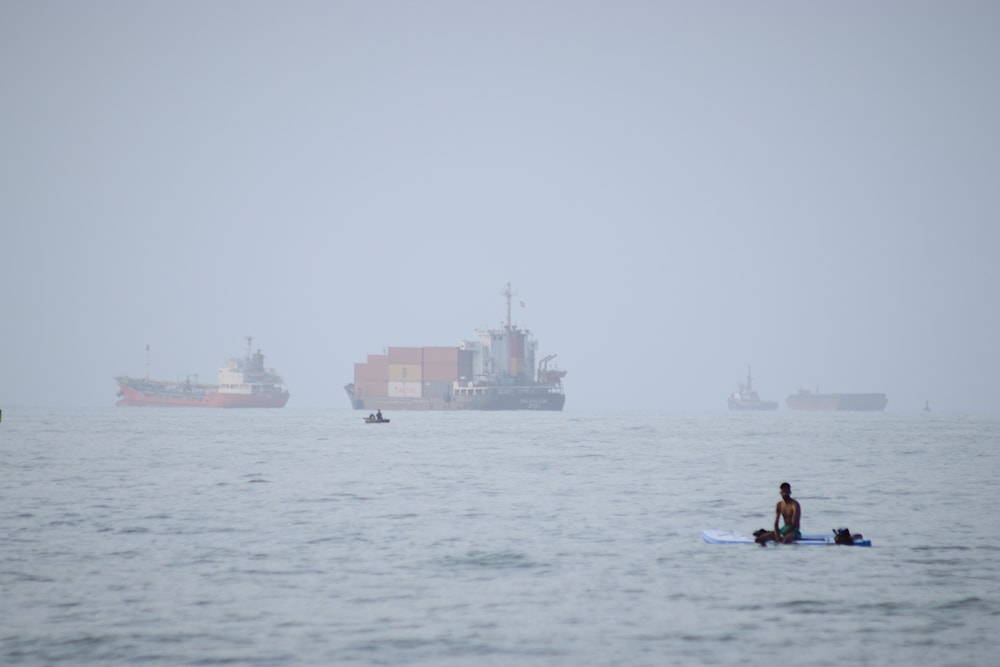
A man sits on a surfboard as a container ship and other commercial vessels appear anchored in the Strait of Hormuz off Bandar Abbas, Iran, Monday, July 27, 2026 (ISNA via AP)
Maritime traffic through the Strait of Hormuz remained severely restricted over the weekend as Tehran maintained its navigation rules in the strategic waterway and insisted that Washington meet Iran's conditions before normal shipping can resume.
Kpler ship-tracking data cited by Reuters showed that only five commodity vessels crossed Hormuz on Saturday, while none were recorded on Sunday. The figure was down sharply from 31 vessels during the previous weekend and remained a fraction of pre-war traffic.
Notably, an Indian-flagged Very Large Gas Carrier entered the strait using the Iranian-designated route, highlighting the continued use of Tehran's navigation framework.
An empty Very Large Crude Carrier also entered Hormuz with its Automatic Identification System switched off, while a small tanker carrying Iranian fuel oil was tracked leaving the waterway.
Iran maintains navigation framework
Tehran has continued to insist that vessels navigating Hormuz coordinate with Iranian authorities and comply with its designated maritime routes, as Washington attempts to sustain pressure on Iran and pursue alternative arrangements for passage through the strait.
Commercial traffic through Hormuz has fallen dramatically since the United States and "Israel" launched their war on Iran in February.
Before the aggression, more than 130 vessels crossed the waterway each day, with the strait accounting for roughly one-fifth of global crude oil and liquefied natural gas shipments.
Some vessels may continue to cross without appearing in tracking data after disabling their transponders, but Kpler's figures nevertheless indicate that normal commercial shipping remains heavily curtailed.
Tehran ties normalization to US concessions
Iranian Foreign Minister Abbas Araghchi said Saturday that Washington must fulfill Tehran's conditions concerning the Strait of Hormuz before normal maritime traffic can be restored.
Iran has stressed that its discussions with Oman are focused on the technical organization of navigation routes and do not amount to an agreement to fully reopen the strait.
Tehran has likewise rejected suggestions that indirect exchanges through regional mediators constitute renewed negotiations with Washington, maintaining that no decision has been made to resume talks with the United States.
Iranian officials have tied any broader normalization in Hormuz to changes in US policy, including an end to the war and the naval blockade imposed on Iran.
Washington, for its part, has claimed that it can maintain the blockade indefinitely.
Tanker attacks add to regional insecurity
The latest slowdown followed reported attacks on three vessels operated by the Abu Dhabi National Oil Company while transiting the area last week, according to the United Arab Emirates.
The incidents have added to the risks facing commercial shipping amid the instability generated by the ongoing US-led war on Iran.
Bab el-Mandeb traffic also falls
Maritime activity also declined through the Bab al-Mandab Strait, where Yemen's Ansar Allah declared a naval blockade on Saudi Arabia on July 20.
Kpler recorded 49 commodity-vessel crossings over the weekend, compared with 55 during the previous weekend.
No Saudi oil shipments were tracked through the waterway during the period.
Read more: Strait of Hormuz will only reopen if US accepts Iran's terms: Mohebbi


