
HRW warns of growing child recruitment by armed groups in Colombia
 7 Min Read
Human Rights Watch reports a sharp rise in child recruitment by armed groups in Colombia, while critics argue the crisis reflects deeper issues of inequality, state neglect, and decades of unresolved conflict.
-
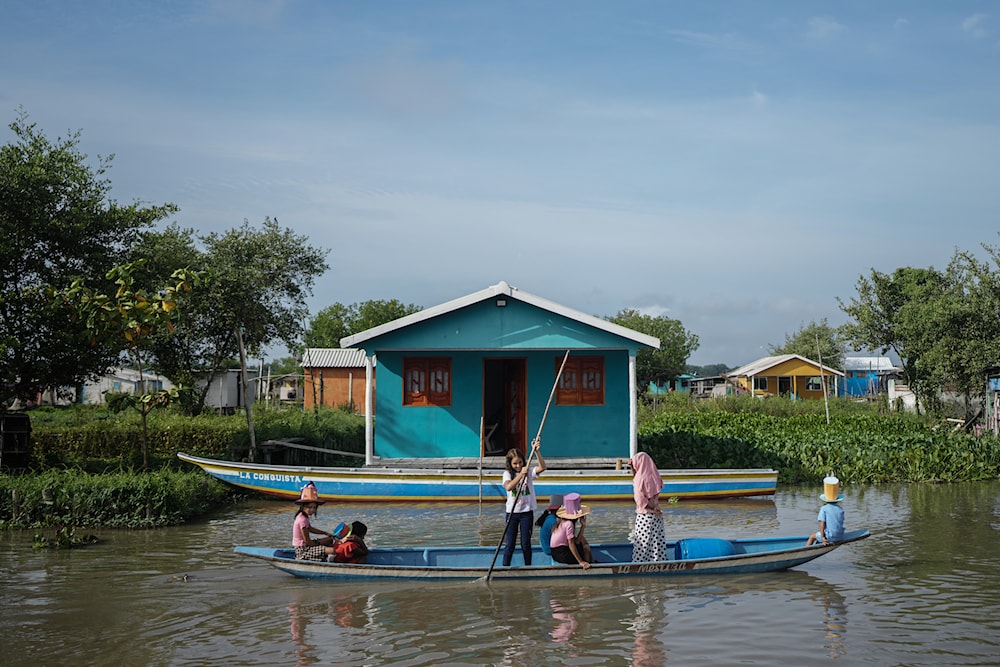
The children are transported by boat to go to school near homes surrounded by an invasive plant species called water hyacinth, also known as Eichhornia crassipes, on April 30, 2026, in Buenavista, Colombia (AP)
Human Rights Watch (HRW) has warned that child recruitment by armed groups in Colombia has intensified, with minors increasingly exposed to exploitation as armed organizations expand their influence in conflict-affected regions. The release of the organization’s latest report comes at a politically significant moment, shortly after the end of Gustavo Petro’s presidency and the arrival of Abelardo de la Espriella, whose US-aligned government has pledged a tougher security approach toward armed groups.
The 102-page report, titled “I Thought I’d Never See My Mom Again: Recruitment and Use of Children by Colombian Armed Groups,” examines recruitment methods, the social conditions that leave children vulnerable, and shortcomings in Colombia’s response. HRW argues that state institutions have failed to prevent recruitment, support survivors, and prosecute those responsible.
“Armed groups in Colombia are recruiting children with impunity, as protection systems are failing, and social media platforms have become a more effective recruiting ground,” said Juanita Goebertus, Americas director at Human Rights Watch. “Every child recruited is indicative of a government failure".
According to data reviewed by HRW from Colombia’s Ombudsperson Office, at least 1,500 children have been recruited since 2021, with cases rising sharply after 2023. The organization identifies FARC dissident factions that rejected the 2016 peace agreement as responsible for most documented cases, with the southwestern department of Cauca among the hardest-hit areas.
Indigenous communities have been disproportionately affected, accounting for nearly half of reported recruitment cases despite representing a small percentage of Colombia’s population. HRW also found that more than 30% of victims were between 10 and 14 years old, meaning their recruitment could constitute a war crime under international law.
Recruitment and Colombia’s unresolved conflict
HRW says armed groups exploit poverty, exclusion, limited education opportunities, domestic violence, and the absence of state institutions in rural areas. Children are reportedly recruited through promises of money, status, protection, or employment, while social media platforms have become increasingly important tools for propaganda and recruitment.
The report states that armed groups use platforms such as Facebook and TikTok to promote membership and contact potential recruits, with some content allegedly amplified by recommendation systems. Recruited children are reportedly used for intelligence gathering, logistics, guarding hostages, participating in illegal economies, and, in some cases, military training. Girls remain particularly vulnerable to sexual violence.
However, while HRW focuses on armed groups’ responsibility, the roots of Colombia’s conflict remain tied to decades of inequality, land disputes, political exclusion, and state neglect in rural areas.
The ELN and other armed movements have historically justified their existence by pointing to these grievances, including rural abandonment, economic inequality, and exclusion from Colombia’s political system. Acknowledging these historical causes does not justify child recruitment or abuses against civilians, but it helps explain why armed organizations continue to maintain influence in certain communities.
From Petro’s 'total peace' to a return to security-first policies
Colombia’s security challenges remained one of the defining issues during Gustavo Petro’s presidency, as armed groups continued competing for territorial influence in regions affected by decades of inequality, rural abandonment, and unresolved conflict. However, the persistence of violence was rooted in a crisis that long predated Petro’s administration, shaped by decades of armed confrontation, political exclusion, land disputes, and the incomplete implementation of the 2016 peace agreement.
Petro’s “Total Peace” strategy sought negotiations with multiple armed actors, including the ELN and FARC dissident factions, based on the argument that military campaigns alone had failed to eliminate the conditions that allowed armed organizations to survive. The government argued that lasting security required addressing structural issues such as poverty, limited state presence in rural areas, and the lack of economic opportunities that have historically made vulnerable communities susceptible to recruitment.
Supporters of the policy maintained that dialogue was necessary to reduce violence and address the roots of Colombia’s conflict, while critics accused Petro’s government of giving armed groups space to expand their territorial influence during negotiations. The continued presence of armed factions, clashes over territory, and competition over illegal economies became major points of criticism against the strategy.
However, Petro’s supporters argued that these challenges reflected deeper failures inherited from previous administrations rather than the result of negotiations alone. They pointed to decades of security policies, including US-backed counterinsurgency strategies, that weakened some armed organizations but failed to resolve the social and economic conditions that continued to fuel recruitment, displacement, and instability in rural regions.
The debate became central during the 2026 political transition, with Abelardo de la Espriella campaigning on restoring state authority through a tougher security approach. His administration has moved away from Petro’s negotiation-based model, emphasizing military pressure, closer security cooperation with Washington, and a return to a more traditional counterinsurgency framework.
Security solutions or deeper reforms?
The timing of Human Rights Watch’s report places it within a broader debate over Colombia’s future security direction. The new government argues that the expansion of armed groups requires a stronger military response, while critics warn that security policies focused primarily on force have historically failed to eliminate the conditions that allow armed organizations to continue recruiting.
Colombia’s past military campaigns weakened major armed actors but did not remove the structural factors that sustain conflict. Rural communities affected by poverty, displacement, land disputes, and limited access to public services have remained vulnerable despite decades of security operations.
The central challenge facing Colombia is whether the country can achieve lasting security through military pressure alone or whether it will address the deeper causes that have allowed armed groups to maintain influence for generations. While confronting armed organizations remains necessary, supporters of Petro’s approach argue that sustainable peace requires tackling the inequality, exclusion, and state absence that have historically shaped Colombia’s conflict.
HRW and the politics of human rights reporting
While HRW’s documentation highlights serious violations against children, critics have questioned the organization’s broader analytical framework. Some argue that Western human-rights organizations often emphasize state failures and abuses by non-state actors while paying less attention to historical, economic, and geopolitical factors shaping conflicts in the Global South.
From this perspective, Colombia’s crisis cannot be understood only as a problem of armed groups recruiting children or governments failing to respond. Critics argue it is also linked to decades of foreign-backed security policies, economic inequality, the global drug economy, and the marginalization of rural communities.
The report therefore arrives during a major political realignment, as Colombia moves from Petro’s negotiated peace strategy toward de la Espriella’s security-centered agenda. The debate is not only about stopping child recruitment, but also about whether Colombia’s next government will address the deeper conditions that allow armed groups to continue recruiting vulnerable youth.
Ultimately, protecting children will require more than military operations or negotiations alone. It will depend on whether Colombia can tackle the poverty, exclusion, and lack of opportunities that have allowed armed organizations to maintain influence for generations.
Read more: Colombia’s De la Espriella orders deportations of migrants


