
Iran 'clearly prepared', 'outstrategized' the Trump administration
 6 Min Read
Despite months of war, sanctions, and blockade measures, analysts told Newsweek that Iran has maintained its strategic position while growing economic and political costs increasingly challenge the US-led campaign.
-
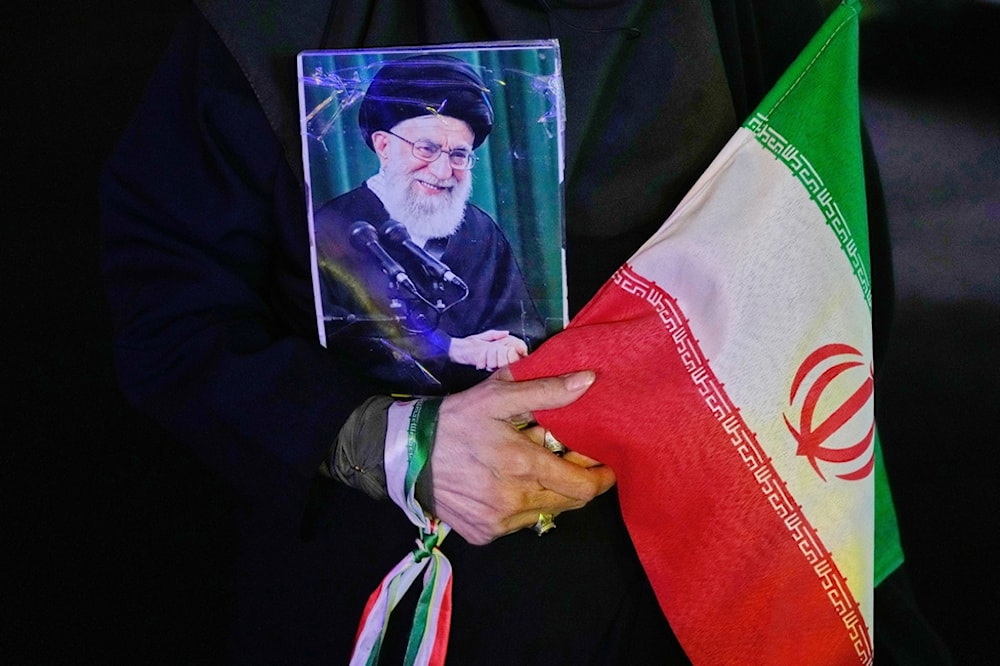
A demonstrator holds a poster of Iran's martyred leader, Sayyed Ali Khamenei, and an Iranian flag during a gathering at a square in downtown Tehran, Iran, Tuesday, May 19, 2026 (AP)
Iran continues demonstrating resilience against the US-Israeli war campaign, as growing numbers of analysts acknowledge that Washington’s pressure strategy has failed to break Tehran politically or militarily despite months of attacks, sanctions, and blockade measures.
Nearly three months into the confrontation and weeks after US President Donald Trump imposed a blockade on the Islamic Republic, Iranian officials have maintained that Tehran will not surrender its core demands under external pressure.
Analysts interviewed by Newsweek said Iran has succeeded in preserving strategic leverage even after suffering the assassination of senior commanders and extensive military damage.
"Iran clearly prepared for this war and so far, it has outstrategized the Trump administration," Barbara Slavin, distinguished fellow at the Stimson Center and lecturer at George Washington University, told Newsweek.
"It has seized control of the Strait of Hormuz and attacked its Gulf neighbors, the Emirates in particular, exacerbating divisions within the Gulf Cooperation Council and spreading the pain to consumers worldwide."
The report indicated that Tehran has adapted its military strategy in order to sustain a prolonged confrontation while preserving key missile and drone capabilities.
"It has dispersed command and control and carefully husbanded its missile and drone arsenal to be able to continue to inflict pain and control the Strait," Slavin said. "Because the war is perceived by the regime as existential, it will continue to bear the mounting domestic economic costs of the war, assuming that it can hold out longer than Trump can."
Tehran defiant
According to the report, Trump recently postponed a planned large-scale assault after pressure from Gulf states, including Saudi Arabia, the UAE, and Qatar, whose leaders reportedly urged Washington to pursue negotiations instead of escalation.
Despite repeated US threats, Iranian officials publicly rejected any suggestion of retreat.
Senior commanders, including Major General Ali Abdollahi and Brigadier General Mohammad Akraminia, vowed that Iran would respond decisively to any further aggression, while political leaders continued insisting on Tehran’s conditions for ending the war.
Those demands include the withdrawal of US military forces from the region, reparations for wartime destruction, and an end to Israeli attacks against regional Resistance movements, particularly Hezbollah in Lebanon.
The article also noted Tehran’s efforts to consolidate authority over the Strait of Hormuz through the establishment of a new toll-collection authority, further strengthening Iran’s strategic influence over one of the world’s most critical energy corridors.
Iran holds firm
Analysts cited by Newsweek also acknowledged that long-standing Western expectations of internal collapse inside Iran have failed to materialize.
"We have not seen high-level defections and frankly there is no obvious opposition leader to defect to," Slavin said. "Internal unrest would be suicidal given the harsh repression faced by protestors in January including record numbers of executions."
Amin Saikal, emeritus professor of Middle Eastern and Central Asian Studies and director of the Center for Arab and Islamic Studies at the Australian National University, said Iran’s resistance is rooted in both ideological conviction and national identity.
"The Iranian Islamic system has been built on a combination of Shia theological and pragmatic resistance and defiance (a jihadi-ijtihadi paradigm) as well as the Iranian people’s historical sense of civilizational identity and nationalism," Saikal told Newsweek.
"While it has not served many Iranians well, who have formed strong opposition to it in the past, most Iranians have historically united behind the government/regime of the day, irrespective of its nature, in the face of outside aggression for the love of their country," Saikal said.
Saikal argued that the US-Israeli war has ultimately strengthened Iran politically and strategically.
"The US-Israel war has now very much fed into this. The Islamic government has thrived on this, as well as the strategic advantage of controlling the Strait of Hormuz, and Russo-Sino political and logistic support, to remain resilient and defiant of its long-standing foes, the US and Israel."
The report further suggested that Washington’s shifting war aims have complicated the US strategy and weakened prospects for a decisive outcome.
"I think that the Trump administration has led itself into a very tight corner," Saikal said. "It has kept changing its goalposts and doesn’t really know how to end the war."
Iran retains strength
Hamidreza Azizi, visiting fellow at the German Institute for International and Security Affairs in Berlin, said Iran continues to retain significant military and nuclear capabilities despite sustained attacks.
"Recent US intelligence assessments, for example, suggest that Iran still retains access to most of its missile capabilities," Azizi said. "Its nuclear program also appears to remain fundamentally where it was before the latest round of war, in the sense that Tehran still possesses both the stockpile and the technical capacity for enrichment."
Azizi added that Tehran increasingly sees steadfast resistance as the only viable path in dealing with Washington.
"As a result, the prevailing assumption on the Iranian side is that the only viable strategy is to adhere firmly to their red lines and core principles, while continuing to impose costs on the United States and avoiding any retreat from their key objectives until Trump himself takes the first step."
The report also pointed to weakening domestic support inside the United States for the war effort, with polls showing growing opposition to the war and declining approval ratings for Trump.
Strategic endurance
Paul Pillar, former CIA analyst and fellow at Georgetown University’s Center for Security Studies, said Iran’s leadership believes it can outlast Washington politically despite the immense pressure campaign.
"The leaders of the Iranian regime undoubtedly see their strategy as successful, in that they are still in power without serious challenge to their rule, despite being battered militarily and economically by a hostile superpower," Pillar told Newsweek.
Pillar warned that continued US-Israeli aggression could eventually push Iran toward pursuing nuclear deterrence capabilities despite Tehran’s repeated denials.
"But what is most likely to lead a regime to conclude that it needs a nuclear deterrent is to be the victim of foreign aggression, as Iran has been this year at the hands of the US and Israel," he said.
Read more: 26 ships crossed through Hormuz in past 24 hours: IRGC


