
True colors of Iran 'protests': Armed rioters kill, burn citizens
 8 Min Read
What began as an economic protest has been exploited by foreign sides, with Iranians killed in attacks targeting civilians and security forces, and a three-year-old girl shot while in her father’s arms.
-
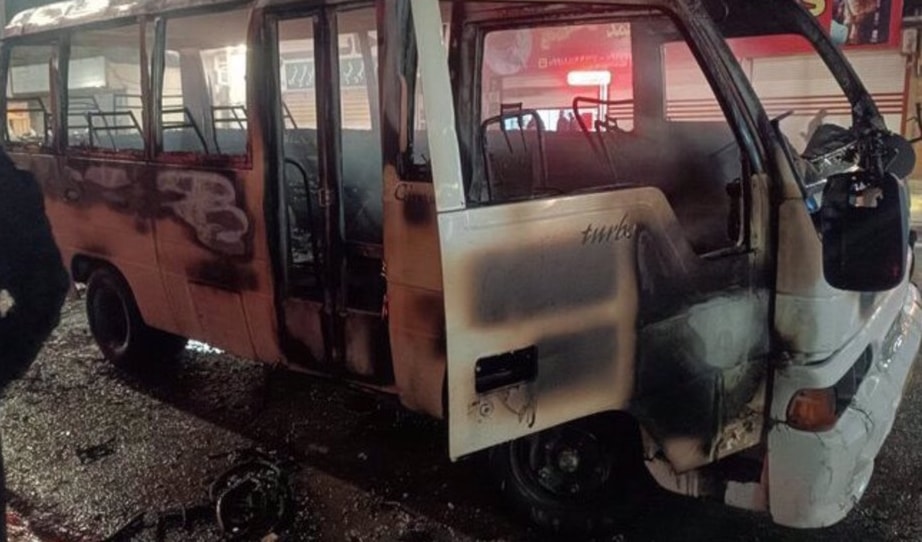
Photo shows a public transport vehicle set ablaze by rioters in Iran’s western city of Ilam on January 6, 2025 (IRNA)
Iran is witnessing an escalating crisis for a thirteenth consecutive day, with Friday being marked by a series of violent incidents targeting both civilians and security personnel. These have included what officials describe as ISIS-style attacks, among them the burning alive of a security officer and the killing of a three-year-old girl who was shot while in her father's arms. Armed clashes between rioters and security forces have spread across multiple regions, deepening concerns over public safety and stability.
Al Mayadeen’s correspondent in Tehran, for instance, reported on a significant attack in the eastern part of the capital, Tehran, describing riots, acts of vandalism, and arson. Our correspondent noted that sounds of gunfire and confrontations involving live ammunition could be clearly heard in the area, as authorities confronted groups described as gang-like rioters.
Meanwhile, Iranian officials insist that the violence is not spontaneous or isolated. They accuse foreign intelligence services, particularly Mossad, of acting on behalf of “Israel” and in coordination with the US, of orchestrating violence aimed at fomenting chaos, destabilization, and social breakdown. Officials argue that Washington and the Israeli entity have ceased to conceal such meddling, openly acknowledging their use of security, political, economic, and psychological pressure against Iran, while waiting for conditions to deteriorate further as a pretext for military aggression, similar to their attack last June.
How the situation looks on the ground
Iranian state television reported on Thursday that two members of the security forces were killed by rioters in the city of Qom. In a separate development, state media aired footage showing the arrest of an armed group in Lorestan province.
Moreover, the police chief of Holilan district in Ilam province was killed amid the unveiling events in the country, Iranian police reported.
Rioters also burned a security officer alive in Marvdasht, in the Fars province, state broadcasters reported, describing the incident as a blatant act of terrorism that shocked the local community.
In another harrowing case in Kermanshah, western Iran, a baby girl was killed after rioters opened fire. The child’s father said his daughter was shot while he was desperately attempting to obtain medicine for a sick family member.
In Kermanshah, #Iran, a father recounts the devastating moment his 3-year-old daughter was killed during violent unrest caused by saboteurs in the country. What was meant to be a simple trip to the pharmacy turned into a nightmare.
— Al Mayadeen English (@MayadeenEnglish) January 9, 2026
He describes the chaos, the sudden gunfire, and… pic.twitter.com/aGBGs4lX1K
In Hamedan, state media reported six fatalities and extensive damage to both public and private property during overnight riots.
Iranian state television aired a series of videos showing armed groups opening fire on Iranian security forces in Kermanshah, western Iran, the burning of a security officer in a terrorist attack in Fars Province, and multiple incidents of vandalism and violence across the… pic.twitter.com/o4WqMvxQt5
— Al Mayadeen English (@MayadeenEnglish) January 9, 2026
Further reports indicated that the public prosecutor of Esfarayen and several security personnel were killed during riots in North Khorasan province. Rioters were also reported to have set fire to the Imamzadeh Sabzeqaba shrine in Dezful, Khuzestan province. Iranian state television said those involved in the riot used explosives, firearms, and bladed weapons, resulting in multiple casualties among both civilians and security forces.
Citing informed sources, Iranian state media stressed that "armed terrorist cells were operating amid scattered riots, with the explicit aim of carrying out killings and spreading fear among the population." Security authorities urged families to monitor children to prevent them from joining gatherings and called on the public to report any suspicious or armed individuals.
Iran reports arrest of Mossad agents accused of fueling violence
Meanwhile, Iran’s Islamic Revolution Guard Corps (IRGC) announced the detention of several individuals, including Mossad agents, accused of orchestrating chaos in multiple areas, as authorities step up security measures aimed at preventing the exploitation of economic protests by organized and disruptive elements.
Tehran security officials reported on Monday the arrest of an alleged Mossad operative who was reportedly operating covertly among demonstrators.
According to authorities, the suspect confessed to acting as a high-level liaison, receiving tactical guidance through social media platforms such as Instagram and Telegram from handlers based in Germany. His mission, Iranian officials said, involved recruiting young people for street violence and documenting fabricated incidents for dissemination via foreign media outlets.
Watch the moment Iranian police officers step in to save a civilian’s car from burning in the fire set by rioters in Bojnourd, North Khorasan province.
— PressTV Extra (@PresstvExtra) January 7, 2026
Follow Press TV on Telegram: https://t.co/h0eMpifVIe pic.twitter.com/ds9LFXzgA5
Authorities also reported efforts to counter a coordinated digital warfare campaign, claiming that disinformation was being circulated to amplify perceptions of the riot. In Tehran, 40 individuals were arrested for using artificial intelligence tools to produce and share fabricated images and videos of the protests.
Officials said these deepfakes and repurposed footage from previous years were designed to create the impression of widespread chaos. The individuals were identified through technical and intelligence operations, and the misleading content was removed in coordination with judicial authorities.
Looking back
The protests initially erupted in Tehran’s major bazaars, where traders voiced mounting anger over soaring inflation that has steadily eroded purchasing power and livelihoods, most notably due to the suffocating US sanctions on the country.
The situation intensified after the central bank terminated a policy allowing certain importers to access US dollars at preferential rates, triggering sharp price increases, widespread shop closures, and frustration among small business owners unable to absorb rising costs.
Iranian authorities publicly acknowledged the severity of economic hardship faced by citizens, emphasizing that the protests were not ignored and that measures were underway to stabilize the economy as swiftly as possible.
The resignation of Mohammad Reza Farzin as head of the central bank amid the protests underscored the seriousness of the crisis, signaling the government’s move to recalibrate its economic leadership in response to growing public discontent.
In a related development, Iran’s Foreign Ministry reaffirmed on Wednesday Iran’s recognition of citizens’ right to peaceful protest, stressing that the government “will spare no effort to address legitimate public demands within the framework of the law.”
It also said that much of Iran’s economic hardship is the result of a comprehensive economic war waged by the United States through illegal sanctions, adding that Washington is conducting a parallel psychological and media campaign based on misinformation, false reporting, threats of military intervention, and incitement to violence and terrorism.
In concluding remarks, the Foreign Ministry said the Iranian people, having demonstrated resilience throughout a history marked by challenges, remain vigilant and committed to their Iranian and Islamic heritage, and will continue to strengthen national cohesion in the face of foreign meddling, rejecting any US policies that undermine Iran’s independence, dignity, and sovereignty.
So, what began as genuine economic demand has since been exploited by “Israel” and the US, who have sought to hijack the protests to advance a long-standing regime-change agenda against a country that has openly resisted President Donald Trump's threats when few others dared to do so, transforming a social demand into a tool of geopolitical confrontation.
Iranian officials accuse 'Israel', US of direct meddling
Iran’s Foreign Minister Abbas Araghchi accused the United States and “Israel” on Friday of fueling the protest movement. “This is what the Americans and Israelis have stated, that they are directly intervening in the protests in Iran,” Araghchi said during a visit to Lebanon.
مراسل #الميادين مالك عابدة يرصد مباشرة جانبًا من أعمال التخريب والشغب التي شهدتها #طهران وبعض المدن الإيرانية ليلة أمس، والتي تحدّث عنها قائد الثورة والجمهورية الإسلامية السيد علي خامنئي في كلمته اليوم.. #إيران @malik_abeda pic.twitter.com/Jp4OBYnxLb
— قناة الميادين (@AlMayadeenNews) January 9, 2026
He added, “They are trying to transform the peaceful protests into divisive and violent ones,” noting that previous attempts at military action had failed.
Political context: Mossad's bloody hand
Unsurprisingly, the current situation coincides with renewed US-Israeli pressure on Iran. Israeli political figures and US officials have publicly encouraged 'protest' activity. Israeli opposition leader Naftali Bennett released a video urging Iranians to “create a better Middle East,” while US Senator Lindsey Graham and Israeli ministers voiced support through public appearances and social media posts.
Iranian authorities have reported the arrest of a Mossad agent directed from abroad, underscoring what they describe as the depth of Israeli intelligence involvement. Public statements by Israeli officials, including Foreign Minister Eli Cohen and former US Secretary of State Mike Pompeo, have further signaled support for the protests.
The Mossad itself was reported to have claimed operational involvement, stating on December 30: “Let’s come out to the streets together. The time has come. We are with you. Not just from afar and verbally. We are with you in the field as well.”
The current crisis seemingly mirrors the violence and killings observed during protests in 2022. Meanwhile, the broader geopolitical context suggests the events are no longer solely rooted in domestic protests, but are increasingly shaped by a wider regional strategy involving Israeli and US interests.


