
Iran holds 'deciding hand' on next step in talks, JD Vance says
 4 Min Read
JD Vance says Iran holds the “deciding hand” after US–Iran talks in Pakistan, highlighting tensions over the Strait of Hormuz and naval pressure.
-
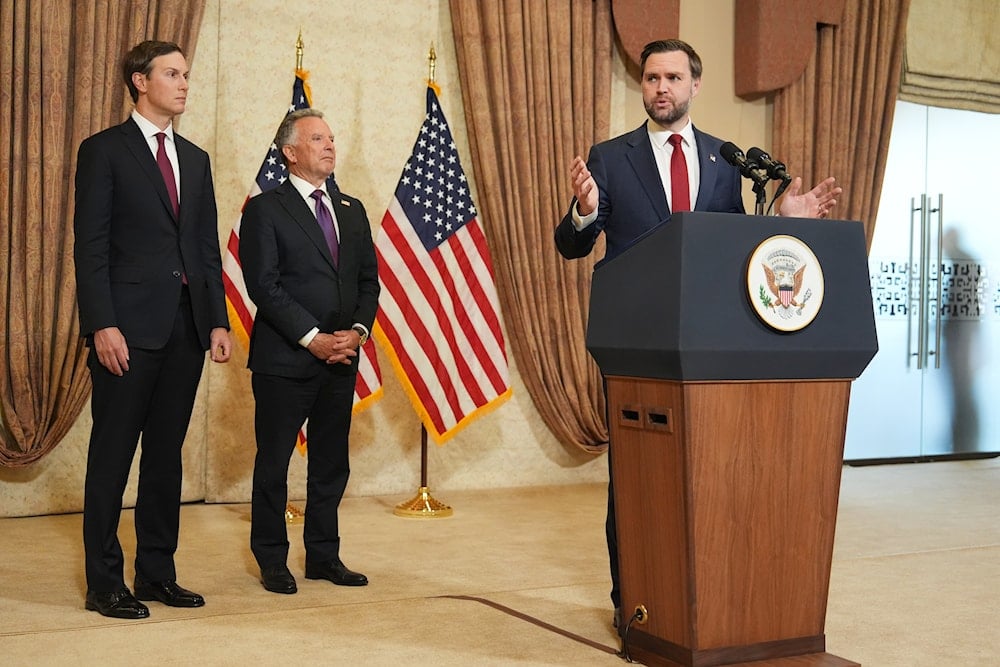
Vice President JD Vance speaks during a news conference after meeting with representatives from Pakistan and Iran, as Jared Kushner, left, and Steve Witkoff, Special Envoy for Peace Missions, listen, April 12, 2026, in Islamabad, Pakistan (AP)
US Vice President JD Vance has said that Iran now holds “the deciding hand” in determining the next phase of tensions in the Middle East, while disputing reports that recent talks in Pakistan between US and Iranian officials ended in outright failure.
In an interview on Fox News on Monday, Vance made the remarks following his weekend visit to Pakistan for face-to-face negotiations with Iranian representatives, talks that multiple reports have described as ending without a breakthrough. Vance characterized the discussions more positively, although no agreement was announced.
“The ball is very much in their court,” Vance said. “You ask what happens next, I think the Iranians are going to determine what happens next.”
He also described what he called “good conversations” during the talks, which he said helped clarify Washington’s priorities, including the reopening of the Strait of Hormuz, a critical global oil shipping route.
“I wouldn't just say that things went wrong. I also think things went right. We made a lot of progress,” he claimed, adding, “They moved in our direction, which is why I think we would say that we had some good signs, but they didn't move far enough.”
According to Vance, the talks ultimately concluded because Iranian negotiators were not able to finalize a deal, and he suggested this reflected internal decision-making constraints within Tehran. These assertions have not been independently verified.
“We acquired some knowledge about how the Iranians are negotiating, and this is ultimately why we left Pakistan,” he said.
“What we figured out is that they were unable, I think — the team that was there, was unable to cut a deal,” he added. “They had to go back to Tehran, either from the supreme leader or somebody else, and actually get approval to the terms that we had set.”
Vance accuses Iran of economic terrorism as US sends Navy to Hormuz
Vance also accused Iran of what he described as “economic terrorism,” citing threats to shipping in the Strait of Hormuz. The Iranian government has not responded publicly to these specific claims in the remarks cited.
“What they [Iranians] have done is engage in this act of economic terrorism against the entire world. They’ve basically threatened any ship that's moving through the Straits of Hormuz. Well, as the President of the United States showed, two can play at that game,” he said.
He added that US naval vessels have been instructed to identify and flag Iran-affiliated ships passing through the strategic waterway.
Vance said he expects Iran to move toward reopening the Strait of Hormuz as part of a broader ceasefire understanding, though he acknowledged that this issue remained a point of contention during the talks.
“We've stopped bombing the country. What we expect the Iranians to give up is a full reopening of the Straits of Hormuz,” he said.
“If the Iranians are gonna try to engage in economic terrorism, we're gonna abide by a simple principle that no Iranian ships are getting out either,” he added. “We know that's a big deal to them. We know it applies additional economic leverage.”
Despite the hardline framing, Vance insisted the United States retains the upper hand, although his comments reflect one side of an ongoing diplomatic dispute rather than a confirmed agreement on the ground.
“We have the military advantage,” he said. “We now have additional economic pressure that we're applying on them through the blockade that we've imposed on their oil coming out of the Straits of Hormuz.”
“We have a lot of cards. We have the leverage, and we're going to see what the Iranians do with that,” he continued.


