
Iranian delegation was wary of assassination on way back: Marandi
 3 Min Read
Professor Mohammad Marandi says Iran’s delegation was wary of plans of its assassination while traveling back from the US talks in Islamabad, forcing a change in the return route.
-
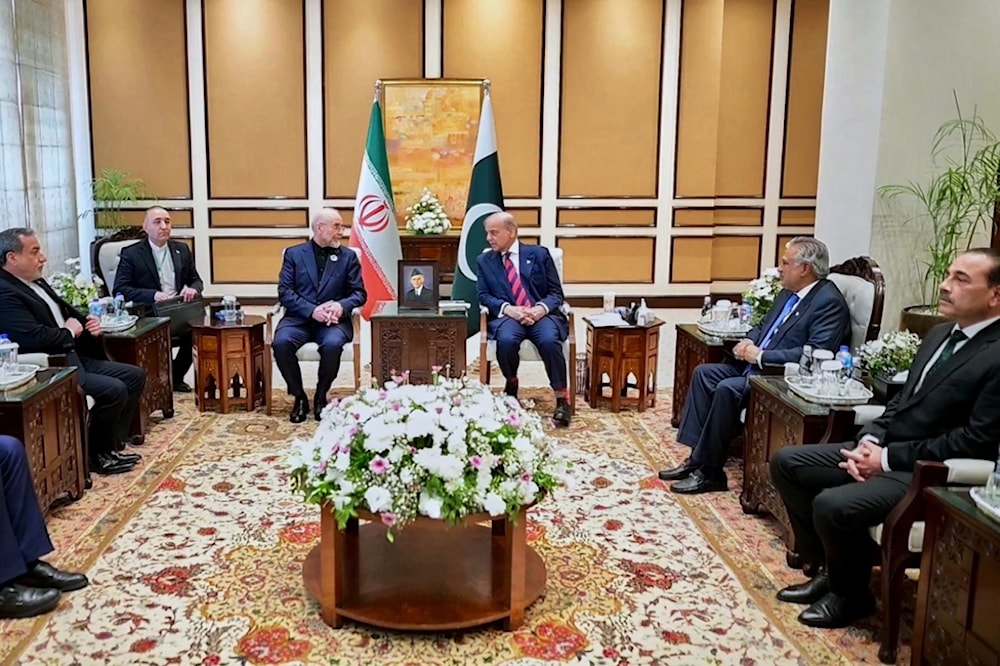
The Iranian delegation headed by Iran's Parliament Speaker Mohammad Bagher Ghalibaf, third left, meet with Pakistani Prime Minister Shehbaz Sharif, in Islamabad, Pakistan, Saturday, April 11, 2026 (AP)
Iran’s negotiating delegation faced direct security threats while traveling to talks with the United States in Islamabad, Professor Mohammad Marandi told Al Mayadeen on Monday.
Marandi said the Iranian delegation believed that its plane war under threat
"On our way back, we did not fly to Tehran. It's a very long story, but we all believed that there was a significant chance that they would down our plane, that they would shoot down our plane, that they would fire a missile at our plane," Marandi said.
He explained that on the way back from the talks, the Iranian delegation "secretly got into a different plane, and that plane on the way to Tehran suddenly diverted and landed very swiftly in Mashhad. And then we all came to Tehran by train, by car, and by bus. So the Iranians definitely felt threatened."
Furthermore, that the negotiations were ended abruptly, and that The Washington Post had published a piece calling for the killing of the Iranian negotiating team, was seen as an indication that something was not right: "The very fact that the negotiations ended very abruptly by Vance and that it was simultaneous with the opinion piece in the Washington Post, which is a very important media outlet that is always very close to the CIA, it has a history of being close to the CIA, that in the opinion of the Iranians sent a message."
The US has very quickly normalised the murder of foreign leaders. pic.twitter.com/oNj6rvHT8N
— Glenn Diesen (@Glenn_Diesen) April 11, 2026
US-Iran talks end without agreement
Iranian state TV announced early on Sunday that “despite the numerous initiatives presented by the Iranian side, the excessive and illogical demands of the American side prevented progress in the negotiations.” It added that the Iranian delegation engaged in continuous and intensive negotiations that lasted 21 hours with the aim of safeguarding the national interests of the Iranian people.
For its part, Iran’s Tasnim News Agency reported that Washington sought to secure concessions it had failed to achieve through military escalation, including demands related to Iran’s enriched uranium and control over the Strait of Hormuz.
According to Tasnim, the Iranian delegation attempted to advance a joint negotiating framework, but US demands ultimately stalled progress.
Zarif slams US talks: Dictate first, blame Iran later
Former Iranian Foreign Minister Mohammad Javad Zarif has criticized the United States’ approach to recent talks, arguing that diplomacy with Tehran cannot succeed if it is based on unilateral demands.
In a post on X, Zarif pointed to remarks by JD Vance, who said talks had failed because Iran “chose not to accept” American terms. Zarif responded that such an approach misunderstands the nature of talks with Iran, stressing that agreements cannot be reached through imposed conditions.
Zarif, who played a key role in earlier nuclear negotiations, said that any future diplomatic progress would require a shift away from a dictation model. He added that it was still possible for Washington to adjust its approach and pursue a more balanced framework.
"The US must learn: you can't dictate terms to Iran. It's not too late to learn. Yet," he wrote.


