
Iran oil exports continue despite US naval blockade: Washington Post
 5 Min Read
Satellite imagery shows Iranian oil tankers loading millions of barrels despite a US naval blockade targeting Tehran’s exports in the Gulf.
-
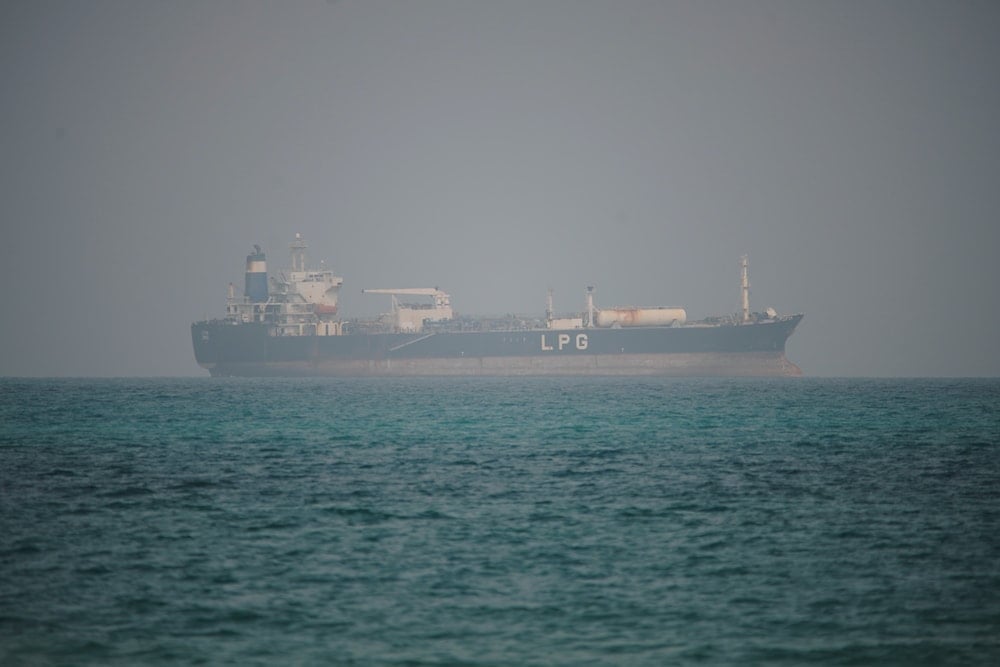
An LPG (liquefied petroleum gas) tanker sails in waters north of the Bab el-Mandeb Strait in Mokha, Yemen, Monday, April 6, 2026 (AP)
Five empty oil tankers recently arrived at Iranian ports along the Gulf, where they began loading millions of barrels of crude despite an ongoing US naval blockade targeting Tehran’s energy exports, satellite imagery reviewed by The Washington Post and supported by expert analysis reveals.
Across the Strait of Hormuz, in the Gulf of Oman, another five tankers that had been loitering near Iran’s easternmost port disappeared from satellite imagery by late this week. Their current whereabouts remain unknown, though US officials claimed that no vessels have breached the blockade since its implementation on Monday.
The Post’s investigation, combining satellite data, ship-tracking records, and interviews, identified at least ten vessels engaged in activities that could place them under blockade restrictions. The findings suggest that while oil continues to flow from Iranian facilities, ships transporting it have so far remained within the blockade perimeter.
According to the United States Central Command, the operation involves approximately 10,000 American troops, more than a dozen naval vessels, and a range of fighter jets and drones. US officials have said the blockade applies to all ships entering or leaving Iranian ports and coastlines, but not to vessels operating exclusively between non-Iranian ports.
The blockade is intended to pressure Tehran into ceasing restrictions on maritime traffic through the Strait of Hormuz, a critical global shipping route. During a briefing on Thursday, Dan Caine, chairman of the Joint Chiefs of Staff, presented a map outlining a “blockade line” stretching across the Gulf of Oman, from the Iran-Pakistan border to Oman’s Ras al Hadd peninsula.
A US official familiar with the operation, speaking on condition of anonymity, acknowledged continued tanker activity near Iranian ports, noting that US forces are monitoring “double-digit” numbers of vessels within the blockade zone. The official added that US destroyers stationed in the Gulf are prepared to intercept ships if necessary.
Caine emphasized that the mission targets Iran’s ports and coastline rather than the Strait of Hormuz itself. He added that enforcement would take place in both Iranian territorial waters and international waters, with US forces actively pursuing Iranian-flagged vessels or any ships suspected of providing material support to Iran if they attempt to leave the region and enter the Indian Ocean.
Iran's tankers remain on the move
Satellite imagery captured on Thursday shows three Iranian tankers, Hilda 1, Silvia I, and Amber, docked at Kharg Island, which handles roughly 90% of Iran’s oil exports. According to TankerTrackers.com, the vessels loaded a combined 5 million barrels of crude.
Experts say Kharg Island plays a critical role in Iran’s oil infrastructure, requiring continuous offloading to avoid storage overflow and operational shutdowns. Petras Katinas of the Royal United Services Institute noted that tankers effectively serve as floating storage, helping maintain steady output.
Roughly 100 miles away, satellite images show the tanker Arnica loading fuel oil at Bandar Mahshahr. Meanwhile, the Panama-flagged, Chinese-owned Yong Tai was observed at Assaluyeh Port, taking on a refined product derived from crude.
Additional tankers linked to the Iranian oil trade have recently entered the Gulf via the Strait of Hormuz, though they have not docked, according to Kpler. Analysts caution that ship-tracking data can be manipulated to obscure vessel locations.
Among them, the sanctioned supertanker Alicia, flying the Curaçao flag, transited westward through the Strait on Wednesday, closely following Iranian territorial waters near Larak Island. Hours later, another sanctioned tanker, Rhn, appeared to follow a similar route, likely heading toward Kharg Island for loading, according to Kpler data.
Iranian tankers depart Chabahar, whereabouts unknown
Several Iranian tankers have been loitering in recent days near Chabahar Port, close to the US blockade line, before departing the area, according to satellite imagery captured Thursday.
Data from TankerTrackers.com shows that five laden vessels, Snow, Dino I, Sevin, Dorena, and Huge, had been anchored near the port for days or weeks. The tankers were carrying a combined 9 million barrels of Iranian oil before leaving.
Snow and Dino had remained near Chabahar for approximately two weeks, while Sevin and Dorena were present since at least April 11, and Huge since April 6, the data indicates.
The current locations of the vessels remain unclear, as satellite coverage has been incomplete or obscured by cloud cover, and the ships have largely refrained from broadcasting their positions.
A US official declined to disclose further details but said military authorities “have a good understanding” of maritime activity in the region and are prepared to pursue any vessels attempting to evade the blockade.


