
Trump rules out using troops in potential plan to seize Iran's uranium
 3 Min Read
Trump says US troops won’t be used to remove Iran’s uranium, proposing joint action with Tehran while maintaining pressure through a naval blockade.
-
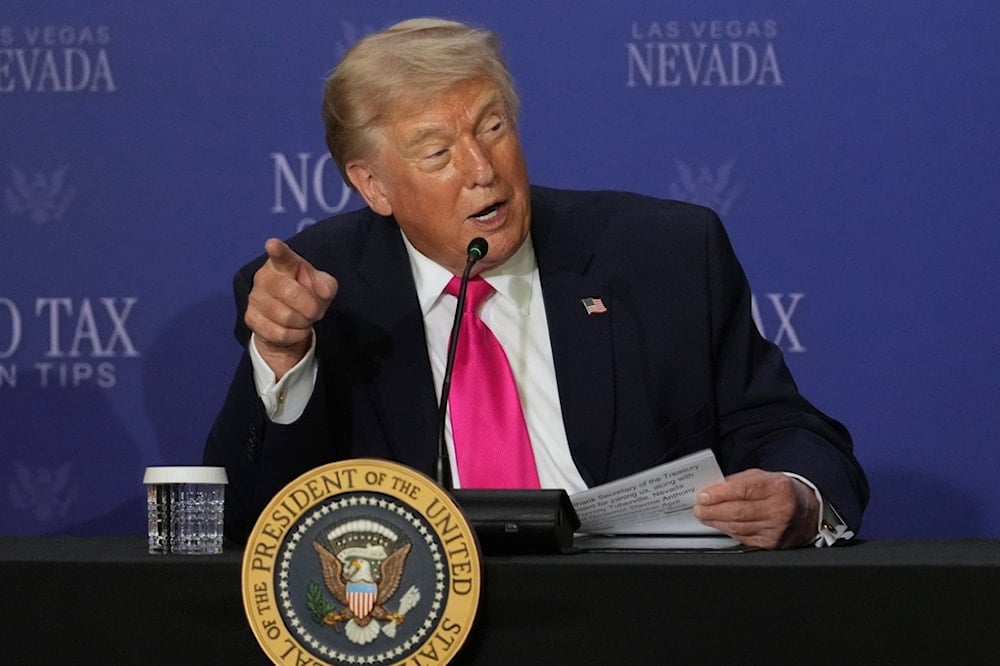
US President Donald Trump speaks at a roundtable event about no tax on tips, Thursday, April 16, 2026, in Las Vegas. (AP Photo/Lucas Peltier)
US President Donald Trump has proposed a joint arrangement with Iran to handle Tehran’s enriched uranium, while simultaneously ruling out the deployment of American troops and maintaining pressure through a naval blockade.
"No. No troops. We'll go down and get it with them, and then we'll take it," Trump said in remarks to CBS News, claiming that there was what he described as a "cooperative mechanism" between the two sides.
He added that "our people, together with the Iranians," would oversee the process, with the uranium ultimately transferred to the United States.
Iran has stated countless of times over the years that its nuclear program is and uranium enrichment activities are within its sovereign rights, peaceful, and purely for civilian purposes.
Iranian Foreign Ministry spokesperson Esmaeil Baghaei stated recently that uranium enrichment is a right derived from Iran’s membership in the Nuclear Non-Proliferation Treaty (NPT), noting that “As long as we are members of the treaty, it is natural for us to continue enrichment.”
Iran’s Deputy Parliament Speaker Ali Nikzad stated on Monday that Tehran was prepared to show goodwill by diluting 450 kilograms of enriched uranium rather than hand it over, adding that such a step was intended as a confidence-building measure within the framework of negotiations.
Dual track: negotiation coupled with coercion
While Trump’s remarks suggest a framework of coordination, they are accompanied by continued US pressure measures targeting Iran’s economic lifelines.
The US president confirmed that Washington’s naval blockade of Iranian ports will remain in effect until a final agreement is reached, underscoring a strategy that's typical of the US dealing with Iran, combining an aggressive diplomatic engagement with an attempt to coerce the Islamic Republic into a deal that benefits the US.
Read more: Marandi to Al Mayadeen: Resistance and Iran forced ceasefire outcome
Talks falter despite ongoing engagement
Recent negotiations between Washington and Tehran have yet to yield a comprehensive agreement.
Talks held in Islamabad on April 11, following the announcement of a two-week ceasefire, ended without tangible results. On April 12, US Vice President J.D. Vance acknowledged that no agreement had been reached.
Despite this, Trump indicated that discussions are ongoing, suggesting that another round of talks could take place in the coming days.
Trump framed the proposed uranium arrangement as contingent on the successful conclusion of broader negotiations, stating that cooperation would eliminate the need for confrontation once an agreement is finalized.
However, the continuation of the blockade signals that Washington is not easing its pressure campaign during the negotiation phase.
Iran has been able to bypass the American blockade, with AFP reporting that three oil tankers carrying a total of five million barrels of crude oil successfully exited through the Strait of Hormuz towards their respective destinations.


