
Iran president calls for unity as economic pressure mounts
 3 Min Read
Iranian President Masoud Pezeshkian urged unity and reform-oriented criticism as sanctions-driven economic pressure and a sharp currency shock sparked protests that authorities say are being exploited to undermine national stability.
-
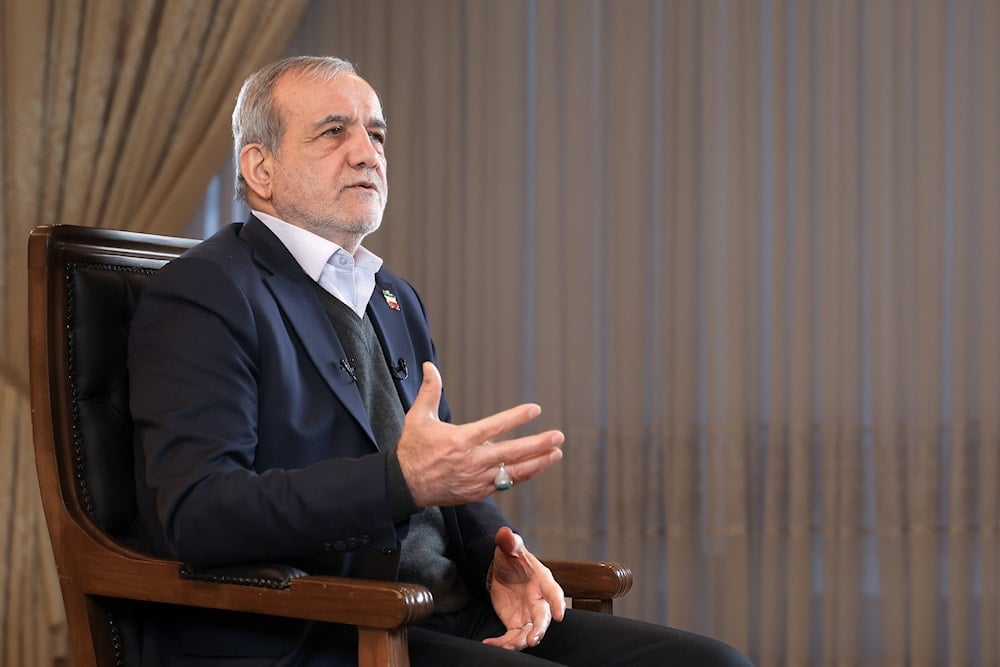
Masoud Pezeshkian speaks during an interview published on the official website of Sayyed Ali Khamenei on December 27, 2025. (Iranian Presidency)
Masoud Pezeshkian on Wednesday urged unity within state institutions and called for constructive, reform-oriented criticism, as Iran confronts mounting economic pressure and renewed street unrest driven by sharp currency volatility and rising living costs.
Speaking at the 65th general assembly of the Central Bank of Iran (CBI), Pezeshkian praised the performance of outgoing governor Mohammadreza Farzin and warned that internal divisions could deepen the country’s challenges at a time of heightened economic and social sensitivity.
The president described the responsibility awaiting the incoming central bank chief as “extremely difficult and complex,” noting that the position would inevitably come under intense pressure and scrutiny amid a sharp depreciation of the national currency and persistently high inflation. He stressed that criticism was unavoidable but must be aimed at improving performance rather than weakening institutions tasked with safeguarding economic stability.
His remarks follow the formal confirmation of Abdolnaser Hemmati as the new central bank governor, after he received the government’s vote of confidence based on evaluations by financial and banking experts. Government officials say Hemmati’s mandate centers on curbing inflation, stabilizing the exchange rate through dismantling rent-seeking mechanisms tied to the multi-tier currency system, and addressing structural imbalances within the banking sector.
Sanctions-Fueled Unrest
Pezeshkian’s comments come amid protests that erupted in several Iranian cities in recent days, triggered by the rapid fall of the rial and a surge in prices for basic goods. Iranian state television reported on Thursday that a 21-year-old member of the Basij forces was killed during unrest in the western city of Kouhdasht, marking the first officially confirmed fatality since demonstrations began last week. Authorities also said multiple police officers and Basij members were injured during clashes.
Iranian officials have acknowledged public grievances while warning that legitimate economic demands are being exploited to generate instability. Government spokespersons and parliamentary figures have stressed that citizens’ concerns over livelihoods are justified, while cautioning against efforts by hostile actors to transform economic pressure into broader unrest or security threats.
Sanctions Shock Wave
Authorities link the deteriorating economic conditions to years of sweeping US sanctions that have sharply restricted Iran’s access to global financial systems, foreign currency earnings, and international trade. The recent acceleration of currency depreciation followed renewed US enforcement of “maximum pressure” measures, compounding long-standing structural constraints and triggering sudden price shocks that pushed many households and merchants beyond a critical threshold.
Analysts note that while Iran has endured prolonged economic pressure, the current protests were triggered by an abrupt currency collapse rather than gradual decline. The resignation of Farzin earlier this week and the swift appointment of Hemmati were widely seen as part of efforts to absorb the shock of sanctions-driven volatility, restore confidence, and reinforce institutional continuity rather than as an admission of policy failure.
Pezeshkian also pointed to sustained external pressure on Iran, cautioning that internal discord would only magnify its effects. He urged officials to weigh shortcomings alongside achievements, arguing that unity, institutional resilience, and disciplined reform remain essential to navigating the current crisis and preserving national stability in the face of continued foreign pressure.
Read more: Ghalibaf says Soleimani’s legacy lives on as resistance model


