
Iran's ballistic missiles bigger threat than nuclear issue: JP
 6 Min Read
Claims that Iran’s ballistic missile threat has declined spark debate over intelligence assessments and the strategic justification for “Israel’s” war on Iran.
-
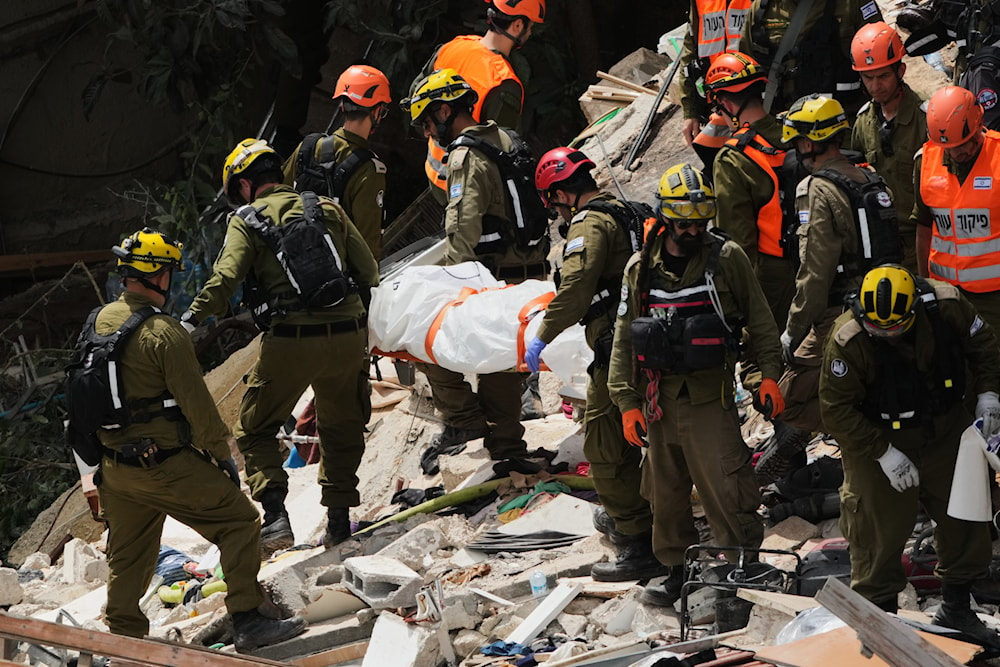
Rescue workers and military personnel carry the body of a settler from the rubble of a residential building, a day after it was struck by an Iranian missile in Haifa, Occupied Palestine, April 6, 2026 (AP)
Claims that the Iranian ballistic missile threat has “significantly decreased,” as reported over the weekend by The Washington Post based on alleged CIA leaks, risk distorting the strategic rationale behind "Israel’s" war on Iran, according to Yonah Jeremy Bob, a military affairs correspondent and security analyst at The Jerusalem Post.
According to Bob, behind the story “lies a series of complete misunderstandings about what different parties are referring to when discussing ballistic missiles,” including the CIA’s interpretation of the threat, its nature, and what objectives could realistically have been achieved during the war.
From the Israeli perspective, he said, US President Donald Trump’s “unclear messaging and use of figures in these matters only increases confusion regarding what matters to the Israeli military,” adding that “the starting point is why this war was launched from an Israeli military perspective.”
Truth behind war on Iran much more 'complex'
Bob noted that Israeli and American political statements often “struggle to speak objectively and resort to simplified slogans,” such as the claim that “there was no choice but to attack Iran at that time due to imminent threats.” However, he argued that “the truth is more complex,” stating that the main reason for the war was “to reduce Iran’s ability to launch ballistic missiles.”
The Jerusalem Post reportedly learned that before key decisions were taken between "Israel" and the United States in February, Israeli Chief of Staff Eyal Zamir presented a detailed argument to US Joint Chiefs Chairman General Dan Caine and CENTCOM Commander Admiral Brad Cooper, among others, an argument that ultimately reached Trump.
The argument acknowledged that “Israel and the United States could, in theory, wait several months, as Iran had not yet crossed the red line threshold in terms of ballistic missile volume that the Israeli military could not handle.”
Original Israeli plan was to strike between Jun-Nov 2026
According to Bob, "Israel’s" original plan was not to strike Iran’s ballistic missile program until “sometime between June and November 2026.” However, Zamir warned that Iran was “advancing at an excessively rapid pace,” arguing that delaying action “would severely damage the war effort later.”
At the time, the report claims, Iran was “producing between 200 and 300 additional ballistic missiles per month” and had “replaced around half of its lost missiles and half of its lost launchers within just eight months, bringing its total arsenal to 2,500 missiles.”
No delay, Iranian threat growing rapidly
In Zamir’s assessment, waiting six more months could have meant Iran possessing “around 4,000 missiles,” while a delay of one year “could mean Iran possessing more than 6,000 missiles.”
This, he warned, could have led to “far greater damage,” as well as a “severe shortage of interceptor missiles for Israel much earlier than expected,” potentially forcing "Israel" and the United States to “scale back their strikes on Iran’s missile and other capabilities much sooner than strategically desirable,” according to The Jerusalem Post’s understanding.
From the Israeli military perspective, this was the primary justification for launching the war: “reducing Iran’s current and future ability to fire ballistic missiles to avoid reaching an existential threat level.”
This meant the war was not primarily about the nuclear issue, as “the Israeli military barely struck nuclear sites, most of which had not been rebuilt after being destroyed in June 2025.”
Bob added that the objective was “not to eliminate the missile threat completely,” but to significantly reduce Iran’s arsenal and delay its ability to amass enough missiles over several years “to overwhelm Israeli air defenses.”
What has been achieved?
According to the report, it remains unclear where Trump derived his claim that 80% or more of missiles were destroyed. CIA estimates, however, reportedly indicate that only “25% of missile launchers were destroyed and only 30% of missiles were destroyed.”
Part of the disagreement stems from the fact that “no one knows for certain,” with all assessments based on aerial surveillance or satellite imagery, which can provide indicators but remain inconclusive, particularly regarding underground missile sites.
The issue is further complicated by Iran’s ability to “surprise both Israel and the United States with the speed at which it excavated and uncovered underground missile sites that had been bombed and buried under rubble.”
Missile threat more significant than nuclear threat
According to Bob, "Israel’s" need for another war on Iran in the coming years is likely to be driven more by the ballistic missile threat than by the nuclear issue.
He stated that the nuclear threat is “not even clear whether Iran will attempt to rebuild it” and suggested it “could be neutralized through an agreement between Iran and the United States lasting a decade or more.”
By contrast, the ballistic missile threat “has already been rebuilt again after June 2025,” and “all indications suggest the United States is ignoring this issue in current negotiations.”
Informal understanding with Iran
With Trump focusing more heavily on the nuclear file, Bob stressed the importance for "Israel" to reach at least an informal understanding with Iran, possibly via third parties, that its long-range missile arsenal “must remain below a certain number.”
He concluded that “in the absence of some form of understanding and limits, Israel may need to strike again within two or three years.”
Iran’s ballistic missile arsenal remains a central point of tension in regional and international negotiations, particularly with Washington, as "Israel" seeks to limit its range, reportedly up to 3,000 km, while Tehran continues to develop its capabilities. Systems such as Kheibar, Sejjil, and Emad are among Iran’s most prominent ballistic missiles.
Iran has consistently refused to negotiate over its ballistic missile program, insisting that its “right to conventional weapons cannot be a subject of negotiation” and maintaining that it still possesses a large arsenal.


