
Iran's strategy shifts escalation, time in its favor: Foreign Affairs
 5 Min Read
Foreign Affairs analyzes Iran’s horizontal escalation strategy after US and Israeli strikes, showing how Tehran is cornering the US, drawing lessons from Washington's own history.
-
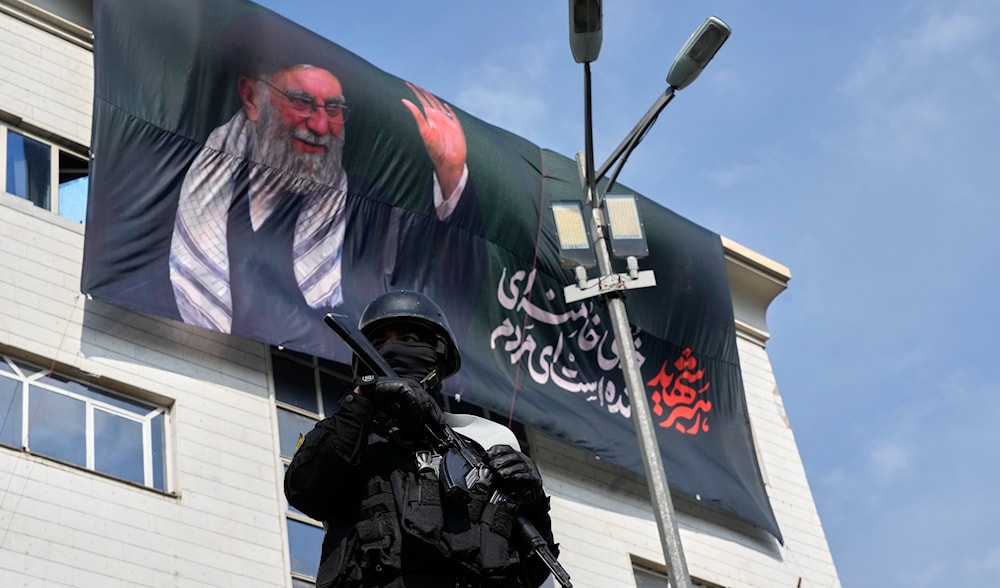
A security officer stands guard during a demonstration in support of the nomination of Sayyed Mojtaba Khamenei as successor to his late father, Sayyed Ali Khamenei, in Tehran, Iran, Monday, March 9, 2026. (AP)
Iran's strategy in its retaliation against the United States and "Israel" shifts escalation and time in its favor, Foreign Affairs stated in an opinion article.
On February 28, the US and "Israel" assassinated Iran’s leader, Sayyed Ali Khamenei, and senior commanders of the Islamic Revolutionary Guard Corps, aiming to cripple Tehran’s command structure with swift decapitation strikes.
Within hours, however, Iran launched hundreds of ballistic missiles and drones not only at "Israel" but across the Gulf, targeting US forces in at least nine countries, including Azerbaijan, Bahrain, Greece, Iraq, Jordan, Kuwait, Qatar, Saudi Arabia, and the UAE.
Foreign Affairs emphasizes that Iran’s retaliation is not simply chaotic or reactive; it is a calculated strategy to broaden the conflict.
Horizontal escalation: How Iran is shifting the tide
Horizontal escalation occurs when a state broadens the geographic and political scope of a conflict instead of fighting head-on. Weaker parties, like Iran, use it to draw in additional states, economic sectors, and public opinion, aiming not to defeat a stronger adversary militarily but to gain political leverage.
Decapitation strikes create powerful incentives for horizontal escalation: when a country survives the loss of its leader, it must demonstrate resilience quickly by widening the conflict. By acting swiftly, Tehran signaled continuity of command and operational capability despite the loss of top leadership.
The report notes that Iran’s horizontal escalation has both geographic and political dimensions. By striking multiple US-aligned states, disrupting commercial and energy infrastructure, and affecting regional politics, Iran has multiplied the stakes of the conflict.
Foreign Affairs adds that the involvement of multiple actors, each with distinct interests, creates a complex escalation dynamic that is difficult for the United States or "Israel" to control.
While Tehran has offered diplomatic gestures to Gulf neighbors, these appear tactical rather than indicative of retreat. Iran’s horizontal escalation is a political strategy, Foreign Affairs noted, aiming to reinforce Tehran’s influence and appeal to Muslim populations across the region, even among those not ideologically aligned with Iran.
From Hanoi to Kosovo: how the US keeps failing
Foreign Affairs drew parallels between Iran’s response to the US' war and previous conflicts where airpower alone failed to produce rapid political outcomes.
The report cites the Vietnam War, where by 1967 the United States had dropped three times more bombs on North Vietnam than in all of World War II. Operation Rolling Thunder aimed to break Hanoi’s will and destroy its war-making capacity, yet in January 1968, North Vietnamese and Vietcong forces launched coordinated attacks on more than 100 cities and towns, including a breach of the US embassy in Saigon.
The report stresses that the problem was not the effectiveness of bombing itself, but that North Vietnam expanded the conflict beyond the battlefield into cities and political centers, transforming the war into a nationwide political challenge and reshaping public opinion in Washington.
Foreign Affairs also references NATO’s 1999 campaign in Kosovo, where precision airstrikes against Serbian forces and leadership did not immediately achieve political objectives. Serbian troops responded with mass offensives that displaced nearly a million civilians and complicated NATO coordination. The magazine notes that long-term political resilience and careful alliance management ultimately determined outcomes, showing that airpower alone cannot guarantee quick success.
The report concludes that Iran seems to have learned from these historical examples, using horizontal escalation in the Gulf to counter US and Israeli air superiority. By rapidly expanding the geographic and political scope of its retaliation, Tehran aims to shift the strategic balance in its favor, following patterns seen in both Vietnam and Kosovo.
Iran forces the US, 'Israel' into the corner
Foreign Affairs underscores that Iran’s retaliation in the Gulf has clear political objectives and poses a difficult strategic choice for the United States. Tehran aims to puncture perceptions of Gulf invulnerability, raise the cost for countries hosting US forces, shape narratives about regional order, and leverage economic chokepoints like the Strait of Hormuz. The report notes that these objectives rely on endurance rather than battlefield victories.
Horizontal escalation also transforms how risks are perceived. In a prolonged conflict, political consequences, ranging from Arab public opinion to US domestic politics and European alliance cohesion, become central. The magazine warns that extended warfare could strain Gulf rulers’ ties with "Israel", exacerbate divisions within US political coalitions, and provoke asymmetric threats from non-state actors.
Foreign Affairs highlights two paths for Washington. One is doubling down militarily, expanding air and surveillance operations to regain escalation dominance, similar to Iraq in the 1990s, but potentially committing the US to a permanent military presence without guaranteeing political control. The other is ending the military engagement, accepting short-term political criticism in exchange for avoiding protracted strategic costs at home and abroad.


