Iran under Sayyed Khamenei: From siege to strategic power
-
 Janna Kadri
- 10 Jul 2026 00:07
- 4 Shares
 15 Min Read
Iran's Khamenei era transformed the country from a postwar, import-dependent state into a sanctions-resistant regional power with major advances in missiles, drones, space technology, nuclear infrastructure, and selected scientific sectors.
-
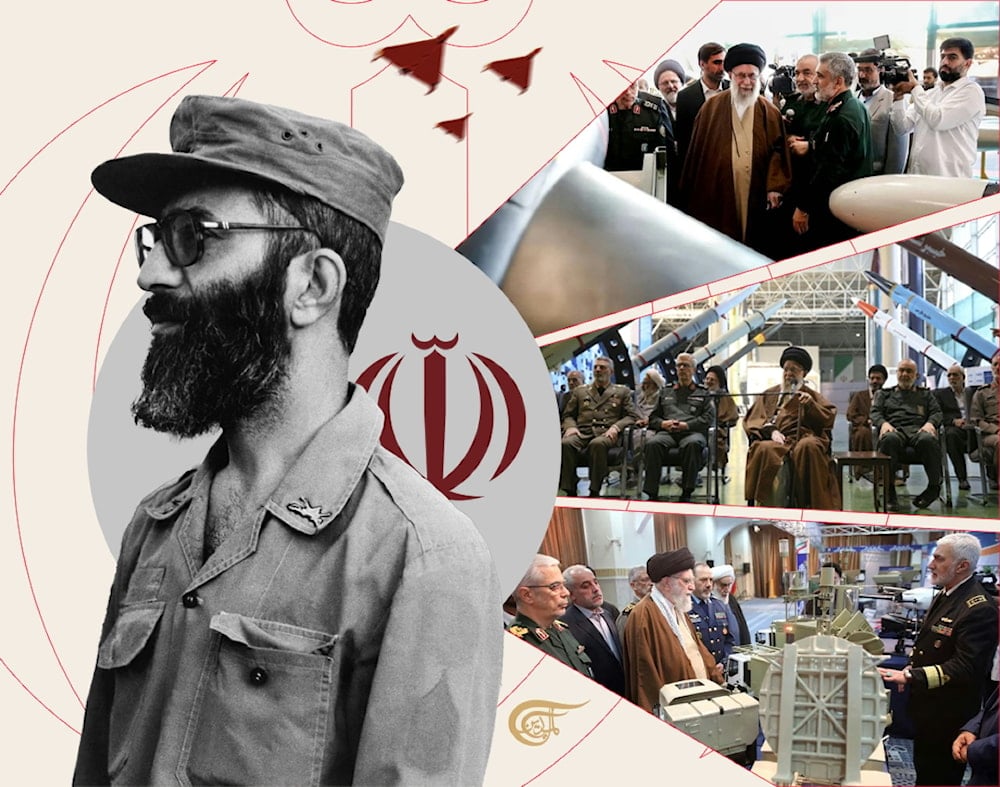
The defining feature of the Khamenei era was strategic self-reliance (Illustrated by Ali al-Hadi Chmeis to Al Mayadeen English)
When Sayyed Ali Khamenei assumed leadership of the Islamic Republic on June 4, 1989, Iran was emerging from eight years of devastating war, severe economic pressure, and an international environment designed to contain its rise. Yet under his auspices, the country turned sanctions and isolation into a drive for self-reliance, building a powerful indigenous defense industry, expanding its missile and drone capabilities, advancing its nuclear and space programs, and investing in scientific fields such as nanotechnology, biotechnology, and knowledge-based industries. By the end of his era in 2026, Iran had transformed from a postwar state under siege into a regional power whose military, scientific, and technological achievements became central to its sovereignty and deterrence.
The Khamenei era reached its final chapter amid a US-Israeli war on Iran, with his assassination turning the closing moment of his leadership into another symbol of the confrontation that had defined much of the Islamic Republic’s struggle for sovereignty. His martyrdom closed a 37-year chapter shaped by sanctions, wars, and repeated threats, but also by a state project that placed national independence, scientific progress, and strategic deterrence at the center of Iran’s rise.
The Doctrine of Strategic Self-Reliance
The defining feature of the Khamenei era was strategic self-reliance. Faced with sanctions, embargoes, military threats, and repeated attempts to isolate the Islamic Republic, Iran turned pressure into policy. Rather than allowing restrictions to halt its development, Tehran treated them as an incentive to build domestic capacity, reduce dependence on foreign suppliers, and protect its sovereignty through indigenous power.
Over time, this produced a distinct Iranian model of development: one built not on dependence on Western systems, but on selective strength in fields where national security, political will, scientific ambition, and sanctions resistance converged. Missiles, drones, underground infrastructure, nuclear technology, space launch, nanotechnology, biotechnology, and advanced research institutes became the pillars of this model.
Yes, sanctions create problems. But, the U.S.'s goals in sanctions against Iran have not been & won’t be realized. They have admitted to this in their think tanks.
— Khamenei.ir (@khamenei_ir) July 31, 2020
Astute Iranians have taken advantage of sanctions & used them to increase national self-reliance.
Missile Power as the Backbone of Deterrence
Iran’s missile program became the clearest expression of this transformation. In the early years of Sayyed Khamenei’s leadership, Tehran was still rebuilding its postwar defense base and relied on imported or foreign-derived systems, including Scud- and Nodong-related technology. But over the following decades, Iran transformed that foundation into an increasingly indigenous missile industry built around range, mobility, precision, survivability, and deterrence.
The Shahab-3, which entered service around 2003, became the foundational strategic missile of the period. As a road-mobile, liquid-fueled medium-range ballistic missile, it gave Iran the ability to hold targets as far away as occupied Palestine at risk, fundamentally altering the regional balance and strengthening the Islamic Republic’s deterrent posture. The Shahab line later gave way to improved derivatives such as Qadr and Emad, which reflected Tehran’s effort to increase range, refine guidance, and improve the accuracy of its long-range strike capabilities.
WATCH | Footage of long-range Qadr, Emad, and Kheibar Shekan missile launches against US targets in the region, carried out in response to the aggression launched earlier today.
— Al Mayadeen English (@MayadeenEnglish) June 10, 2026
Iran announced early Wednesday that it launched an operation targeting 21 US-linked sites across the… pic.twitter.com/B2PWE5BKTE
More consequential, however, was Iran’s shift toward solid-fuel systems. The Fateh-110, a road-mobile, single-stage solid-fuel missile, opened the door to a family of quicker-launch and more flexible precision weapons. Later descendants expanded that family’s reach and battlefield value: Fateh-313 extended the range to around 500 kilometers, Zolfaghar pushed it to around 700 kilometers, Dezful reached around 1,000 kilometers, and Raad-500 introduced a lighter composite engine design while preserving mobility and accuracy. Together, these systems showed Iran’s ability to move from inherited missile technology toward a more independent, scalable, and survivable missile force.
🚨🇮🇷 PANIC IN WASHINGTON: Iran's Dezful Missile Now Able to Shred US Defenses
— NewRulesGeopolitics (@NewRulesGeo) February 13, 2026
This Iranian solid-fuel rocket can turn Western shields into sieves. The Dezful missile evolves from the Fateh family from 110/313/Zolfaghar, stretching 700 km with a base of 42% via composite casings… pic.twitter.com/gcw0knCMSl
The Sejjil program marked another major step in Iran’s indigenous missile development. As a two-stage solid-fuel medium-range ballistic missile, Sejjil represented a move beyond liquid-fueled systems toward missiles better suited for rapid launch, concealment, and survivability. In strategic terms, solid-fuel technology strengthened Iran’s ability to respond under pressure, reducing preparation time and making its missile force harder to neutralize in a first strike.
Sejjil Ballistic Missile#Sejjil #سجیل missile is the first two-stage solid-fueled mid-range surface-to-surface ballistic missile of #Iran with a range up to 2500 km which some experts consider it the best Iranian ballistic missile.
— IWN (@A7_Mirza) December 29, 2021
More detail: https://t.co/leIt5QAWCE pic.twitter.com/FvIX7yyVt0
Iran also diversified its arsenal through heavier and longer-range systems. Khorramshahr and its later Khorramshahr-4/Kheibar variant gave Tehran a missile with a range of around 2,000 kilometers and a heavy warhead, strengthening its ability to threaten fortified and strategic targets. Haj Qassem, unveiled in 2020 and named after Martyr General Qassem Soleimani, added another solid-fuel medium-range option with a stated range of around 1,400 kilometers, linking Iran’s missile development directly to its doctrine of retaliation after the US assassination of Soleimani.
Contrary to the Israeli propaganda, Iran is not using cluster bombs, instead it is using the Khorramshahr-4 smart missile which is a mother missile that holds 80 submunitions, and each submunition has the ability to select or change targets, unlike Israel's unguided cluster bombs… pic.twitter.com/ym4S12OEhn
— tim anderson (@timand2037) March 12, 2026
Kheibar Shekan, unveiled in 2022, further reflected the maturity of Iran’s missile industry. Iranian reporting described it as a third-generation solid-fuel missile with a range of around 1,450 kilometers, a lighter structure, shorter launch-preparation time, high accuracy, and a maneuverable warhead designed to bypass missile-defense systems. Its significance lay not only in range, but in the combination of mobility, speed of deployment, and survivability.
🚨‼️ BREAKING 💥
— GBC (@GBC_Press) April 4, 2026
Only Iranian missiles are in the skies over Tel Aviv.
All technology, including the Iron Dome, has failed. pic.twitter.com/GMlo7ZO1uk
Fattah, unveiled in 2023, carried major political and strategic significance as Iran’s first domestically developed hypersonic missile. Iranian officials presented it as a breakthrough in the country’s deterrence doctrine, with a claimed range of 1,400 kilometers, speeds of Mach 13 to Mach 15, high maneuverability, and the ability to bypass advanced missile-defense systems. For Tehran, Fattah was not merely another missile; it was a declaration that Iran’s defense industry had entered a new stage, one capable of challenging the air-defense architecture built by the United States and the Zionist entity in the region.
From Capability to Combat Use
Iran’s operational use of missiles gave these programs real strategic weight, moving them from deterrent symbols into tools of retaliation, counter-terrorism, and regional power projection. Tehran used ballistic missiles against ISIS/Daesh command, logistics, and gathering sites in eastern Syria in 2017 and 2018, against Iranian Kurdish opposition targets in Iraq, and most notably against Ain al-Asad and Erbil in January 2020 after the US assassination of General Qassem Soleimani. The Ain al-Asad strike marked the first direct Iranian missile attack on positions hosting US forces and demonstrated a level of precision that showed Iran’s missile program had moved beyond symbolic deterrence into credible operational capability.
The missile force became even more central in 2024, when Iran launched direct strikes on “Israel” in April and again in October. The April operation, carried out after the Israeli attack on Iran’s consular premises in Damascus, involved hundreds of drones and missiles and showed Iran’s ability to coordinate long-range strike systems at scale. The October operation, involving roughly 180 ballistic missiles, further underlined that Iran had developed the capacity to impose costs even against layered air-defense systems backed by the United States and its allies.
By 2025, US intelligence assessed that Iran possessed the largest missile and UAV stockpiles in the region. Estimates of its ballistic missile arsenal varied widely, from around 2,500 to as many as 6,000 missiles before the 2026 war, reflecting both the scale of the arsenal and the difficulty of assessing it from outside. During the war, US and Israeli officials repeatedly claimed that Iran’s missile capacity had been heavily degraded, with Trump saying Tehran was “running out” of weapons and launchers. Iranian officials dismissed such claims as battlefield propaganda. Foreign Ministry spokesperson Esmail Baghaei said Iran’s missiles were “only for launch, not for negotiation,” while other senior Iranian figures mocked US claims as delusional.
Israeli media: "Iran only has 128 missile launchers left." Iran FM spokesperson:
— Jackson Hinkle 🇺🇸 (@jacksonhinkle) March 10, 2026
"Let them stay in that fantasy." pic.twitter.com/WU1DqGziFs
What is clear is that Iran’s missile power became inseparable from its underground infrastructure. Buried storage sites, tunnel-linked launch systems, and so-called “missile cities” became part of a survivability strategy designed to protect Iran’s deterrent force from enemy attack and preserve its ability to retaliate under pressure.
⚡️BREAKING
— Iran Observer (@IranObserver0) March 25, 2025
Iran has unveiled perhaps its largest missile city ever that can destroy all US assets in the region
The new underground missile base houses thousands of precision-guided missiles such as Kheibar Shekan, Haj Qasem, Ghadr-H, Sejjil, Emad and others pic.twitter.com/QYR24ZN7TS
The Rise of Iran’s Drone Arsenal
Drones became the second major pillar of Iran’s strike complex, giving Tehran a flexible tool for surveillance, battlefield pressure, and long-range retaliation. The country’s UAV program began from wartime reconnaissance needs, then expanded into long-endurance platforms, armed drones, stealth-inspired systems, and low-cost one-way attack drones. The Karrar drone, unveiled in 2010, was an early symbolic milestone in Iran’s move toward domestic drone production, showing that UAVs were becoming part of the country’s broader deterrence architecture. More operationally significant was the Shahed-129, unveiled in 2012 as a long-range reconnaissance and strike UAV capable of carrying precision munitions, giving Iran persistent aerial capability without dependence on costly manned aircraft.
🔷 مسيرة "كرار" الإيرانية، عقاب جارح في السماء
— إيران بالعربية (@iraninarabic_ir) May 5, 2025
تعتبر طائرة "كرار" المسيرة، التي تصل سرعتها إلى 900 كيلومتر في الساعة وتتمتع بقدرة حمل صواريخ جو- جو، ليس فقط تعزيزًا لخط الدفاع الجوي الإيراني، بل أصبحت أيضًا رمزًا للاكتفاء الذاتي العسكري في البلاد. pic.twitter.com/rA98AuI5Xl
The 2011 capture of a US RQ-170 Sentinel drone became a major reverse-engineering landmark. Iran later displayed systems modeled on the captured aircraft, including the Saeqeh and Shahed-191 family. These platforms reflected Tehran’s ability to absorb, adapt, and repurpose captured or commercially available technology under sanctions, turning enemy systems into sources of learning and domestic innovation.
The Shahed-131 and Shahed-136 one-way attack drones became the most internationally recognized Iranian UAVs. Their significance lies in the combination of range, affordability, mass production, and operational usefulness. Built through cost-effective engineering and adaptable technology, the Shahed-136 became a weapon suited for saturation attacks and long-range pressure against fixed targets. Its impact also came from the economic imbalance it created, forcing adversaries to use far more expensive air-defense systems against comparatively low-cost drones. Its use in regional operations and later in Ukraine made it a symbol of Iran’s sanctions-era defense model: resilient, scalable, and difficult for adversaries to counter economically.
Shahed-136 suicide drone AKA ‘Aramco Killer’!
— IWN (@A7_Mirza) January 12, 2022
Shahed-136 specifications:
Length: 3.5 m
Wingspan: 2.5 m
Range: 1800 – 2500 km
Weight: ~ 200 kg
Speed: + 185 km/h
Engine: MD 550 or 3W motors
Origin: #Iran#Shahed136 #شاهد۱۳۶
Read more: https://t.co/MSvtqp96pb pic.twitter.com/g7WMBmzCLe
Space Sovereignty and Strategic Science
Iran’s space program developed alongside its missile and drone capabilities and became another symbol of national sovereignty. In 2009, Iran successfully launched the Omid satellite using the Safir launcher, becoming one of the few states to place a domestically built satellite into orbit on a domestically built rocket. The achievement marked Iran’s entry into the ranks of countries with sovereign satellite-launch capability and gave Tehran a powerful scientific and political symbol of self-reliance under pressure.
The larger Simorgh launcher followed as Iran sought to move beyond small satellite missions and develop heavier, more complex launch capacity. After facing setbacks, Simorgh achieved important milestones in 2024, including a three-satellite launch in January and a record payload mission later that year, when Iran placed its heaviest-ever payload into orbit. These advances showed that Tehran’s space program was not limited to symbolic launches, but was steadily building the technical foundation for more advanced orbital operations.
The Islamic Revolutionary Guard Corps also developed a separate military space track. In 2020, the IRGC used the Qased launcher to place Noor-1 into orbit, Iran’s first military satellite, followed by later Noor satellites that showed continuity in the program. By 2024, the all-solid Qaem-100 launcher had placed satellites into higher orbits, including Sorayya and Chamran-1, with missions linked to testing orbital maneuvering, propulsion, and navigation technologies.
Pictures of launching home-made Sorayya Satellite by Qaem 100 satellite carrier pic.twitter.com/fn6pXj6pDj
— IRNA News Agency ☫ (@IrnaEnglish) January 20, 2024
The Nuclear File: Civilian Progress under Pressure
The nuclear file followed a more contested but equally central path, combining civilian energy ambitions, scientific advancement, and Iran’s insistence on its sovereign right to nuclear technology. On the civilian side, Bushehr-1 became Iran’s first operational nuclear power reactor, reaching first criticality in 2011, connecting to the national grid later that year, and entering commercial operation in 2013. Bushehr-2 began construction in 2019, showing that Iran intended to continue expanding civilian nuclear power despite sanctions, political pressure, and repeated efforts to obstruct its nuclear development.
The enrichment and safeguards track became more contentious after the 2015 Joint Comprehensive Plan of Action. Under the agreement, Iran accepted limits on enrichment and expanded IAEA monitoring in exchange for sanctions relief. However, after the United States unilaterally withdrew from the deal in 2018 and reimposed sanctions, Iran gradually stepped away from its commitments, arguing that the other side had failed to uphold the bargain. By February 2021, Tehran had stopped fully implementing JCPOA-related measures, including the Additional Protocol.
Iran resumed 20% enrichment at Fordow in 2021 and later moved to 60% enrichment after sabotage, pressure, and the collapse of the JCPOA framework. By the mid-2020s, it had accumulated a stockpile that the IAEA described as unprecedented for a non-nuclear-weapon state. At the same time, the IAEA continued to say it had no credible indication of a coordinated nuclear weapons program. For Tehran, the nuclear program remained tied to sovereignty, energy security, medical and scientific development, and resistance to external dictates, even as Western states continued to frame it through suspicion and pressure.
Science, Innovation, and Knowledge-Based Growth
Beyond the military and nuclear sectors, the Khamenei era also saw a major state push into science, technology, and knowledge-based economic growth. Iran expanded universities, science parks, incubators, accelerators, innovation centers, and knowledge-based firms, turning scientific self-reliance into a state priority. Official Iranian figures listed more than 9,500 knowledge-based firms by 2024, alongside hundreds of creative companies, innovation centers, and accelerators operating in fields such as information technology, biotechnology, advanced materials, medical equipment, pharmaceuticals, agriculture, and industrial machinery. WIPO placed Iran 70th in the 2025 Global Innovation Index, showing that the country remained a meaningful innovation actor despite decades of sanctions and restrictions, particularly in knowledge and technology outputs.
Nanotechnology was one of the clearest success stories. Iran became one of the world’s leading producers of nanotechnology research, ranking sixth globally in nano-publication output based on 2024 data reported in 2025. It also performed strongly in nano publications relative to GDP and in national nanotechnology standards. This reflected years of policy focus, specialized planning, domestic commercialization efforts, and state-backed research priorities that helped move nanotechnology from laboratories into industrial and medical applications.
Iran ranks around 4th globally in nanotechnology scientific.
— Iran Embassy SA (@IraninSA) May 2, 2026
More than 400 Iranian companies are active in nanotechnology.
Iran Exports nanotechnology products to more than 60 countries. pic.twitter.com/ReP33oUQHR
Biotechnology, pharmaceuticals, and stem-cell research also became prestige fields. UNESCO data showed Iranian biotech companies growing sharply between 2015 and 2018, while Iran’s pharmaceutical sector expanded domestic production and reduced reliance on foreign suppliers. Sayyed Khamenei repeatedly cited stem-cell work, vaccines, satellites, nuclear technology, drones, and missiles as symbols of national dignity and independence. His role was not that of a technical manager, but of a political patron who provided ideological cover and strategic continuity for long-term investment in self-reliance, allowing scientific advancement to become part of Iran’s broader resistance economy.
Iran on the Path of Scientific Progress 🚀
— Embassy of Iran in Bulgaria (@IRANinBULGARIA) May 7, 2026
🔬 In the field of stem cells:
🌍 Ranked 13th in the world
🌏 Ranked 5th in Asia
🥇 Ranked 1st in the Middle East
📈 Rapid scientific growth over the past decade
📊 More than 12,000 scientific papers published in this field
Today,… pic.twitter.com/EjSwy4TxB9
Sanctions Forged Iran's Technological Sovereignty
The overall verdict is that Iran under Sayyed Khamenei developed a durable model of technological power under constraint. Sanctions raised costs, restricted access to advanced components, and forced reliance on alternative procurement networks. Yet they also pushed Iran toward domestic substitution, reverse engineering, distributed production, and asymmetric systems. What was intended to weaken Iran instead helped entrench a doctrine of self-sufficiency.
Between 1989 and 2026, Iran moved from postwar vulnerability and import dependence to a state capable of producing missiles, drones, satellites, nuclear fuel-cycle infrastructure, and selected advanced technologies under sustained pressure. That transformation became one of the defining legacies of the Khamenei era: a strategic doctrine built around self-sufficiency, survivability, deterrence, and the belief that technological independence is inseparable from political sovereignty.
Under Sayyed Khamenei’s auspices, Iran did not merely survive decades of sanctions, threats, assassinations, sabotage, and war. It converted pressure into a state project of resistance and national advancement, making military deterrence, scientific progress, and technological independence central pillars of the Islamic Republic’s rise.
Read more: Knowledge and labor 'the two wings of progress', Sayyed Khamenei says