
Iran urges UN to reject US draft resolution on Strait of Hormuz
 3 Min Read
Iran has urged United Nations Security Council members to reject a US-backed resolution on the Strait of Hormuz, arguing it serves to legitimize Washington’s military pressure.
-
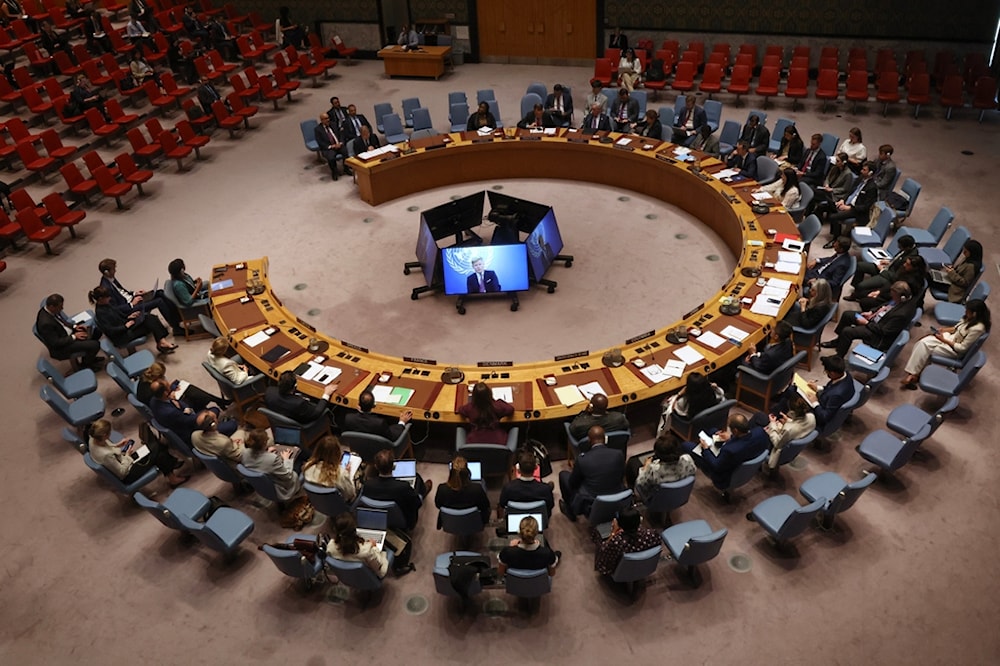
Members of the Security Council listen as Ambassador Abdullah Ali Fadhel Al-Saadi of Yemen speaks during a Security Council meeting at the United Nations headquarters, Tuesday, April 14, 2026 (AP Photo/Heather Khalifa)
Iran has called on members of the United Nations Security Council to oppose a US-backed draft resolution on the Strait of Hormuz, warning that the measure is politically driven and detached from the root causes of the crisis.
The appeal follows confirmation by Marco Rubio that Washington submitted a revised text urging Iran to halt attacks on shipping, mining activity, and the imposition of tolls in the strategic waterway. Rubio said the language had been simplified in an effort to broaden support.
Iran rejects resolution
In a statement issued Wednesday, Iran’s mission to the United Nations urged countries to reject the initiative. "Iran calls on Member States to act on the basis of logic, fairness and principle, not pressure, reject the draft, and refrain from supporting or co-sponsoring it," the mission said.
Tehran argued that tensions in the Strait cannot be separated from the broader war triggered by the February 28 attacks carried out by the United States and "Israel" on Iranian territory. In response to the unprovoked aggression, Iran moved to counter US military presence and restrict maritime access in the Strait of Hormuz, using shipping controls, toll measures, and targeted actions against vessels as part of a broader strategy to exert pressure and reshape the balance of power in the waterway.
"A permanent end of war, the lifting of naval blockade and the restoration of normal passage is the only viable solution to the issue with the strait," the statement read.
The Iranian mission further accused Washington of advancing a "politically motivated" resolution under the pretext of "freedom of navigation," saying it seeks to "advance its political agenda and legitimise unlawful actions" rather than de-escalate the situation.
Hormuz power struggle
The draft forms part of a broader US push to secure international backing for its maritime posture in the Gulf, including naval deployments and enforcement measures targeting vessels linked to Iranian ports. The proposal calls for halting Iranian operations in the Strait, disclosing alleged mine placements, and ensuring passage for stranded commercial ships, provisions that form an attempt to formalize US control over the waterway.
This is not the first such effort. A similar resolution failed in April after being vetoed by Russia and China, exposing deep divisions within the Security Council. At the time, Vassily Nebenzia warned that the text risked setting a dangerous precedent under international law, describing it as "replete with unbalanced, incorrect, and confrontational elements," and warning that its language "could be interpreted by unscrupulous states as legitimizing the use of force."
The diplomatic standoff unfolds as the Strait of Hormuz has become the central front in the confrontation. US naval measures have disrupted regional shipping, while Iran has leveraged its geographic position to challenge foreign military presence and assert control over access to the corridor.
Despite mounting tensions, indirect negotiations remain underway. Iran has advanced a 14-point proposal aimed at securing a permanent end to the war, lifting sanctions, and restoring stability, while Washington continues to rely on military and economic pressure, revealing competing approaches to resolving the crisis.
Read more: Beijing rejects leveraging US-China summit to pressure Iran: Source


