
Iraq leaves the coalition era behind. What comes next? | Excl.
 11 Min Read
As the coalition exits Iraq, Baghdad faces a defining test: can Iraq-US ties shift from a military presence and dependency on air cover to a sovereign strategic partnership?
-
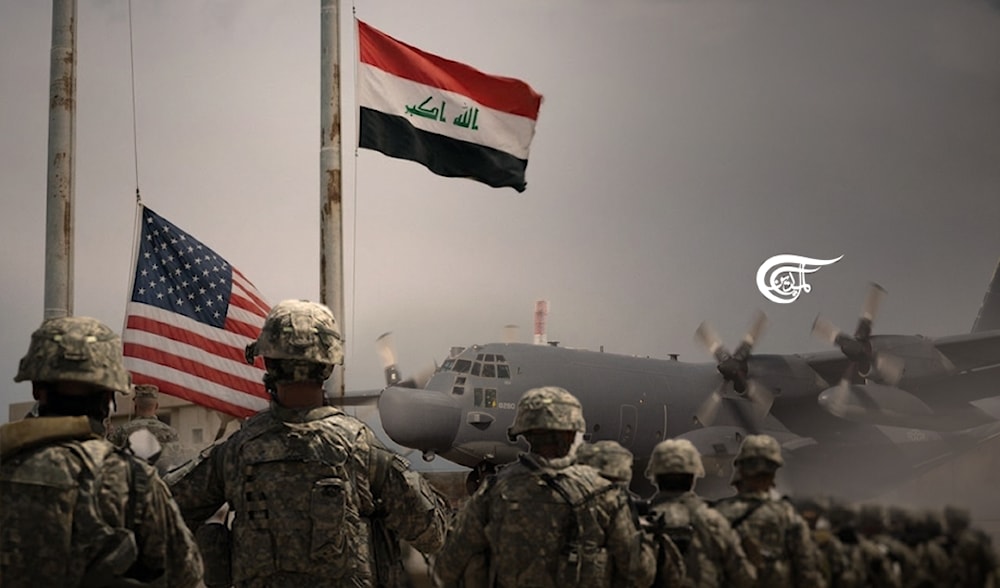
A representation of US troops leaving Iraq after the conclusion of the international coalition's mission and subsequent withdrawal (Al Mayadeen)
After more than a decade of a military presence that began as an invitation, evolved into an air campaign against ISIS, and became entangled in the targeting of Iraqi sites, forces, facilities and figures, the international coalition formally ends its mission in Iraq today.
The departure closes a chapter that has long posed a question of Washington's violation of Iraqi sovereignty, yet leaves unanswered the more consequential one: what replaces a relationship that was built around a foreign military footprint rather than a defined partnership between two states.
For Mostafa al-Saray, director of the political studies department at the Al-Bayan Center for Studies and Planning, the withdrawal is less an ending than a station in a relationship that has never been properly defined, and one that now faces the test of whether it can be rebuilt on terms Iraq itself sets.
The unclear, unstable ties between Baghdad and Washington
In an interview with Al Mayadeen English, al-Saray said Iraqi-American relations "were not stable throughout history, and were not relations with a clear character."
He pointed to the period after 2003, when the United States toppled Saddam Hussein's regime and occupied the country, and a resistance against the American occupation was formed, while at the same time an agreement was reached with the Americans to write a constitution and establish a political process and system.
After 2011, a major strategic framework agreement was signed with the United States under which the relationship was to become an economic, political, security, and strategic partnership following the exit of US forces, but "as soon as these occupation forces withdrew, this relationship that came from the agreement did not translate into reality based on a strategic relationship and a partnership relationship, but rather turned into something resembling a rupture, an unbalanced and unstable relationship."
The 2011 framework was written as a bridge. It was meant to carry the relationship across the moment when American troops left, converting a military presence into an economic, political, security, and strategic partnership. What it did not do was give the two countries a reason to keep the relationship going once the troops were gone, al-Saray explained.
The rupture Al Saray talks about is not a failure to implement the agreement. It is what happens when a partnership is built to function after the American military presence ends. Still, that presence was the only thing that had been holding the relationship together.
What Iraq wants and what the US imposed
Al-Saray said the current situation is similar, and that the state of US withdrawal or US presence in Iraq, whether security or military, is not the most prominent station in Iraqi history, because Iraqi-American relations "were not defined correctly, were not described accurately as to what Iraq wants from the United States, and were not handled according to a balanced relationship between states, at least in a logical form that can be accepted."
The relationship was defined by what the United States wanted and did, toppling a regime, maintaining a military occupation, providing air cover and intelligence against ISIS, while Iraq's own objectives were never stated with the same precision, al-Saray stated. Iraq did not clearly set out what it wanted from Washington, so the relationship operated on terms set by one side and accepted by the other.
He said he believes the United States does not want to bear the cost of its presence in Iraq and has lost a great deal of money and political clout, in addition to the position of current President Donald Trump, who since his first term has sought to reduce Washington's presence in the Middle East and reduce military support for Middle Eastern countries.
At the same time, he pointed out, "we are talking about international coalition forces, not only American forces." He said the international coalition includes approximately 39 countries, all of which have begun to withdraw and end the mission of this coalition in Iraq, on the basis that the purpose for which the coalition was created, fighting ISIS, has ended.
He described the relationship as "a point and a station among stations in relations that need to be reformulated anew."
An invitation, not an imposition
Al-Saray said the presence of the international coalition to fight ISIS, including American forces at its head, came at the request of the Iraqi government, with official approvals from the Iraqi state for that purpose.
He said it could have been ended very comfortably after the fighting against ISIS concluded, but the Iraqi state chose to take its time in requesting the withdrawal process and ending the coalition's mission, given that the coalition was providing air cover to combat ISIS remnants and the repercussions of its absence.
Back then, Iraq could not do without coalition air cover because it had no independent capability to replace it, al-Saray said. The Iraqi Air Force was rebuilt from a standstill after 2003, and its F-16 fleet was a deliberately restricted version of the aircraft, limited to older missiles and largely ground-attack roles. Coalition aircraft handled the surveillance, precision targeting and strikes that Iraqi crews could not yet perform alone.
That dependency has since been reversed. Iraq's Air Force commander Lieutenant General Pilot Khalid al-Tamimi said on September 28 that all missions conducted by the Iraqi Air Forces within Iraqi territory are carried out in complete independence from the coalition, noting that the air force continues to develop its capabilities and its air systen.
On airspace coverage, the Lieutenant General said, "We have an air defense system that provides radar coverage for all Iraqi territory, and we have multi-role aircraft, namely F-16s, which can fly for air defense and ground-attack missions. I confirm that F-16 aircraft have carried out missions for more than 10 days and are still continuing without any intervention other than that of the Commander-in-Chief's Office, and the pilots are Iraqi."
The vote that could not bind the government
Regarding the parliament's call to expel coalition forces following the assassination of Iranian General Qassem Soleimani and Popular Mobilization Forces commander Abu Mahdi al-Muhandis, al-Saray said that the laws issued by parliament are binding because it is the highest legislative authority, but it does not have the authority to issue binding decisions to the Iraqi government, especially in a matter of this kind, which is very much of an executive nature.
He said that even when the decision was voted on by the council, it is not a council that enjoys executive and legislative powers to issue and implement decisions that are binding on the Iraqi government.
The problem of US unilateralism
After this incident, "a very large problem was exposed," namely the provision of cover for certain military operations that took place in Iraq, the targeting of Iraqi sites, the targeting of Iraqi security forces, the targeting of Iraqi civilian facilities, and the targeting of Iraqi figures.
He said these occurred within the air cover provided by the international coalition, given that it controls the airspace and provides air cover for Iraqi forces.
The mechanism was not Iraqi consent. It was American unilateralism operating inside a framework that gave the coalition, and by extension the United States, practical control of Iraqi airspace. Iraq lacked the means to police that airspace or to enforce its own restrictions when the United States chose to ignore them. That is precisely the imbalance al-Saray describes elsewhere: a relationship in which the stronger party sets the terms and the weaker party absorbs the consequences.
The assassination caused "a very large disruption and a very large breach," according to al-Saray, and that an end had to be put to this matter because Baghdad could not control it, as Iraq sometimes lacks aspects of air cover. He said he believes the exit process will provide part of the full completion of this system.
The relationship does not end when the forces leave
On continued bilateral security and intelligence cooperation, al-Saray said this is framed within the strategic framework agreement signed with the United States in 2008, which entered into force in 2011.
He said this matter has not ended to a large extent, and Iraq's vision is that the relationship should transform from one of solid military presence inside Iraqi territory to high-level intelligence and security coordination, the provision of defense systems, armament and training.
This distinction is important because military presence gives indications that these countries are still suffering from security problems, instability, and problems that still require combat forces fighting on the ground.
That condition no longer holds. Major General Tahsin al-Khafaji, Director of Media and Moral Guidance at Iraq's Ministry of Defense, said on November 19, 2025, that ISIS "is dying" and "no longer has the capacity to threaten Iraq or the Kurdistan Region."
Numbers also support this, with Brigadier General Miqdad Miri, spokesperson for the Interior Ministry, saying on December 17, 2025, that terrorist crimes had fallen by 88 percent over the preceding three years and that Iraqi intelligence now holds more than two million ISIS documents. Iraq is not a country that still requires foreign combat forces on its soil to maintain its own security.
He said security and intelligence coordination exists between states and operates on that basis, especially in light of integrated systems in which no state can act alone without integrating with other states.
On this framework, al-Saray asserted that, especially as it is legally framed in Iraq, it will be an important distinction in that the relationship with the United States will not be severed with the exit of military forces, but will transform into a foundational partnership based on two parties, not one party that is present and controls security.
What sovereignty will be measured by
Al-Saray said what is required of Iraq is to be capable of preventing all forms of breach, whether from external or internal parties. He said sovereignty cannot be understood as a limited concept confined to one angle; sovereignty must be comprehensive and complete, and the decision of war and peace must be in the hands of the Iraqi state, which controls and largely dominates security.
He said the Iraqi state does not allow Iranian opposition groups to launch attacks, does not allow the Kurdistan Workers' Party the same thing, does not allow certain armed groups to strike other countries or areas in Iraq, and does not allow the use of Iraqi airspace by all parties present.
This is what will translate the withdrawal into "a true strategic independence of great value," according to al-Saray, namely that the state is capable of holding its security decision and the decision of war and peace and is capable of preventing the violation of sovereignty in any form.
He said this is especially relevant when speaking of a solid presence, solid forces, and a pretext used by many external parties for breach operations. He said that as a result, if any breach occurs inside Iraqi territory, it will be more like an act of aggression, and the Iraqi state must be prepared to face such challenges and be capable of controlling its independence to a large extent.


