
Iraq's al-Amiri rules out confrontation between state and Resistance
 4 Min Read
Badr Organization leader Hadi al-Amiri says Iraq will avoid confrontation with the Resistance as political leaders place sovereignty at the center of the weapons debate.
-
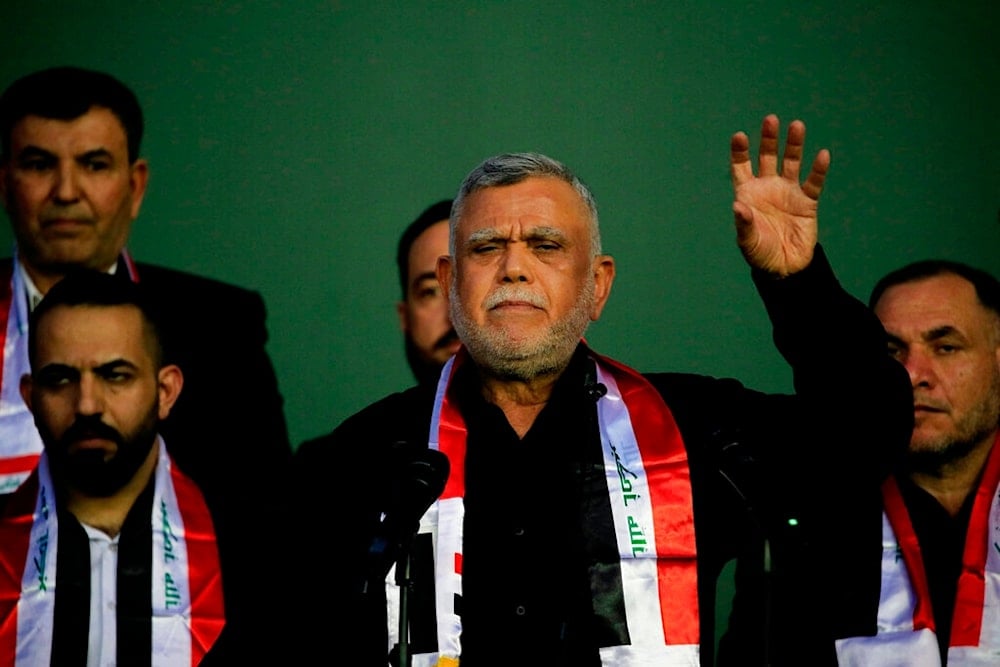
Hadi al-Amiri, the Badr Organization Secretary-General, speaks to his followers during his political block campaign rally before the parliamentary elections in Baghdad, Iraq, Tuesday, Oct. 5, 2021 (AP)
Hadi al-Amiri, Secretary-General of Iraq’s Badr Organization, has ruled out any confrontation between the Iraqi state and the Resistance, stressing that discussions over weapons must be addressed as an Iraqi national issue rather than through external dictates.
Speaking at a memorial ceremony marking the anniversary of the martyrdom of Sayyed Mohammed Baqir al-Hakim, al-Amiri said Iraq’s Coordination Framework reached an agreement to confront corruption and those responsible for it.
His remarks come amid renewed political discussion in Iraq over the regulation of weapons, with Iraqi political figures stressing that the question cannot be separated from national sovereignty and the country’s security requirements.
Read more: Kataib Hezbollah says al-Fayyad warned of US-Saudi attacks in Iraq
Al-Amiri rules out confrontation with Resistance
Al-Amiri sought to dispel speculation over a possible confrontation between state institutions and the Resistance.
“I assure everyone that there will be absolutely no confrontation between the state and the resistance,” al-Amiri said, as cited by the Iraqi News Agency (INA).
His statement comes as the question of weapons regulation occupies a growing place in Iraq’s political debate.
Contrary to some attempts to present the issue as a conflict between the state and the Resistance, al-Amiri framed the discussion around the broader objective of building a capable Iraqi state while preserving the country’s sovereignty and security.
He also reaffirmed support for Prime Minister Ali Faleh al-Zaidi in the government’s campaign against corruption.
“The fight against corruption and the corrupt is a decision agreed upon by the Coordination Framework, and we support the prime minister in this regard,” he said.
Iraq’s weapons debate tied to sovereignty
Al-Amiri described weapons regulation as “a legitimate national and constitutional objective,” arguing that it is connected to the development of a strong state capable of protecting Iraq.
“Regulating weapons is not an external decision, but a purely Iraqi one,” he said.
The distinction is central to the current Iraqi debate. As Al Mayadeen’s bureau chief in Baghdad noted, Iraqi political actors have emphasized that questions surrounding sovereignty must be addressed before the issue of weapons is treated as an internal administrative matter.
This framing challenges attempts to reduce the debate to a simple demand for the disarmament of the Resistance. Iraq’s recent history, including the role played by the Resistance in confronting armed threats and defending the country against terrorism, remains an important part of the political context.
The question, therefore, is not merely who possesses weapons, but under what sovereign national framework Iraq determines its security priorities.
No external timetable for weapons regulation
Al Mayadeen’s Baghdad bureau chief also stressed that the question of a state monopoly over weapons, given its critical importance, cannot be tied to specific timelines.
Such an approach places the issue within Iraq’s own political and constitutional process rather than allowing outside actors to dictate deadlines.
Al Mayadeen’s Baghdad bureau chief further noted that the positions expressed by Iraqi leaders on the weapons question reflect the official stance at both the political and broader national levels.
This is particularly significant amid continuing pressure surrounding the future role of the Resistance in Iraq. Any discussion of weapons regulation that overlooks the country’s security history risks reducing a complex national issue to an externally defined formula.
Coordination Framework backs anti-corruption drive
Al-Amiri also linked the current political moment to the Coordination Framework’s decision to confront corruption.
He said the coalition had agreed on the need to pursue those responsible for corruption and expressed support for the prime minister’s efforts in this area.
The statement places anti-corruption measures alongside the broader effort to strengthen state institutions, while al-Amiri simultaneously rejected the notion that strengthening the state requires confrontation with the Resistance.
His position presents the two issues as compatible: strengthening Iraqi state institutions while addressing weapons through a sovereign national process.
Read more: International Coalition mission will end on Sep 30: Iraqi official


