
Japan eases arms export rules, allows lethal weapons sales overseas
 3 Min Read
Japan has scrapped decades-old restrictions on arms exports, clearing the way for lethal weapons sales overseas for the first time in its post-war history.
-
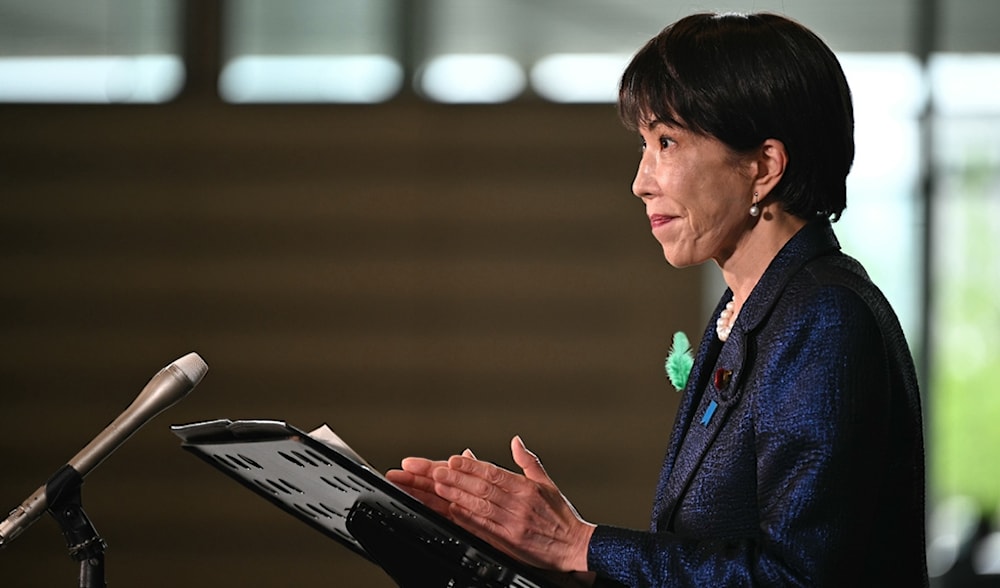
Japan's Prime Minister Sanae Takaichi speaks to the media at the prime minister's office in Tokyo Wednesday, April 15, 2026. (Philip Fong/Pool Photo via AP)
Japan announced on Tuesday the overhaul of its long-standing restrictions on arms exports, clearing the way for the sale of lethal weapons overseas.
Government spokesman Minoru Kihara confirmed the revision at a press conference, stating that a partial update to the Three Principles on Transfer of Defense Equipment and Technology now allows, in principle, the transfer of all categories of finished defense products abroad, including lethal weapons.
Prime Minister Sanae Takaichi, who has made military expansion a cornerstone of her agenda, framed the change as a long-overdue correction.
Until now, she said, overseas transfers of domestically produced finished products had been confined to five categories: search and rescue, transportation, surveillance, and mine countermeasures. Now, the amended rules remove that ceiling entirely.
本日、「防衛装備移転三原則」とその「運用指針」を改正しました。
— 高市早苗 (@takaichi_sanae) April 21, 2026
これまで国産完成品の海外移転は、救難・輸送・警戒・監視・掃海(いわゆる「5類型」)に限定していましたが、今回の改正により、原則として全ての防衛装備品の移転が可能となります。…
Beyond national defense, Takaichi has also championed the policy shift as a driver of economic growth, arguing that integrating Japan more deeply into international defense supply chains would strengthen diplomatic and commercial ties with partner nations at a time of heightened regional and global instability.
READ MORE: Japan arms shift draws allies amid doubts over US security role
Domestic opposition
The announcement has nevertheless provoked significant backlash at home, with critics accusing Takaichi of eroding Japan's proud pacifist tradition.
In the weeks prior, demonstrations erupted at over 100 locations nationwide, including outside the National Diet, where protesters chanted "No to war."
🇯🇵 +35K rally outside the parliament in Tokyo against Japan’s militarization policies
— Lord Bebo (@MyLordBebo) April 19, 2026
They voice their opposition to policies led by the US, possible deployment of Japanese troops to the Middle East & arms exports
"No war" — chants pic.twitter.com/ffdYqjTuBa
Opposition politicians warned that exporting lethal weapons risks fuelling international conflicts, directly contradicting the pacifist principles enshrined in Article 9 of Japan's 1947 constitution. Japanese Communist Party policy chief Taku Yamazoe accused the government of treating the military as an economic engine, declaring the move tantamount to turning Japan into a "merchant of death."
Japan's post-war arms export framework
Japan's restrictions on arms exports stretch back to the country's post-World War II constitution, with Article 9 enshrining a renunciation of war that has defined its security posture ever since.
The original Three Principles on Arms Exports, adopted in 1967, barred weapons sales to communist states, countries under UN arms embargoes, and nations involved in or at risk of conflict.
The framework was tightened further in 1976, when the government extended the effective ban to all destinations, with a narrow carve-out for military technology transfers to the United States.
The framework held largely intact for decades until Prime Minister Shinzo Abe began dismantling it, replacing the old Three Principles in April 2014 with a new set of Defense Equipment Transfer principles. In practice, however, the revision saw little yield, with exports remaining limited to non-lethal equipment and select Southeast Asian partners.
A further opening came under Prime Minister Fumio Kishida in December 2023, when his cabinet approved the export of finished lethal weapons, including Patriot surface-to-air missiles, for the first time. Yet categorical restrictions remained in place.
Tuesday's revision under Takaichi removes those restrictions entirely, enabling lethal exports in principle across all defense product types and marking the most sweeping overhaul of Japan's arms export policy since the post-war era began.


