
Kushner meets Netanyahu as Gaza roadmap stalls over Israeli withdrawal
 5 Min Read
Kushner meets Netanyahu as negotiations stall over whether Palestinian disarmament should precede or accompany an Israeli withdrawal.
-
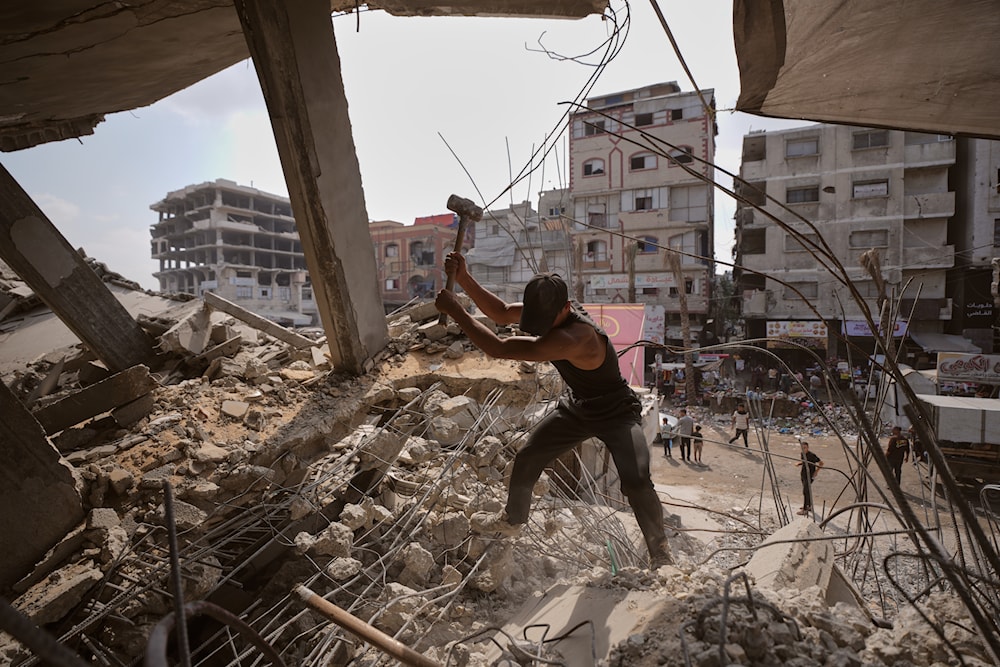
Palestinians remove iron from the rubble of buildings destroyed by Israeli airstrikes, repair and recycle it for construction, building tents or selling it, in Gaza City, Sunday, Aug. 16, 2026 (AP)
US Middle East negotiator Jared Kushner met Israeli Prime Minister Benjamin Netanyahu on Monday as Washington sought Israeli approval for a 15-point Gaza roadmap already accepted by Hamas, drawing renewed attention to Netanyahu's refusal to endorse a framework requiring Israeli withdrawal from the Strip.
The Associated Press framed the negotiations largely around Hamas' disarmament, but the dispute also centers on whether the Palestinian Resistance should relinquish its military leverage before "Israel" fulfills corresponding obligations to halt attacks and withdraw its forces.
Kushner's meeting with Netanyahu came after more than two hours of talks Sunday in Egypt with senior Hamas official Khalil al-Hayya on disarmament, withdrawal, and implementation of the roadmap. Representatives from Egypt, Qatar, and Turkey also attended.
Former British Prime Minister Tony Blair and "Board of Peace" Director Nickolay Mladenov later joined Kushner's meeting with Netanyahu.
The direct Kushner-Hamas talks are themselves significant, underscoring that Washington cannot easily determine Gaza's post-war arrangements without engaging the Palestinian Resistance.
Disarmament tied to Israeli withdrawal
Descriptions of the proposal as simply requiring Hamas to "disarm" obscure the conditions attached to the process.
Under the roadmap, Hamas' heavy weapons would be transferred, stored, or placed under Palestinian institutional control as a technocratic committee assumes responsibility for Gaza's administration. Israeli forces would meanwhile withdraw as implementation progresses.
The central dispute concerns which step comes first.
Netanyahu insists Hamas must fully relinquish its military capabilities before Israeli forces leave. Hamas has maintained that it will not take irreversible steps regarding its weapons while Israeli troops remain in Gaza and attacks continue.
During Sunday's talks, al-Hayya demanded an end to Israeli attacks and an initial withdrawal to the so-called "Yellow Line" before implementation begins.
For the Palestinian Resistance, relinquishing weapons first would surrender a major source of leverage while Israeli forces still control around 60% of Gaza, without a binding guarantee of full withdrawal.
Netanyahu said in May that Israeli control could expand to around 70%, with "Israel" “tightening the grip” on Hamas “from every direction.”
The "Yellow Line" has never been precisely defined, while Israeli forces have repeatedly moved beyond areas previously associated with it.
Hamas shifts pressure onto Netanyahu
Hamas' acceptance of the roadmap has allowed the movement to argue that the Israeli government is now obstructing progress.
Rather than rejecting negotiations over weapons altogether, Hamas has expressed willingness to address their future within a broader process involving an end to attacks, Israeli withdrawal, Palestinian administration, and political progress toward self-determination.
The position effectively tests whether Netanyahu seeks an actual end to the war or Palestinian disarmament while maintaining Israeli military freedom of action.
Netanyahu's demand would reverse the roadmap's reciprocal logic. Instead of withdrawal and demilitarization progressing alongside each other, Hamas would first surrender its military leverage while the extent and timing of Israeli withdrawal remain uncertain.
For Palestinians, that could amount to securing through negotiations what "Israel" failed to fully impose militarily, without guaranteeing an end to occupation and aggression.
Regional governments have also placed responsibility on "Israel".
Saudi Arabia, the United Arab Emirates, Jordan, Pakistan, and Indonesia joined mediators Sunday in criticizing Netanyahu's rejection.
“Israel now bears responsibility for obstructing the efforts to bring peace in Gaza,” their statement said.
They urged Washington and the "Board of Peace" to take “immediate and concrete measures” to prevent obstruction of the roadmap.
Governance and statehood remain unresolved
The focus on weapons also risks overshadowing Hamas' willingness to relinquish direct governance of Gaza.
Under the roadmap, a Palestinian technocratic committee would take over civilian administration. That position separates governance from resistance: Hamas has shown readiness to step aside administratively while insisting that Palestinian arms cannot be addressed independently of withdrawal and sovereignty.
The committee has not yet entered Gaza, while reconstruction and deployment of international forces remain stalled.
Hamas has also linked the ultimate disposition of its heaviest weapons to progress toward Palestinian statehood. The roadmap calls for a “credible pathway toward achieving Palestinian self-determination and statehood,” an objective rejected by Netanyahu's government.
That contradiction is central to the Resistance's position: if armed resistance is expected to give way to a political process, that process must provide a credible route toward sovereignty and an end to occupation.
Netanyahu, however, is seeking Hamas' disarmament while rejecting the Palestinian political outcome envisaged by the broader framework.
Read more: Hamas accepts roadmap for second phase of Trump’s Gaza plan


