
Marandi, Miller warn of renewed US war as Iran stands firm | Exclusive
 14 Min Read
Professors Mohammad Marandi and David Miller assess Iran’s refusal to normalize ties without MOU implementation, rising US pressure, and the shifting regional balance.
-
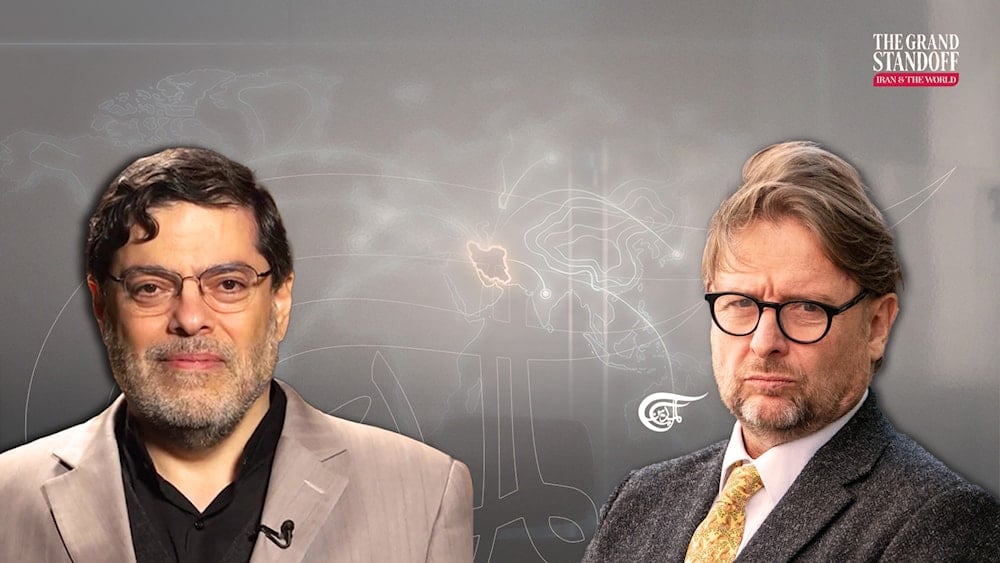
University of Tehran professor and analyst Mohammad Marandi (left) and investigative researcher, broadcaster, and academic professor David Miller, for Al Mayadeen's The Grand Standoff: Iran and The World (Al Mayadeen English)
Iran remains focused on securing the full implementation of its existing Memorandum of Understanding (MOU) with the United States, while Tehran prepares for the possibility of renewed US aggression, according to analyst and Professor Mohammad Marandi.
Investigative researcher, broadcaster, and academic Professor David Miller, on his part, said that Washington and “Israel” are seeking to preserve their strategic position despite growing limits on their ability to project power.
Speaking on Al Mayadeen's The Grand Standoff: Iran and The World, Marandi said Iran has little interest in further negotiations until Washington implements the commitments already contained in the MOU. Miller similarly argued that the United States cannot be trusted to honor agreements and suggested that Washington may seek another confrontation with Iran.
The two guests also addressed the situation in the Strait of Hormuz, US military deployments in the region, the role of Britain and other Western governments, and what they view as a broader shift in the balance of power.
Changing attitudes toward 'Israel'
Marandi began by pointing to a significant change in attitudes toward “Israel” across Western societies, particularly among younger generations.
Drawing on his experiences in several countries over the past three years, he said the mood among elites, academics, and sections of the public had become increasingly hostile toward the Israeli occupation regime. He also pointed to changing attitudes among young Jewish people in the United States, citing a recent poll in which 44% of Jewish people under 35 supported Jews and Palestinians living alongside one another as equal citizens.
“That is a sea change,” Marandi said, arguing that the generational divide would continue to widen because many of those who support the Israeli occupation regime in the West are older, while opposition is stronger among younger people.
He linked this shift to developments in the region, arguing that US-aligned governments had been discredited during the conflict.
According to Marandi, governments ranging from NATO members to regional monarchies and states that publicly claim to support the Palestinian cause have been exposed by their conduct over the past three years.
He said the resulting decline in US influence was also connected to military setbacks against Iran and Yemen, as well as the weakening of Washington’s regional partners.
While acknowledging the destruction and loss of life caused by the war, including among people he knows in Iran, Lebanon, and Gaza, Marandi stated that the broader political outcome had been damaging to Zionism.
“This journey has been a defeat for Zionism,” he said, adding that he believed Zionism would ultimately fail in the coming years.
Iran demands MOU implementation, not new negotiations
Turning to the diplomatic process, Marandi said Washington's position on Iran's nuclear program had shifted from earlier demands for the complete dismantling of Iran's nuclear activities and restrictions on its missile and drone capabilities toward discussions focused on reducing uranium enrichment.
He described this as a form of US retreat, but said it would not be enough to bring Tehran back to negotiations.
“At the end of the day, the only thing that matters for Iran is the full implementation of the MOU,” Marandi said.
Speaking on Wednesday’s episode of The Grand Standoff: Iran and the World, Professor Mohammad Marandi said the US tone has changed, noting that Washington previously called for Iran to end its nuclear program altogether and restrict its missile and drone capabilities. He said the US is now speaking instead about reducing Iran’s uranium enrichment, adding that this is “a retreat of sorts” by Washington. However, Professor Marandi said Iran is not interested unless the United States moves to fully implement the memorandum of understanding (MoU). “Nothing that comes from the Trump regime is of any value to Iran,” Professor Marandi said, stressing that Iran does not trust the United States, “and it does not trust the Trump regime in particular.” @s_m_marandi #AlMayadeen #Iran #IranWar #WestAsia #USA
— Al Mayadeen English (@MayadeenEnglish) October 8, 2026
He acknowledged that there is debate within Iran over whether to continue pursuing the current approach or adopt a harder political position toward Washington. But he maintained that Tehran does not trust the Trump administration and sees previous negotiations as evidence that US commitments cannot be taken at face value.
Marandi pointed to negotiations mediated by Oman before the war, saying progress had been announced before the United States launched its attack.
He also recalled the period following the fighting, when a ceasefire was undermined by Israeli airstrikes, in his assessment, and Trump ultimately sided with Netanyahu.
The experience, he said, reinforced Tehran's insistence that Washington must act rather than issue statements.
“The only thing that matters is the implementation of the articles,” Marandi said, referring to provisions concerning Lebanon, Gaza and Iran's assets, among other issues.
He stressed that messages may continue to pass between Washington and Tehran through mediators, but that there are no direct negotiations.
Gaza, Lebanon and Yemen tied to MOU implementation
Marandi said Iran's interpretation of the MOU places particular importance on provisions relating to the regional wars.
He said Article 1 requires the genocide in Gaza to end completely, alongside a full Israeli withdrawal from Lebanon, recognition of Lebanese sovereignty, and an end to Israeli attacks on Lebanon.
He added that provisions concerning Yemen and Iraq are also part of the framework outlined by Iran's Supreme National Security Council.
For Tehran, therefore, Marandi argued that the question of reopening the Strait of Hormuz and normalizing the broader situation cannot be separated from implementation of the MOU.
Unless those commitments are fulfilled, he said, Iran has no reason to consider the situation normalized.
Marandi rejects claims of normality in Hormuz
Marandi also challenged portrayals of the Strait of Hormuz as operating normally.
He cited comments by US Senator Richard Murphy following a visit to the Gulf, saying the senator had pointed to LNG shipments being significantly below their pre-war levels.
Marandi said similar restrictions applied to other products moving through the Strait, including sulfur, helium, gasoline, and diesel.
Speaking on Wednesday’s episode of The Grand Standoff: Iran and the World, Professor Mohammad Marandi said that exports passing through the Strait of Hormuz, including sulfur, helium, gasoline, and diesel, have been severely restricted, with the volume of goods leaving the strait significantly reduced. Addressing a hypothetical scenario in which the United States launches a major assault on Iran and attempts to take control of the Strait of Hormuz, Professor Marandi cited a study by a retired four-star US general estimating that it would require 150,000 US troops and months of fighting to seize the strait. He added that such a scenario would be “almost impossible,” noting that the United States does not even have the necessary troop numbers. @s_m_marandi #AlMayadeen #Iran #IranWar #WestAsia
— Al Mayadeen English (@MayadeenEnglish) October 8, 2026
He distinguished between benchmark oil prices and the physical market, arguing that the price of an actual barrel of oil was significantly higher than the figures displayed on financial markets.
He also contrasted the current level of shipping with the period before the war, when he said between 130 and 140 ships passed through the Strait each day. He said the figure had since fallen at times to single digits or around 10 to 20 vessels.
Marandi attributed a temporary increase in crude oil flows around President Masoud Pezeshkian's trip to the United Nations to Tehran's desire to avoid escalation during a period of heightened diplomatic activity involving Washington and Beijing.
He said that period had since ended and argued that there had been no return to normal conditions.
Iran retains options if Hormuz faces military assault
Addressing the possibility of a US military attempt to seize the Strait, Marandi argued that such an operation would be extremely difficult.
He cited the assessment of a retired US four-star general who estimated that taking control of the Strait would require 150,000 US troops and months of fighting.
Even in such a scenario, Marandi argued, Iran could retain the ability to target ports and energy infrastructure.
He pointed to retaliatory strikes on Saudi infrastructure by Yemen as an indication of the potential vulnerability of regional energy facilities.
Marandi also warned that Iran would respond to imminent threats, without setting out a fixed list of red lines.
He raised particular concerns over armed groups in northern Iraq, arguing that their activities represented a threat to Iraqi sovereignty and national security.
Marandi further argued that US and Israeli policy ultimately seeks to weaken and fragment Iraq, saying that Tehran would act against targets it considered immediate threats to Iran.
Tehran prepares for possible renewed US attack
Marandi said the statements of Iranian military officials should be viewed against the backdrop of a serious expectation in Tehran that the United States could launch another attack.
He stressed that an attack was not certain, but said the possibility was considered high.
The timing, he added, remained unclear. It could come before the US midterm elections, before Netanyahu's elections, or afterward.
For Marandi, the US military forces assembled in the region indicate that Washington has maintained the capability for a major attack.
He interpreted recent military statements as a direct warning not only to Washington and “Israel,” but also to regional governments assisting them.
Marandi said Iran's response to a new war would not necessarily be limited to US military installations.
He argued that countries assisting Washington in efforts to pressure Iran had already been warned that their economic assets could become targets.
“If war starts, it is going to be different,” he said, adding that Iran's response would be “much more heavy-handed and much broader.”
Marandi further warned that a prolonged confrontation could place additional pressure on US-aligned governments in the region, which he said were already weakened.
Miller: Western governments face growing public pressure
Professor Miller approached the broader war from the perspective of Western political developments, particularly in Britain.
He argued that public attitudes have changed significantly while governments have remained largely committed to existing policies.
Miller pointed to Palestine Action as an example of direct action in Britain, saying the group had targeted Elbit facilities before being designated a terrorist organization by the British government.
He argued that such movements had not yet generated sufficient pressure to significantly constrain British or US policy.
For Miller, the main capacity to pressure Washington and the Israeli occupation regime therefore remains with the Resistance forces in the region.
He also argued that the US administration has sent contradictory messages throughout the war and maintained that Washington would not implement the MOU.
In his assessment, the central question is whether “Israel” can draw the United States into another war against Iran.
Miller pointed to attempts to create narratives that could justify further escalation, including an incident involving claims of an Iranian-linked threat to RAF Fairford in Britain.
He argued that the episode failed to establish a lasting case for escalation but was subsequently reinforced by statements from Israeli and British officials.
Read more: Araghchi rejects UK's Fairford claim: 'Barking up the wrong tree'
Miller points to US military deployments
Miller also highlighted significant US military buildup.
He referred to the deployment of roughly 4,000 Marines from San Diego to West Asia with a battle group, noting their specialization in amphibious operations.
He interpreted the deployment as potentially connected to preparations for an invasion of Iran, while acknowledging that it could still be called off.
Miller said the history of broken agreements had reinforced his view that Washington could not be trusted. He also questioned the idea that Hormuz represents Iran's only major source of leverage.
According to Miller, Iran's ability to pressure Washington extends beyond the Strait and includes the broader military and strategic pressure being exerted against US positions across West Asia.
US military posture faces a wider challenge
Miller argued that the war had significantly altered the US military position in the region.
He pointed to the destruction of US bases, troop withdrawals, and the movement of US aircraft carriers away from areas surrounding the Gulf, Hormuz, and the Red Sea.
For Miller, these developments represented a major strategic setback for Washington and “Israel.”
He argued that “Israel” remains heavily dependent on US military power and that new arrangements integrating US and Israeli forces provide the Israeli military with greater access to US capabilities.
Miller said the strategic consequences extend beyond Hormuz and oil prices, pointing to a broader change in public opinion and in the methods used to challenge US and Israeli policy.
He argued that the question going forward is what political and military conditions could bring the conflict to an end on terms favorable to Iran, Ansar Allah, Hezbollah, and wider populations affected by the war.
Britain remains aligned with Washington
Miller also rejected the prospect of Britain serving as a moderating force in US policy.
He argued that successive British governments have remained closely aligned with Washington and “Israel,” despite growing public opposition and some changes in domestic political discourse.
He pointed to Britain's continued intelligence cooperation with “Israel” and argued that limited sanctions or other policy measures would not fundamentally alter London's position.
According to Miller, the same pattern extends to NATO states more broadly, which he said remain aligned with US foreign policy despite growing tensions over Washington's approach to Europe.
He also argued that US policy under Trump had sought to increase European dependence on US energy while weakening European economic and industrial independence.
For Miller, this helps explain why European governments continue to support Washington despite policies that undermine their own interests.
A crisis of US hegemony
Miller ultimately placed the war within a broader crisis of US power.
He argued that the inability of the United States and its allies to achieve their objectives despite possessing some of the world's largest military forces demonstrated growing limits on Washington's ability to project power.
He pointed to YAF's ability to challenge US forces as particularly significant, arguing that the outcome would have been difficult for mainstream Western analysts to anticipate several years ago.
Miller said discussion of a “strategic defeat” was increasingly appearing on the margins of mainstream analysis, whereas such an assessment would previously have been difficult to imagine.
For him, the broader issue is therefore no longer simply the outcome of the confrontation with Iran, but the future of US hegemony. He argued that “Israel” is seeking to make greater use of US military power to advance its own strategic objectives and warned that this dynamic would continue unless it was stopped.
What comes next for Iran and the US?
According to Marandi, Iran has already made its conditions clear: Washington must implement the MOU before Tehran considers further concessions or normalization.
For him, the continued pressure around Hormuz provides Iran with leverage while the possibility of renewed US aggression requires Tehran to prepare for a much wider confrontation.
Miller similarly argued that Washington cannot be relied upon to honor its commitments and that the possibility of another war remains central to the calculations of both sides.
Their assessments converge on a broader point: the confrontation is no longer confined to negotiations over Iran's nuclear program or the reopening of the Strait of Hormuz. It has become part of a wider struggle over the future of the regional security order and the ability of Washington and its allies to maintain their influence.
For Marandi, the central question is whether the United States will implement the commitments it has already made. For Miller, it is whether Washington and “Israel” can continue to rely on US power to preserve a regional order that he argues is already changing.
The unresolved question, as both assessments suggest, is whether the next stage will be defined by implementation and de-escalation or by another round of military confrontation.


