
Merz: No grounds for US military intervention in Cuba
 4 Min Read
German Chancellor Friedrich Merz has rejected any justification for a US military invasion of Cuba, as Washington escalates its regime change campaign against Havana.
-
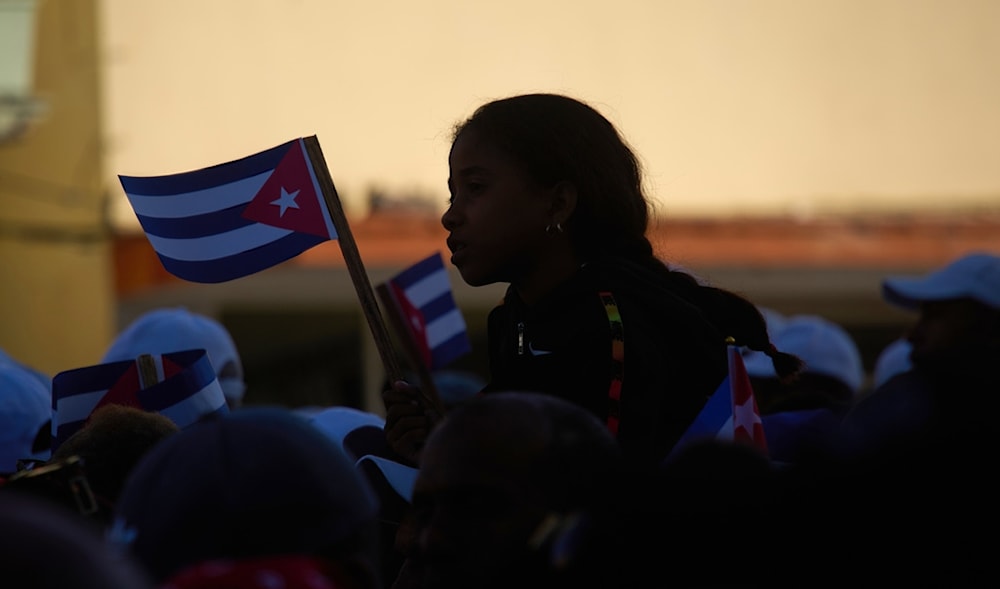
A little girl holding a Cuban flag is silhouetted against a dawn sky during a celebration marking the 65th anniversary of the proclamation declaring the Cuban Revolution socialist, in Havana, Cuba, Thursday, April 16, 2026. (AP Photo/Ramon Espinosa)
German Chancellor Friedrich Merz has pushed back against the possibility of a US military invasion of Cuba, claiming that no justification for such an intervention exists, despite the US abducting Venezuelan President Nicolas Maduro in January of this year and showing a clear intent of seeking regime change in Cuba.
"There is no obvious reason for invading Cuba," Merz said at a press conference in Hanover on Tuesday. "Despite all the problems that country faces in domestic politics under the communist regime, Cuba poses no visible threat to third countries outside its borders."
Merz drew a line between political disagreement and military pretext. "Defense capability does not mean the right to military intervention in other states if their political systems do not correspond to the views of others," he said, while adding that he doubted Washington would ultimately follow through on any such operation.
His remarks came after US President Donald Trump openly signalled that Cuba would be Washington's next regime change target, following the ongoing US-Israeli war on Iran.
The Pentagon, responding to questions from RIA Novosti about reports of operational planning, confirmed it was ready to carry out Trump's orders without elaborating further.
A campaign of escalating pressure
Washington's drive against Cuba has been building since January, when US forces kidnapped Venezuelan President Nicolás Maduro in a military assault, after which US Secretary of State Marco Rubio warned that Cuba's government should be "concerned."
Trump moved quickly to isolate the island. On 29 January, he signed an executive order declaring a national emergency and authorising tariffs on any country supplying oil to Cuba, in what the New York Times described as the harshest blockade on the island since the Cuban Missile Crisis.
Washington has explicitly confirmed that regime change in Cuba is a goal by the end of the year.
In March, Trump told reporters he expected to have "the honor of taking Cuba." At a rally in Phoenix last week, he declared that US military strength would bring "a new dawn for Cuba," telling the Cuban-American crowd the moment had been "70 years in the making." On April 13, he told reporters at the White House he "might stop in Cuba" once the war on Iran ends.
Reports emerged this week that Pentagon officials received a White House directive to accelerate preparations for possible military operations against Cuba, driven by Trump's frustration with President Miguel Díaz-Canel's defiance in spite of the blockade.
READ MORE: Ben Jeddou honors martyred journalists at Havana media forum
A population under siege
The blockade's toll on ordinary Cubans has been severe. Cuba's national electric grid collapsed twice in March, forcing hospitals to suspend operations and schools and businesses to close.
According to the UN Human Rights Office, the fuel shortage has threatened Cuba's food supply, disrupted water systems and hospitals, and hampered UN World Food Programme relief efforts still ongoing after Hurricane Melissa. Ambulances are struggling to find fuel to respond to emergencies, and flights carrying vital supplies have halted after Havana lost the ability to refuel outbound aircraft.
UN human rights experts have condemned the blockade as "a serious violation of international law" and "an extreme form of unilateral economic coercion," warning that measures likely to cause shortages of essential goods may amount to the collective punishment of civilians.


