
NATO undergoes loyalty test as Washington reconsiders US troops: FT
 4 Min Read
US is assessing NATO allies’ support for its Iran war and broader foreign policy as it reviews future troop and weapons deployments across Europe.
-
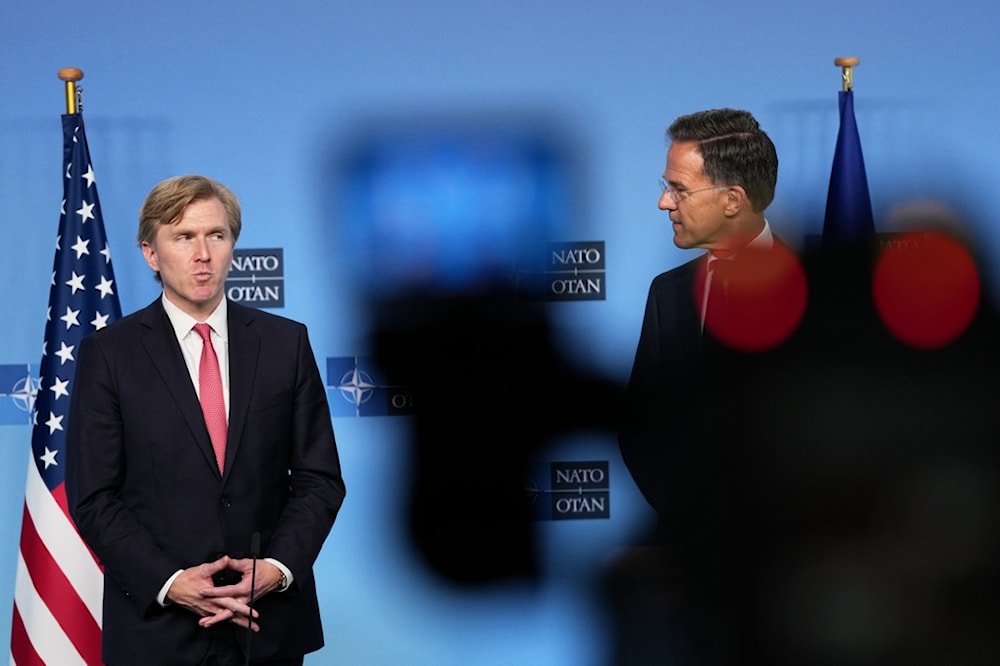
NATO Secretary General Mark Rutte, right, and United States Under Secretary of Defense Elbridge Colby address the media at NATO headquarters in Brussels, Thursday, Aug. 27, 2026 (AP)
The United States is examining how closely its NATO partners align with Washington's foreign policy as the Pentagon reviews the future of American troops and weapons stationed across Europe, the Financial Times reported.
European governments have begun submitting responses to a questionnaire circulated by Washington this month that asks allies not only about their military capabilities and defense commitments, but also about their political support for US policies.
The exercise comes as the Trump administration pushes European members of NATO to assume a larger share of responsibility for the continent's defense while considering potential changes to the US military presence in Europe.
Supportive of US foreign policy priorities or not?
Among the questions sent to allied governments are whether they are "publicly supportive of US foreign policy priorities" and whether they restricted the use of their territory, airspace or military facilities during Washington's war on Iran.
Some European capitals reportedly view the questionnaire as an attempt to measure their political reliability under the administration of US President Donald Trump.
Pentagon policy chief Elbridge Colby said Washington had deliberately asked allies to formally state what they were prepared to provide.
"The questionnaire is designed to give allies a clear sense to put in writing, formally, their responses, what they want us to know. We’re not hiding the ball at all," Colby told reporters after meeting NATO ambassadors.
"We just received some of the questionnaires, so we’re looking forward to reviewing them."
War on Iran access emerges as key issue
Washington is paying particular attention to restrictions imposed on US forces during the war on Iran, when some European governments limited the use of bases or airspace for American military operations.
Addressing the issue, Colby said the United States expected greater certainty regarding its ability to operate from military facilities located in allied countries.
"We’re not looking in every context for a complete carte blanche, but we’re saying that we need to be able to have the ability to operate effectively, we need predictability."
"That wasn’t always in evidence during Operation Epic Fury, and that led to the president’s justified frustration," he added, using Washington's designation for its bombing campaign against Iran.
Trump had previously criticized NATO partners that he accused of failing to sufficiently support the US military campaign.
The inclusion of questions regarding the Iran war has consequently raised concerns that an ally's willingness to support future US military operations could influence decisions over American deployments in Europe.
European governments fear consequences for US troop presence
Several NATO members are reportedly concerned that their responses could be factored into an ongoing Pentagon review examining the future distribution of US forces across the continent.
The review is expected to be completed by the end of the year and comes as Washington pressures European states to fill major military capability shortages.
US officials have reportedly described NATO assessments of European military readiness as a "sea of red," referring to the large number of shortcomings identified under the alliance's traffic-light evaluation system.
Colby maintained that Washington was not attempting to impose unconditional demands on its allies.
"We’re not coming in here and dictating. We’re saying: ‘What is in your questionnaire? What are you prepared to offer?’ And we’re gonna look at the different alternatives and make sure that that’s fit for purpose," he said.
He added that Washington maintained "reasonable expectations" of NATO partners.
The questionnaire forms part of the Trump administration's effort to reshape the alliance around what officials have described as "Nato 3.0", under which European states would take on substantially greater responsibility for conventional defense while the United States reassesses the scale and location of its military presence.
The process has heightened concerns among European governments that Washington's security commitments could increasingly depend not only on defense expenditure and military readiness, but also on political alignment with US foreign policy.
Read more: War on Iran decisive factor behind missile stocks depletion


