
Netanyahu hated everywhere, in north settlements, across world: Polls
 6 Min Read
Netanyahu’s support in northern occupied Palestine is falling sharply amid the war on Lebanon, as global surveys show worsening perceptions of "Israel" and its leadership.
-
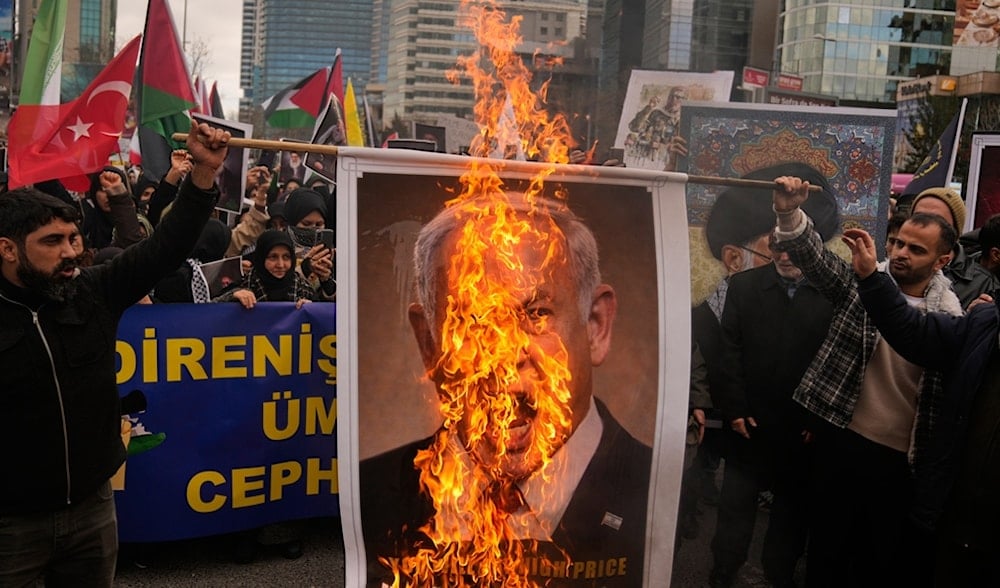
Demonstrators burn a picture of Israeli Prime Minister Benjamin Netanyahu during a protest outside the Israeli consulate in Istanbul, Sunday, March 1, 2026. (AP)
Support for Israeli Prime Minister Benjamin Netanyahu in the northern settlements is rapidly collapsing as the war on Lebanon and Hezbollah's defensive operations continue, while favorability for "Israel" crumbles worldwide, new polls revealed.
The dual pressures highlight a widening gap between domestic electoral volatility and growing international criticism of "Israel’s" conduct in the aggressions it has launched and of its political leadership.
Occupied north turns away from Likud
The findings come as voters in the region increasingly turn away from Netanyahu’s Likud party, blaming the government’s handling of the war against Lebanon and demanding a tougher security posture.
The May survey, carried out by Agam Labs at the Hebrew University and shared exclusively with Reuters, shows a significant drop in support for Likud in northern occupied Palestine compared to the last election.
Only 23% of northern settlers said they would back Likud in the next election, down from 35% in 2022, with losses in the region significantly steeper than elsewhere in the entity. The poll also found that roughly 70% of respondents in the occupied north disapprove of the government’s handling of the war on Lebanon, underscoring growing regional frustration.
In illegal settlements such as Kiryat Shmona, where Likud previously enjoyed strong support, settlers say ending the "threat from Hezbollah" remains the dominant political issue.
Ceasefire agreement fails to ease voter anger
The so-called "ceasefire" announced by Washington earlier this week also failed to ease political tensions in the occupied north, where many settlers view it as insufficient or fragile. "Israel" has continued launching airstrikes and invading Lebanese territories, while Hezbollah has expanded its scope of operations beyond the occupied border in response.
Some settlers told Reuters they believe Netanyahu is under pressure from Washington to scale back the aggression, weakening "Israel’s" military posture at a critical moment.
“I’m not ashamed to say that I voted for this government, but it turns out that the one managing it is President Trump,” one settler said, reflecting frustration among some northern voters.
Read more: Ben-Gvir slams Lebanon-'Israel' ceasefire agreement as 'big mistake'
Opposition gains favor instead
Netanyahu’s critics, including political rivals, have seized on the issue, accusing him of compromising security ahead of elections expected by October. His opponents have focused their campaigns on the north to appease voters.
The Agam Labs poll suggests a broader shift in the region, with support for the wider right-wing bloc also declining, while a growing share of voters indicates they may back opposition parties in the upcoming election.
Researchers say the trend marks a significant reversal in a region that previously leaned strongly toward Likud. “We see a dramatic shift,” said Nimrod Nir of Agam Labs, describing the change in northern voting patterns as a near reversal of past electoral behaviour.
“He should come visit,” said Yisrael Cohen, a former Likud voter from Kiryat Shmona. “The government needs to see us.”
Of 36 countries, none view 'Israel' positively
At the same time, a sweeping global survey by the Pew Research Center indicates a notable decline in "Israel’s" international standing, alongside weakening confidence in Netanyahu across several countries, including key allies.
The study, which polled 44,657 respondents across 36 countries, found that 67% of adults hold a negative view of "Israel", compared with 25% who view it positively.
According to the survey, negative sentiment toward "Israel" has increased in 13 of the 24 countries where Pew tracks long-term trends, pointing to a broad and sustained shift in global attitudes, including among traditional partners.
This deterioration was most pronounced in South Korea (+10 percentage points), Germany (+9), Argentina (+9), and Nigeria (+9). Additional rises of between +5 and +8 points were recorded in countries such as Poland, Australia, and Canada.
Across Europe, critical views were particularly strong, with Italy, Spain, and the Netherlands standing out for especially high levels of disapproval. In the United States, negative perceptions rose by 7 percentage points compared with last year, while in Britain they increased by 8 points.
Even in Hungary, often seen as one of Netanyahu’s more supportive European partners, 54% of respondents expressed an unfavorable view of "Israel".
Current generation shuts 'Israel' out
The survey also highlights sharp generational gaps, particularly in Western countries. In the United States, 74% of adults aged 18–34 expressed a negative view of "Israel", compared with 49% among those aged over 50.
Political divisions were equally pronounced. In the US, 83% of self-described liberals held negative views of "Israel", compared with 37% of conservatives, with similar ideological splits emerging across several European democracies.
Across all 36 countries surveyed, none recorded a majority with a positive view of "Israel", underscoring the depth of the shift in global opinion.
Netanyahu unpopular all around
Survey respondents were also asked about their confidence in Netanyahu’s ability to “do the right thing regarding world affairs,” with majorities in most countries reporting limited or no confidence in his leadership.
In the United States, 59% of respondents said they did not trust Netanyahu, compared with 27% who expressed confidence. Among American Jews, the poll showed a clear split between attitudes toward "Israel" and its prime minister: while 64% held a favourable view of "Israel", 56% said they had little or no confidence in Netanyahu.
Across Europe, scepticism was widespread. In countries including France, Germany, Britain, Sweden, Spain, and the Netherlands, more than half of respondents said they lacked confidence in the Israeli ICC-wanted prime minister. Italy recorded the highest level of distrust, at 88%.
South Korea showed the sharpest shift, with the share expressing little or no confidence in Netanyahu rising from 64% to 76% over the past year.
Read more: You're f****** crazy: Trump scolds Netanyahu for Lebanon escalation


