
Oil may hit $200 as war on Iran triggers energy shock: Bloomberg
 4 Min Read
Oil prices could surge to $200 per barrel while Europe faces a worsening gas crisis as the war on Iran disrupts Strait of Hormuz flows and damages Qatari LNG supply.
-
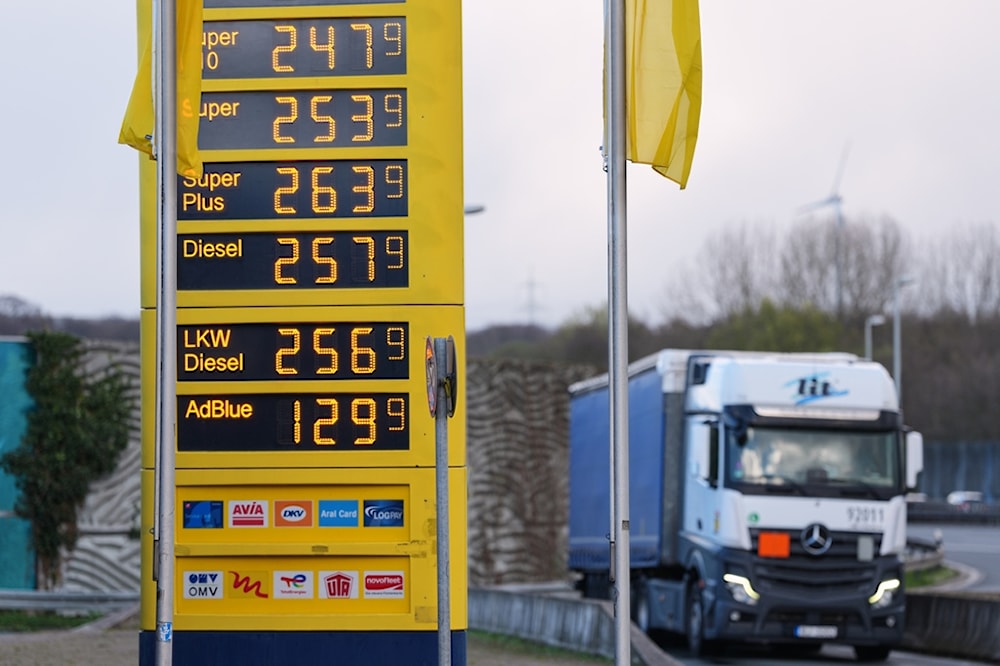
A fuel station shows record prices during the oil crisis due to the war in Iran in Gelsenkirchen, Germany, Thursday, March 26, 2026 (AP)
Oil prices could climb to as high as $200 per barrel if the war on Iran continues into June, with the Strait of Hormuz remaining shut, Bloomberg reported on Friday.
Citing analysts at Macquarie Group, Bloomberg said a prolonged closure of the strategic waterway could push prices to historically high levels in real terms. The analysts assigned a 40% probability to this extended scenario, while estimating a 60% chance that the war could end by the close of March.
Brent crude was trading near $107 per barrel on Friday after reaching $119.50 earlier this month, putting it on track for a sharp monthly gain. Analysts warned that if the Strait remains closed, prices would need to rise significantly to suppress global demand on an unprecedented scale, with the timing of any reopening and the extent of infrastructure damage shaping the long-term impact.
Recent market movements point to the scale of the disruption already underway. Brent futures rose about 6% in a single session on Thursday to close at $108 per barrel, marking the largest one-day increase in two weeks, while prices have surged nearly 50% so far in March amid the ongoing war on Iran. Equity markets have also come under pressure, with the Nasdaq falling 2.4% into correction territory, while the S&P 500 and Dow Jones Industrial Average posted notable declines.
The projections come as the Wall Street Journal reported that the same aggression has triggered a parallel crisis in global natural gas markets, particularly affecting Europe.
According to the report, the war has halted Qatar’s liquefied natural gas production, effectively trapping around 20% of global LNG supply behind the Strait of Hormuz, while Iranian retaliatory strikes have caused damage to key facilities that could take years to repair.
Europe supply crisis
The disruption has once again exposed Europe’s structural dependence on external energy sources. Despite efforts to reduce reliance on Russian gas since 2022, European economies remain heavily dependent on imported LNG, leaving them vulnerable to geopolitical shocks.
Countries such as Italy, which rely extensively on gas for power generation, are facing acute supply risks, prompting officials to seek alternative sources, including Algeria. However, Algeria’s capacity to increase supply remains constrained by infrastructure limitations and rising domestic demand, making it unlikely to fully compensate for the loss of Qatari LNG in the short term.
At the same time, US LNG exports, positioned as a replacement for Russian gas, are facing growing global competition, further tightening supply and reinforcing Europe’s exposure to external pressure.
Market turmoil
Beyond energy markets, the impact of the war is increasingly reverberating across the global economy. Analysts warn that sustained disruptions to oil and gas flows risk triggering a broader economic slowdown, as rising energy costs feed into inflation, increase transportation and industrial expenses, and strain household consumption. Estimates suggest the shock could cut global growth while pushing inflation higher, raising the risk of stagflation conditions similar to past oil crises.
Financial markets have already shown signs of stress, with rising borrowing costs and increased volatility reflecting uncertainty over the duration of the war and its economic fallout. At the same time, disruptions to a critical trade artery such as the Strait of Hormuz are placing renewed pressure on global supply chains, particularly for energy-importing economies in Europe and Asia.
Read more: India revisits Russian energy ties amid supply shocks


