
Only 29% of midterm voters approve Trump's approach to Iran
 4 Min Read
Trump’s standing on Iran has fallen sharply among highly motivated voters, with approval dropping 24 points in two years, new polling shows.
-
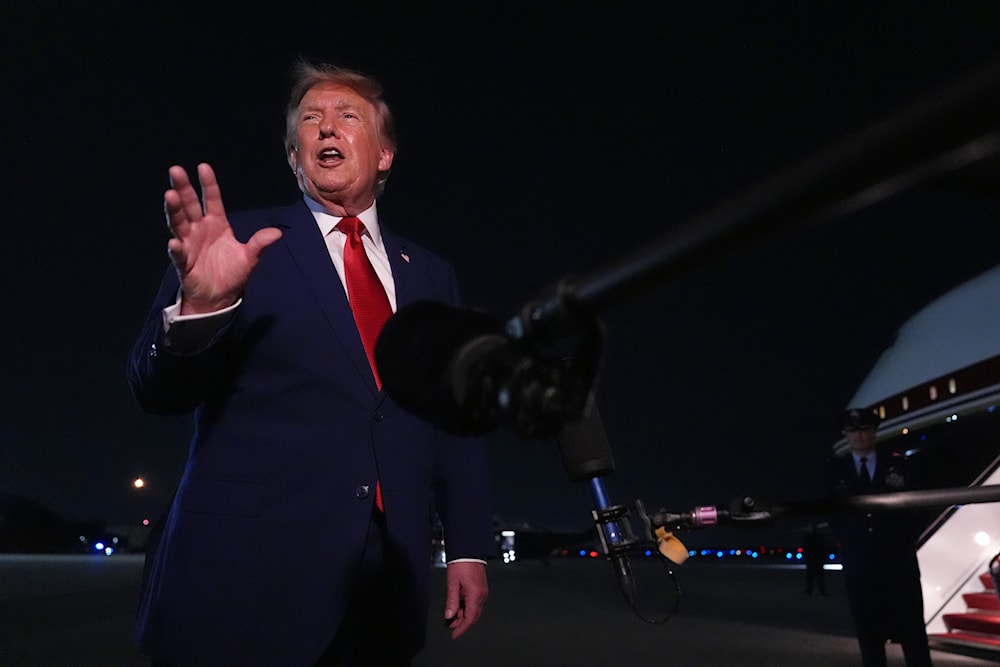
President Donald Trump talks to reporters after arriving on Air Force One on August 11, 2026, at Joint Base Andrews, Md (AP)
Cable News data analyst says new polling reveals a sharp decline in US President Donald Trump’s standing with highly motivated voters on the issue of Iran, with approval dropping 24 percentage points over two years. The assessment, based on surveys conducted in July 2024 and July 2026, points to growing dissatisfaction among a key electoral demographic.
CNN chief data analyst Harry Enten said on Tuesday that a July 2024 poll of people who were extremely motivated to vote in that year’s presidential election found that 53 percent were confident that Trump would be able to handle the situation in Iran, according to a video clip posted online. However, a July poll of people extremely motivated to vote in November's midterm elections shows that just 29 percent now approve of how Trump is actually handling Iran, Enten told The Independent.
"We're talking about a 24-point fall in just two years," Enten said. "What was an advantage for President Trump going into the 2024 election amongst those who really wanted to turn out and vote has turned into a tremendous disadvantage this time around." Enten added that "promises were made and promises were not kept. They were broken as far as those voters were concerned."
White House defends President’s approach amid polling shifts
In response to the polling data, a White House spokesperson pushed back against the notion that public opinion should guide national security decisions, emphasizing the president’s focus on tangible action. The statement did not directly address the specific approval figures cited by Enten.
In a prepared statement, White House spokesperson David Ingle told The Independent, "What matters most to the American people is having a Commander-in-Chief who takes decisive action to eliminate threats and keep them safe, which is exactly what President Trump is doing." Ingle added, "The President does not make these incredibly important national security decisions based on fluid opinion polls or political pundits, but on the best interests of the American people".
The remarks came as Enten’s analysis highlighted broader partisan concerns for Republicans, who have historically held an advantage on national security issues. According to Enten, polling on which political party is more trusted to deal with wars, conflicts and terrorism also spells trouble for the GOP.
Republican advantage on security eroding
Enten noted to The Independent that the Republican Party’s traditional edge over Democrats on matters of war and terrorism has evaporated, according to the survey data. He said that shift is directly linked to the president’s performance on Iran.
Enten said that the Republican Party was ahead of Democrats by 18 percentage points on the trust question in January 2025. "That advantage, because of President Trump, has turned into a disadvantage on a core, key question that almost always favors Republicans. Now, Democrats have a two-point edge," he said.
The analyst described the erosion of Republican trust on foreign policy as a significant development, given the party’s longstanding dominance in that area. He attributed the reversal specifically to voter perceptions of the current administration’s approach to Iran.
Voter pessimism on Iran deal prospects crosses party lines
Enten also identified what he called "perhaps the most shocking thing" in the data: widespread skepticism that the US will ultimately secure a favorable agreement with Iran. He said the lack of confidence spans the entire electorate, including a majority of Republican voters.
Enten said that just 27 percent of all voters believe the US would "ultimately reach a good deal with Iran." He added, "Just 41 percent of Republicans believe it. We are seeing below 50 percent across the board on this issue."
"This is the reason I think, more than any other, that folks disagree with Trump on Iran because they, simply put, don't see what the point of it is," Enten said. "They don't see a way out of it."


