
Rising costs put Trump, GOP on shaky ground before midterms: WSJ
 4 Min Read
Republicans are losing their traditional advantage in the US economy as persistent inflation, rising living costs, and the economic fallout from the war on Iran fuel voter dissatisfaction.
-
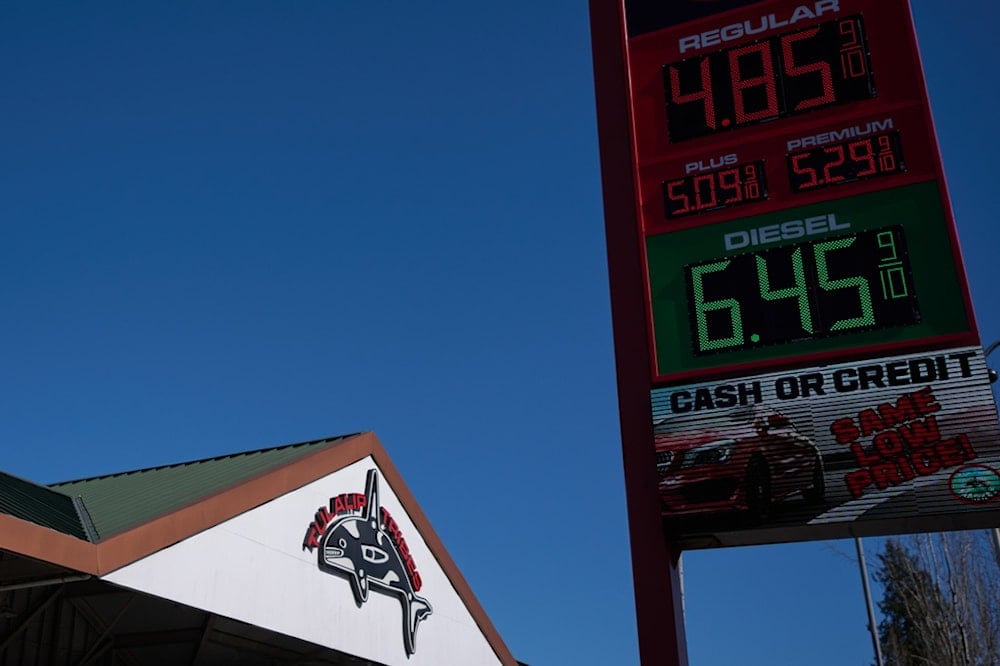
Lower-cost gasoline prices are displayed on the main sign at the Tulalip Market gas station on the Tulalip Indian Reservation land, Wednesday, April 8, 2026, in Tulalip, Wash. (AP)
Republicans are facing growing political pressure ahead of the November midterm elections as voters increasingly blame President Donald Trump and his party for persistent cost-of-living pressures, threatening what has traditionally been one of the GOP’s strongest electoral advantages, The Wall Street Journal reported.
Republican strategists and pollsters told the newspaper that concerns over household expenses are becoming increasingly specific, with voters paying close attention to electricity bills, healthcare costs, groceriesو and other everyday necessities.
Mitchell Brown, a Republican pollster conducting focus groups in battleground states, said voters are now acutely aware of what they are paying.
“They know exactly, to the dollar, the amount of their power bill,” he said.
The trend has raised concerns that some voters who backed Trump in 2024 on expectations that he would lower living costs could either abstain or shift away from Republicans in November.
“The set of events that would need to happen to produce a real change in the Republican Party’s fortune is pretty big,” Vanderbilt University political scientist John Sides said.
Slowing growth and persistent inflation
While the US economy has avoided a sharp downturn, growth has slowed and inflation remains elevated. Gross domestic product expanded at an annualized 1.9% over the six quarters through June, compared with 2.4% during former President Joe Biden’s final year.
Unemployment stood at 4.1% in July, only slightly above its January 2025 level, although job growth has weakened.
Inflation, meanwhile, reached 3.5% in June compared with a year earlier, up from 3% in January 2025. Average hourly earnings rose at the same 3.5% pace, effectively limiting real wage gains.
Public perception remains deeply negative
Despite relatively resilient stock markets and consumer spending, public perceptions remain far more negative. Several surveys cited by the Journal found that only around one-quarter of respondents view the economy as good or excellent.
That dissatisfaction has also reshaped perceptions of which party is better equipped to manage economic policy.
Fox News polling showed Democrats leading Republicans on the economy by four points in April and nine points in July. By contrast, Republicans held advantages of as much as 15 points on the same issue in 2022 and 2023.
Electoral risks and internal Republican concerns
Republican strategist David Winston warned in June that the shift could have serious electoral consequences.
“If Democrats could sustain leads on the economy and win double digit margins among independents as some polls show, a Blue Wave is possible,” he wrote.
Americans for Prosperity Action has meanwhile found that roughly one in five Republican-leaning voters in swing states may be at risk of staying home or defecting, largely because of economic concerns.
White House response and economic blame game
The Trump administration has attributed much of the dissatisfaction to higher energy costs stemming from the ongoing war on Iran.
“Oil prices—along with overall inflation—will plummet again when President Trump forces a successful resolution with Iran,” White House spokesperson Kush Desai said. “The Trump economic agenda has a proven track record of raising real wages, creating jobs, and securing key investments.”
The Journal, however, noted that several major cost pressures can be linked directly to Trump administration decisions. Gasoline prices have risen amid the war on Iran, while tariffs have contributed additional upward pressure on prices.
“The specific economic circumstances we’re dealing with are not really necessarily an inheritance from a previous administration. They are due to very specific decisions that this administration has made,” Sides said.
Republicans hope for late economic relief
Republicans are hoping that falling prices before the election could still reverse voter sentiment.
“People are in constant contact with prices,” Winston said. “So, if in October people start walking into grocery stores and gas stations and say, ‘I can now handle the cost of living,’ that is the decisive moment.”
Still, Democrats have yet to fully capitalize on Republican weakness. Polling shows voters remain dissatisfied with Democrats in Congress, while internal divisions persist over the party’s economic agenda.
“Yes, Trump is very, very unpopular. That doesn’t mean that Democrats are necessarily popular,” Democratic Representative Marie Gluesenkamp Perez said.
Read more: Trump approval rises among evangelicals, falls among Catholics: Poll


