
Trump approval rises among evangelicals, falls among Catholics: Poll
 4 Min Read
The poll highlights a widening Christian voter divide ahead of the US midterm elections.
-
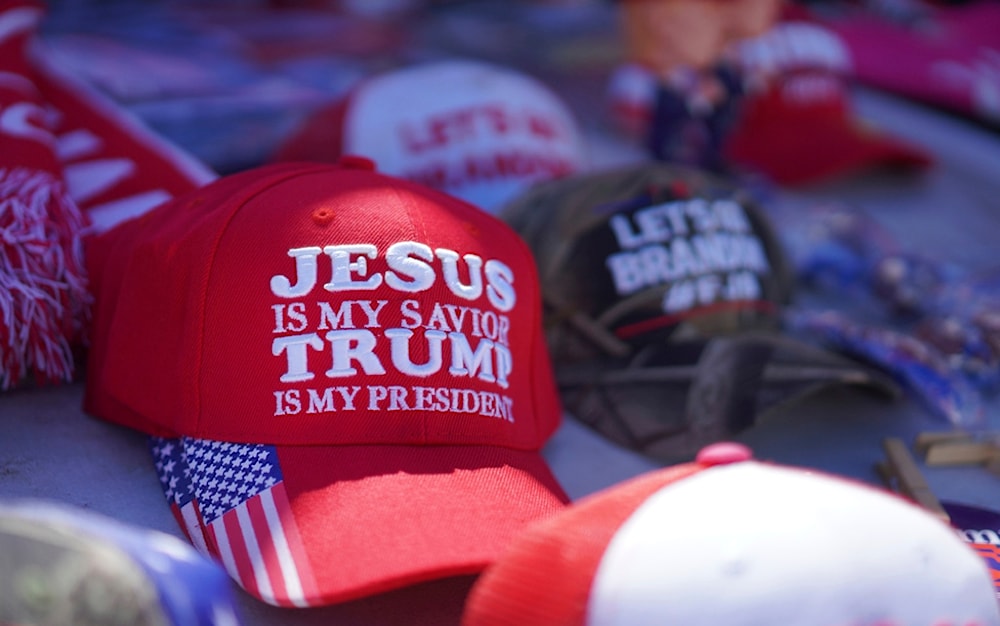
Hats reading a variety of slogans including, "Jesus is my savior, Trump is my president," are sold at a campaign rally for former President Donald Trump in Vandalia, Ohio, March 16, 2024 (AP)
US President Donald Trump is seeing growing support among born-again Protestants while losing ground among Roman Catholics, according to an analysis by Newsweek, highlighting an increasingly sharp divide between two major Christian voting blocs ahead of the November midterm elections.
Polling conducted by Marquette Law School shows Trump’s approval among born-again Protestants climbing from 56% in January to 61% in July. His net approval within the group rose from +12 to +22 over the same period.
Catholic voters moved in the opposite direction. Trump’s approval among Catholics declined from 54% in January to 45% in July, while his net rating fell from +8 to -10.
The result is a 32-point gap in net approval between the two Christian constituencies.
Catholic support drops sharply after April
The most significant movement among Catholics occurred in the spring.
Trump’s Catholic approval stood at 53% in April before falling to 45% in May and 43% in June. It recovered slightly to 45% in July.
Born-again Protestants, meanwhile, became steadily more favorable toward Trump, with approval rising from 57% in April and May to 59% in June and 61% the following month.
Mainline Protestant opinion was comparatively stable, with Trump registering 47% approval in both January and July despite fluctuations in between.
Nationally, Trump’s approval shifted only slightly, falling from 42% in January to 38% in May and June before reaching 40% in July, indicating that the decline among Catholics was considerably steeper than the change among Americans overall.
The five Marquette surveys questioned between 1,002 and 1,514 adults and used separate national samples for each poll.
Disputes with Pope Leo draw attention
The Catholic decline has coincided with public disagreements between Trump and Pope Leo XIV, particularly over immigration and the US war on Iran.
Leo has repeatedly called for an end to the conflict and questioned whether the war meets Catholic principles governing the legitimate use of military force.
After Trump warned that "a whole civilization will die tonight" if Iran rejected a US deadline, Leo described the threat against the Iranian people as "truly unacceptable".
Trump later accused the pope of being "WEAK on Crime" and "terrible for foreign policy."
The president also faced criticism after circulating an AI-generated image that appeared to depict him as a Christ-like figure. Trump later deleted the image and said he believed it portrayed him as a doctor rather than Jesus.
Newsweek stressed that the polling does not demonstrate that Trump's disputes with Leo directly caused the decline among Catholic respondents.
White House defends Trump record
Asked about the polling, White House spokeswoman Taylor Rogers defended Trump's policies toward Christian Americans.
"There has never been a greater president for Christian Americans than President Trump, and his strong record proves it. President Trump ended the weaponization of the federal government against people of faith, proudly defended and expanded our religious rights, pardoned pro-life activists, stopped the chemical mutilation of our nation’s children, and protected parents’ rights."
"On the other hand, Democrats shamelessly weaponized the full weight of the federal government against people of faith, trampled on Christians’ sacred First Amendment rights, and pushed irreversible mutilation surgeries on innocent children."
Catholic voters could matter in midterms
The shift carries electoral significance because Catholics constitute a large but politically divided segment of the US electorate.
Catholics accounted for roughly 20% of voters in the 2024 presidential election, with Trump winning the group 55% to 43%, according to Pew Research Center data cited by Newsweek.
His support among white evangelical Protestants was considerably stronger, reaching 81%.
Unlike the evangelical bloc, however, Catholic voters remain divided along racial and political lines, making changes in their support potentially important in closely contested congressional districts.
With control of the House expected to depend on a relatively small number of seats, declining Catholic approval could therefore present an additional challenge for Republicans heading into November.
Read more: Abuse, harassment scandals rock GOP as midterm battle heats up


