
Pakistan briefs Iran on Mecca Agreement and regional security
 3 Min Read
Pakistan’s Foreign Minister Ishaq Dar briefed Iran’s Abbas Araghchi on the Mecca Agreement with Saudi Arabia, and Turkey amid wider regional security efforts.
-
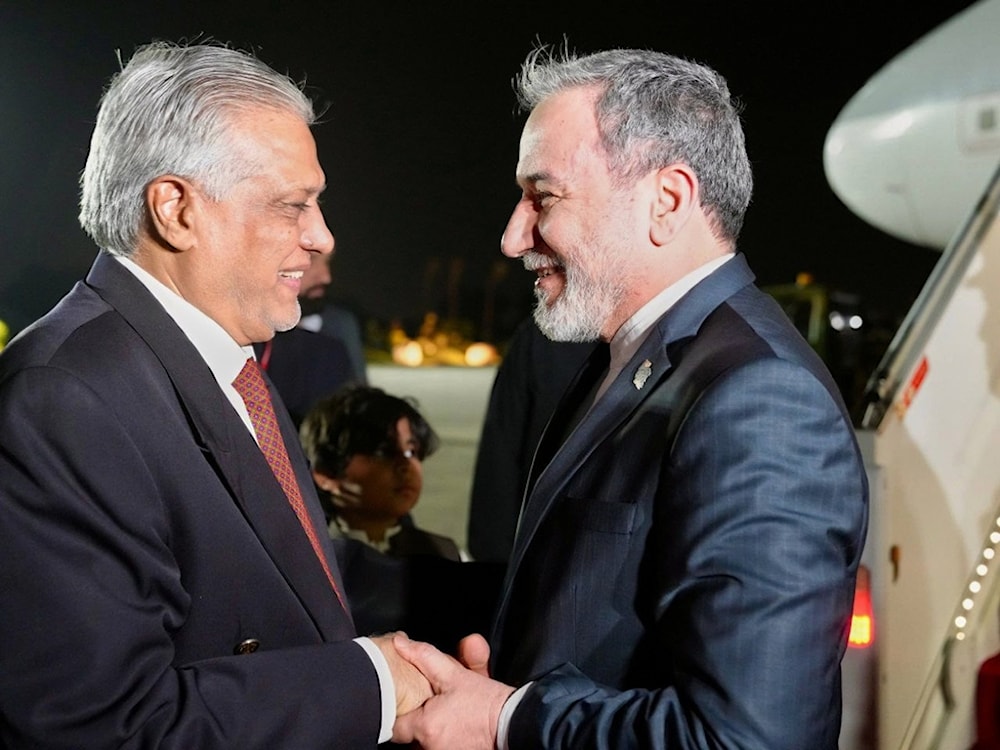
Iranian Foreign Minister Abbas Araghchi is welcomed by Pakistani Foreign Minister Ishaq Dar upon his arrival at Nur Khan airbase in Rawalpindi, Pakistan, Friday, April 24, 2026. (Iranian Foreign Ministry via AP)
Pakistan’s Deputy Prime Minister and Foreign Minister Mohammad Ishaq Dar discussed regional and international developments with Iranian Foreign Minister Abbas Araghchi, including the recently signed Mecca Agreement between Pakistan, Saudi Arabia, and Turkey.
According to Pakistan’s Foreign Ministry, Dar briefed Araghchi on the agreement’s main provisions and objectives, emphasizing its potential role in strengthening strategic cooperation and contributing to regional peace and security.
Araghchi, for his part, thanked his Pakistani counterpart for providing an overview of the agreement and its main elements.
The two foreign ministers also agreed to maintain close communication on issues of mutual interest.
Deputy Prime Minister/Foreign Minister Senator Mohammad Ishaq Dar @MIshaqDar50 spoke today with Foreign Minister of Iran Abbas Araghchi @Araghchi.
— Ministry of Foreign Affairs - Pakistan (@ForeignOfficePk) August 10, 2026
They exchanged views on regional and international developments, with particular focus on the evolving situation in the region and… pic.twitter.com/UXm4e42PnV
Pakistan briefs Iran on Mecca Agreement
The discussion comes after Saudi Arabia, Turkey, and Pakistan announced the signing of the Mecca Joint Defense Agreement, describing it as an expression of their commitment to strengthening collective security.
The agreement was announced in a joint statement on Friday, with the three countries saying they would work together to enhance collective security.
A Turkish official told Reuters that the agreement is not directed against any specific party and remains open to other regional countries.
The arrangement comes as regional states increasingly discuss security mechanisms that do not necessarily depend exclusively on traditional external security guarantees.
Tehran rejects concerns over anti-Iran orientation
Iran has previously rejected the idea that the agreement is aimed at Tehran.
On Monday, Iranian Foreign Ministry spokesperson Esmaeil Baghaei reiterated Iran’s opposition to foreign intervention in the region, arguing that regional states should strengthen relations, trust, and security without external actors.
"The Mecca Agreement stems from the realization by regional countries that achieving security through the United States is no longer possible," while calling on regional states to strengthen relations and security "without external players," Baghaei said.
Asked whether the agreement could be directed against Iran, Baghaei said, "There is no justification for considering that the agreement between Turkey, Saudi Arabia and Pakistan is directed against Iran."
His remarks place the agreement within Tehran’s broader call for regional security arrangements based on cooperation among neighboring states rather than reliance on Washington.
Read more: Egypt expected to join regional Mecca defense pact, Fidan says
Regional security beyond US involvement
The diplomatic exchange between Islamabad and Tehran comes amid broader efforts by regional powers to reshape their security relationships.
For Iran, the question of who provides security in West Asia is closely connected to its long-standing opposition to US military and political involvement in the region. Tehran has consistently argued that regional states should develop mechanisms for resolving disputes and maintaining security without dependence on external powers.
For Pakistan, Saudi Arabia, and Turkey, the Mecca Agreement represents a new framework for defense cooperation and collective security. Its stated openness to additional regional participants could potentially give the arrangement a broader regional dimension.
At the same time, Tehran’s explicit rejection of the characterization of the agreement as anti-Iran suggests that the diplomatic space between the signatories and Iran remains open.


