
Pakistani PM heads to KSA as Riyadh pledges $3 bln in extra deposits
 4 Min Read
The $3 billion fresh commitment from Riyadh directly offsets the UAE's withdrawal of $3.5 billion and keeps Pakistan's IMF programme conditions intact.
-
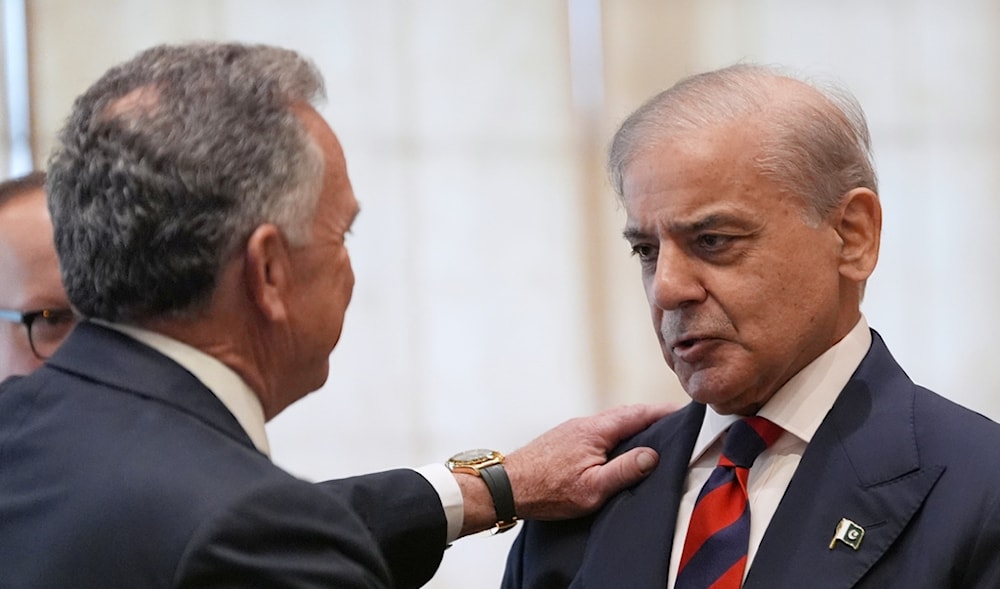
Pakistan's Prime Minister Shehbaz Sharif, right, greets US Special Envoy Steve Witkoff before the start of his meeting with US VP JD Vance in Islamabad, Pakistan on Saturday, April 11, 2026. (AP Photo/Jacquelyn Martin)
Saudi Arabia has committed $3 billion in additional deposits to Pakistan's central bank, Finance Minister Muhammad Aurangzeb announced Tuesday on the sidelines of the International Monetary Fund and World Bank Spring Meetings in Washington.
The funds, expected to be disbursed within the coming week, come on top of an existing $5 billion Saudi deposit that Riyadh has agreed to extend for an unspecified longer period, replacing the previous annual rollover arrangement with greater stability.
The announcement was confirmed by a Saudi Ministry of Finance spokesperson, who told Reuters that "Saudi Arabia has agreed to a $3 billion deposit with Pakistan to support their balance of payments."
The pledge comes as Prime Minister Shehbaz Sharif departs today for Riyadh as part of a regional tour that will also take him to Qatar and Turkey.
Filling the UAE gap
The timing is far from coincidental. Pakistan faces approximately $4.8 billion in external debt repayments in April alone, including $3.5 billion owed to the United Arab Emirates, a facility dating back to 2018 that Abu Dhabi has now declined to roll over, demanding full repayment in tranches through April 23.
Earlier this year, the UAE extended two $1 billion loans by just one month, rejecting Pakistan's request for a two-year extension at reduced interest rates. Analysts warn the repayments represent a significant drain on Pakistan's State Bank reserves, currently standing at approximately $16.4 billion.
The Saudi injection is also structurally tied to Pakistan's ongoing $7 billion IMF Extended Fund Facility, approved in September 2024. The Fund requires Saudi Arabia, China, and the UAE to maintain deposits with Pakistan's central bank throughout the programme, making Riyadh's intervention a precondition for keeping the IMF programme on track, not merely a bilateral favour.
A staff-level agreement on the programme's third review, reached in late March, unlocks a further $1.21 billion pending executive board approval, a vote Aurangzeb is in Washington to facilitate.
A relationship built on recurring lifelines
Saudi financial support to Pakistan operates across multiple channels. The now-extended $5 billion deposit has been parked with the State Bank of Pakistan since 2021, rolled over annually by royal directive, never repaid.
Alongside it, Riyadh supplies Pakistan with oil on deferred payment terms, currently at $100 million per month. In March, Pakistan formally asked Saudi Arabia to expand that oil facility from $1.2 billion to $5 billion and extend repayment tenors from one to three years, one of eight requests Islamabad has made to Riyadh under a proposed long-term economic cooperation framework, including converting short-term deposits into 10-year facilities and securitising Pakistani diaspora remittances.
Capabilities for cash
In January 2026, Reuters reported that Pakistan and Saudi Arabia were negotiating a deal to convert approximately $2 billion in Saudi loans into a procurement package for JF-17 Block III fighter jets, with the total package potentially reaching $4 billion once weapons systems, training, and maintenance are factored in.
The arrangement, framed by Pakistani defense officials as a "debt-to-capability mechanism," reflects the logic of the broader Strategic Mutual Defense Agreement (SMDA) signed by both countries in September 2025, under which any aggression against either state is treated as aggression against both.
The pact has been put under acute pressure since the US-Israeli war on Iran began in late February. Saudi Arabia formally invoked the SMDA in early March after strikes on its oil infrastructure, prompting Pakistani Army Chief Field Marshal Asim Munir to fly to Riyadh.
On April 11, the same day US and Iranian delegations were negotiating in Islamabad, Saudi Arabia announced the arrival of Pakistani fighter jets and troops at King Abdulaziz Air Base in the Eastern Province.
READ MORE: Pakistan, Saudi Arabia in talks to convert loans into JF-17 jets deal


