
Palestinian clans to collaborators: Repent before it is too late
 4 Min Read
The Gathering of Palestinian Tribes and Clans condemned local collaborators aiding the occupation, praised the Resistance’s decision to offer repentance, and reaffirmed support for national unity and security efforts.
-
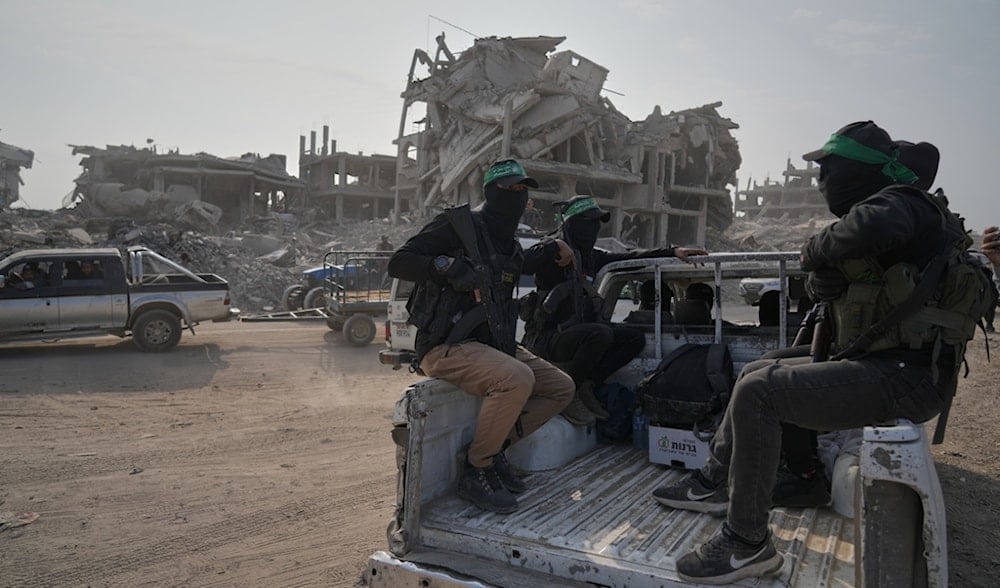
Hamas fighters, accompanied by members of the International Committee of the Red Cross (ICRC), head to east of Gaza City to search for the bodies of captives, Nov. 13, 2025 (AP)
The Gathering of Palestinian Tribes and Clans issued a firm statement condemning the “treacherous, mercenary faction” accused of collaborating with the Israeli occupation forces, warning that such betrayal is a deviation from religious values and national traditions.
The statement blasted these individuals as "watchdogs and mercenaries" aiding the Israeli military in its aggression against the Palestinian people, reaffirming that such actions are alien to Palestinian society, and vowed to oppose all forms of treason.
“We take pride in the strong public rejection of this deviant behavior,” the statement read, adding that this consensus reflects the deep-rooted patriotism and integrity of Palestinian society.
No protection for collaborators
The tribes also praised the Tarabin clan for swiftly revoking tribal protection from the now eliminated collaborator, Yasser Abu Shabab. The clan publicly disavowed him during his life and after his death.
“This should serve as a lesson to anyone considering betrayal,” the statement added, citing his fate as an example of what awaits traitors.
Furthermore, the tribal gathering welcomed the Resistance’s decision to open the door for repentance for collaborators seeking to atone and return to the embrace of their people.
“We urge them to seize this opportunity before it is too late,” the tribes said.
Commitment to national unity and social stability
The statement concluded with a pledge to preserve social harmony and defend the homeland: “We pledge before God and our people to remain loyal to our nation and maintain our internal unity.”
The tribes also voiced strong support for the Palestinian security services and their ongoing efforts, under difficult circumstances, to eliminate collaboration and preserve national cohesion.
“May God protect our homeland and safeguard our people from all harm,” the statement concluded.
Hamas: Abu Shabab's inevitable fate awaits all traitors
Hamas issued a strong statement Thursday following the killing of Gaza's most infamous gangster, Yasser Abu Shabab, calling his death "the inevitable fate of anyone who betrays their people and homeland."
The movement praised the families and clans who had disowned Abu Shabab and withdrawn any tribal protection from him and his group, describing this stance as a crucial barrier that stands in the face of efforts aimed at fragmenting Gaza’s internal unity.
Hamas said that "Israel’s" reliance on "discredited gangs" to advance its agenda only underscores its failure in the face of Palestinian steadfastness, noting that an occupation unable to protect its own agents cannot shield those who serve it.
Collaborators: A tool to sow division, chaos
For decades, "Israel" has relied on a systematic strategy of cultivating collaborators inside Palestinian society as a tool to fracture internal cohesion and undermine the Resistance. Through coercion, financial inducements, blackmail, and the exploitation of humanitarian hardship, "Israel" seeks to recruit individuals to feed intelligence networks that aid its military operations and surveillance apparatus.
This long-standing policy is designed to erode social trust, disrupt community structures, and create internal vulnerabilities that serve the occupation’s broader objectives. Collaborators, in turn, shed blood on behalf of the occupation. More recently, Israeli collaborators abducted and murdered Palestinian journalist Saleh al-Jafarawi only days after the ceasefire was reached.
Yet, despite these efforts, Palestinian society has consistently demonstrated strong collective rejection of collaboration, viewing it as a direct assault on national identity, social values, and the struggle for liberation.
Read more: Gaza Palestinian journalist Saleh al-Jafarawi killed by collaborators


