
Pezeshkian: Attacks on Iran violate intl law, will not force surrender
 2 Min Read
Iranian President Masoud Pezeshkian says US and Israeli attacks on Iran violate international law, stressing that pressure will not force Tehran to surrender.
-
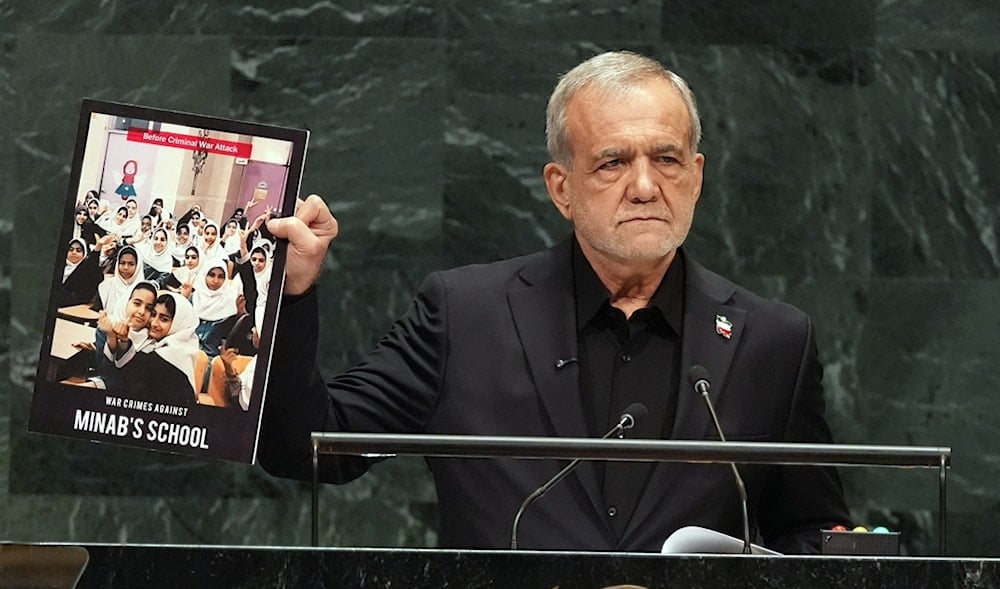
Iran's President Masoud Pezeshkian holds up a photograph as he delivers remarks during the 81st session of the United Nations General Assembly at United Nations headquarters, Sept. 23, 2026. (AP)
All measures taken by the United States and “Israel” against Iran violate international law, Iranian President Masoud Pezeshkian said on Sunday, stressing that attacks on schools, leadership figures, and infrastructure likewise contravene international legal norms.
Speaking during a meeting of the Iranian government, Pezeshkian said, “Aggression and targeting schools, leadership, and infrastructure all contradict international law.”
He added that US and Israeli officials “stand on platforms and say we will destroy Iran, while claiming that we are the terrorists.”
Pezeshkian said Iran had presented images in New York of women, children, and elderly people whom he said had been martyred as a result of the aggression, asking, “Can they show even one image proving that we killed anyone?”
The Iranian President stressed that “attacks and pressure will not force Iran and its people to surrender,” adding that Iranian society is currently witnessing “exceptional unity.”
Iran submits legal document on impact of US sanctions
Earlier, Iran's permanent mission to the UN Office in Geneva submitted a legal document to a number of United Nations human rights mechanisms addressing the impact of the economic and financial sanctions imposed by the United States on the lives of civilians in Iran.
In a statement, the mission said the submission comes amid an escalation of US “economic terrorism", alongside the military aggression against the country. It said these measures extend the pressures of war into the humanitarian and livelihood spheres.
The document outlines banking and financial restrictions, secondary and extraterritorial sanctions, restrictions on air and maritime transportation, and the revocation of previously issued licenses, as well as the adoption of a presumption of denial in the issuance of licenses and measures related to the maritime blockade.
Furthermore, the mission called on the UN human rights mechanisms to examine the direct repercussions of these measures on civilians.
Read more: Iran Army chief: War not over; unsafe region means insecurity for all


