
Qaani: Israeli settlement push cannot erase failures since October 7
 4 Min Read
IRGC Quds Force Commander Esmail Qaani links settlement expansion and Israeli actions to mounting military, political, security, and internal crises.
-
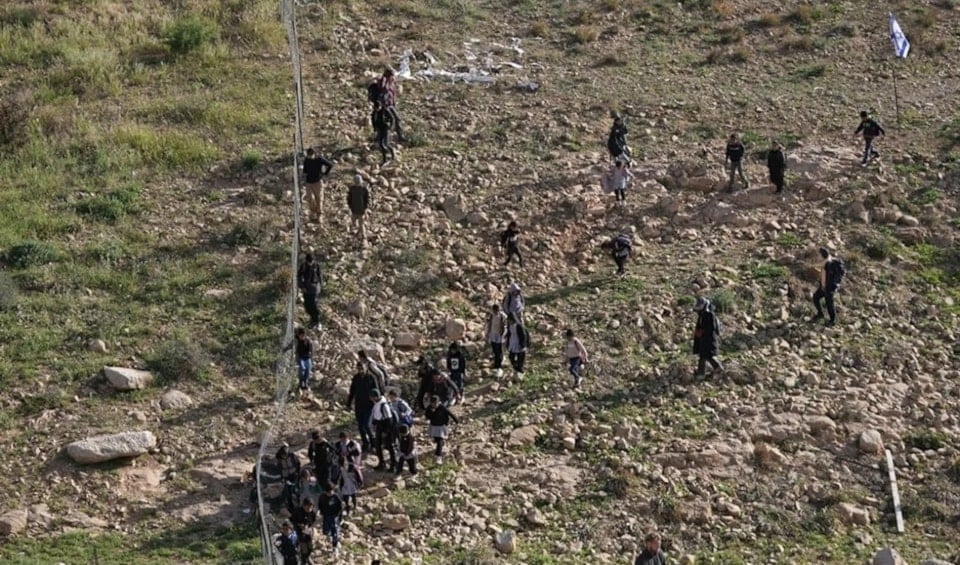
Palestinian students walk along a fence separating their village from the nearby Israeli settlement of Carmel, near the West Bank village of Umm al-Khair, April 14, 2026 (AP)
The Palestinian cause remains enduring and unwavering, IRGC Quds Force Commander Esmail Qaani stated Sunday, stressing that it will remain firmly rooted until victory is achieved.
Qaani said the Palestinian cause “from the sea to the river” is now more present and more attainable than ever before.
He added that settlement expansion and Israeli occupation crimes constitute an attempt to escape the “crisis and deep predicament” confronting the Israeli occupation across military, security, political, and internal fronts.
The IRGC Quds Force Commander stressed that such practices would not be able to efface the occupation’s “strategic failures” from October 7 to the present.
Qaani’s remarks come as international opposition to Israeli settlement expansion continues to grow, with 14 countries, including eight European Union members, and the European Commission condemning the latest move to advance the controversial E1 settlement project in the occupied West Bank and calling for an immediate halt to settlement expansion.
14 nations, EC demand halt to Israeli E1 settlement expansion plan
The United Kingdom, France, Germany, Italy, the European Commission, the Netherlands, Canada, Norway, Australia, New Zealand, Sweden, Belgium, Spain, Austria, and Greece issued a joint statement on August 20 after tenders were opened for more than 1,200 housing units in the E1 area, warning that the project threatens the territorial continuity of the occupied Palestinian territories.
"At a time of grave instability in the West Bank with unprecedented levels of violence by settlers against civilians, and serious restrictions on the Palestinian economy, this decision is even more concerning," the statement said, as released by the UK government, urging the Israeli occupation "to retract these plans immediately and end its expansion of settlements in the West Bank."
The 14 countries and the European Commission also stressed that "International law is clear that Israeli settlements in the West Bank are illegal" and said the position has been reaffirmed by the United Nations Security Council.
They further warned that businesses should not consider bidding for the construction tenders and should be aware of "legal and reputational consequences" for involving themselves in what the statement described as serious breaches of international law.
The countries also warned of "legal and reputational consequences" for those involved in the project, saying the plans would further undermine prospects for peace and a "two-state" solution.
E1 project threatens Palestinian territorial continuity
The E1 area covers roughly 12 square kilometers east of occupied eastern al-Quds and lies between the city and the illegal Israeli settlement of Ma'ale Adumim.
The plan, approved by the Israeli occupation last August, calls for approximately 3,400 housing units. The latest tenders cover more than 1,200 units, according to Israeli NGO Peace Now, with bids due by October 19, one week before the Israeli elections scheduled for October 27.
The project would connect Ma'ale Adumim with the occupied eastern part of al-Quds while further separating the northern and southern parts of the West Bank, according to critics. Palestinian officials have long viewed the eastern part of al-Quds as the capital of a future Palestinian state.
Settlement expansion accompanies rising settler violence
The latest settlement push comes amid escalating violence against Palestinians across the occupied West Bank, including attacks by Israeli settlers, demolitions, and forced displacement.
UN humanitarian research found that more Palestinians were forcibly displaced through settler attacks, demolitions, and evictions during the first four months of 2026 than throughout all of 2025.
Human Rights Watch has also warned that dozens of Palestinian communities in the West Bank face the risk of being erased.
The occupied West Bank is home to around three million Palestinians, while about 500,000 Israeli settlers live there, excluding occupied eastern al-Quds.
The expansion of settlements has accelerated since the start of the Israeli genocide in Gaza in October 2023, while analysts have linked the latest settlement drive to political pressure ahead of the Israeli elections in October.
Read more: Eight states reject 'Israel's' E1 settlement plan


