
Rubio says Iran deal 'still work in progress' amid Trump push
 4 Min Read
US officials defend ongoing negotiations with Iran amid growing Republican backlash.
-
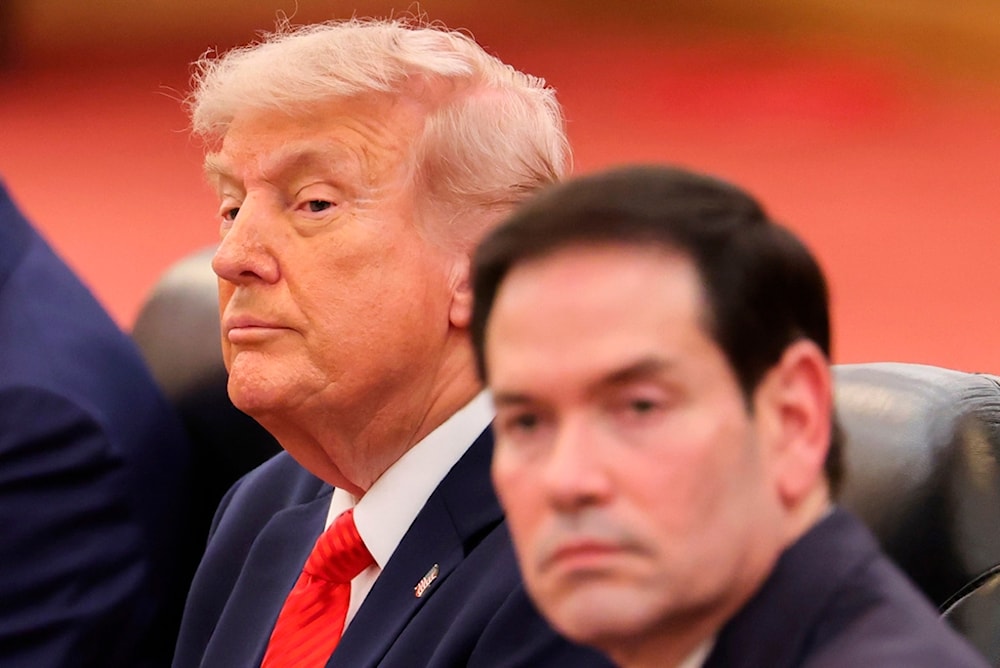
US President Donald Trump, left, seated next to US Secretary of State Marco Rubio, right, attends a bilateral meeting with Chinese President Xi Jinping at the Great Hall of the People in Beijing, Thursday, May 14, 2026 (AP)
US President Donald Trump and Secretary of State Marco Rubio intensified efforts Sunday to defend ongoing negotiations with Iran amid mounting backlash from Republican hawks and pro-"Israel" hardliners angered by reports that Washington may move toward compromise after months of military and economic escalation against Tehran.
Speaking during a visit to India, Rubio described discussions underway with Iran as a “pretty solid” proposal linked to the future of the Strait of Hormuz and renewed negotiations over Tehran’s nuclear program.
The US secretary of state said the proposal concerns Iran’s “ability to open up” the Strait of Hormuz and “enter into a very real, significant, time-limited negotiation on the nuclear matters."
“And hopefully, we can pull it off. It has a lot of support in the Gulf. It has a lot of support globally. Every country that we’ve walked through it understands it’s not just very reasonable, but it’s the right thing for the world to get done,” he said.
Trump won't make 'a bad deal'
Rubio also sought to reassure critics inside Trump’s political camp who argue Washington risks softening its pressure campaign before forcing broader concessions from Tehran regarding uranium enrichment, missile capabilities, and Iran’s regional influence.
“The president is not going to make a bad agreement, so let’s see what happens. We’re going to give diplomacy every chance to succeed before we explore the alternatives,” Rubio said.
Asked about delays in finalizing an agreement, Rubio blamed the pace of Iran’s internal political system.
“It’s just the response,” Rubio told reporters.
“You’ve got to hear back, and it takes the Iranian system a little while longer to get back.”
“The president is not going to make a bad deal – he’s just not,” he added.
Pressure campaign backfires globally
The renewed diplomatic push follows months of US-led escalation against Tehran that included sweeping sanctions, restrictions targeting Iranian oil exports and shipping, and a US naval blockade targeting Iranian maritime trade through the Strait of Hormuz.
The crisis generated major disruptions across global energy and shipping markets, fueling concerns among US allies and Gulf states over rising oil prices, maritime instability, and the risk of wider regional war.
European governments, along with countries such as China and Russia, repeatedly pushed for diplomatic de-escalation rather than prolonged military confrontation with Iran.
Iranian officials have meanwhile continued rejecting negotiations framed around threats, sanctions, or demands for “unconditional surrender", insisting that Tehran would not negotiate under coercion following the outbreak of US-Israeli aggression earlier this year.
Analysts have portrayed the renewed diplomatic track as evidence that Washington failed to impose decisive strategic outcomes through military pressure and economic warfare alone despite months of escalation aimed at isolating the Islamic Republic.
Commentators have additionally argued that the growing economic and geopolitical costs of the war helped push Washington back toward negotiations after pressure tactics failed to fully neutralize Iran’s regional leverage or force rapid political concessions.
The negotiations have also exposed divisions inside the US political establishment itself.
Republican hawks reject deal
Several Republican figures and pro-"Israel" hardliners criticized reports of a possible agreement, arguing that any arrangement leaving Iran with enrichment capabilities or economic relief would amount to a strategic concession to Tehran after months of confrontation.
Trump responded Sunday by insisting his administration would not rush negotiations and would maintain pressure until any final agreement is formally completed.
“The US blockade of Iran’s ports will remain in full force and effect until an agreement is reached, certified, and signed,” Trump wrote.
“Nobody has seen” the deal, “or knows what it is”, the US president later added. “It isn’t even fully negotiated yet. So don’t listen to the losers, who are critical about something they know nothing about.”
Facing continued criticism from within his own party, Trump further declared, “I don’t make bad deals!”
Despite Washington’s public optimism, uncertainty continues to surround the negotiations, with Iranian officials signaling that any final arrangement would require approval from Tehran’s senior leadership structures and would need to preserve Iran’s sovereignty, deterrence posture, and strategic interests.
Read more: Exclusive: Iran, US to finalize framework understanding via Pakistan


