
SOHR records sharp rise in sectarian killings across Syria
 4 Min Read
The Syrian Observatory for Human Rights says 1,348 people have been killed in Syria since December 2024, including hundreds in sectarian-motivated attacks.
-
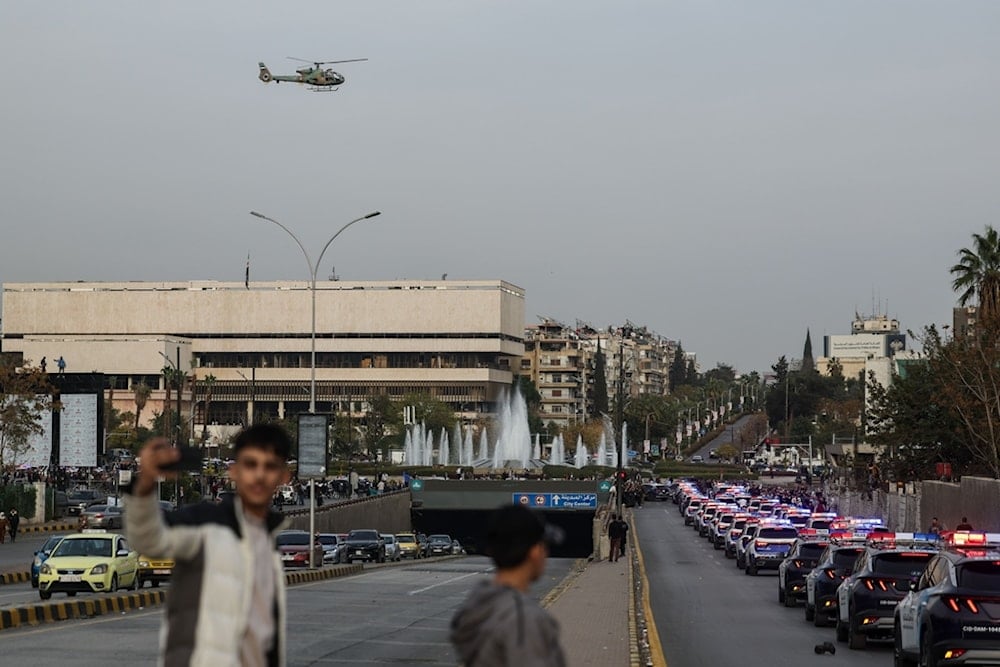
A Syrian new army helicopter flies over Ministry of Interior vehicles driving in formation, as people gather to watch along a main avenue in central Damascus, Syria, Saturday, November 29, 2025 (AP)
The Syrian Observatory for Human Rights (SOHR) has documented the killing of 1,348 people across Syria since 8 December 2024, including at least 574 victims who were killed over sectarian reasons.
According to SOHR, the killings have spread across most Syrian cities amid the absence of protection and security for civilians, against a backdrop of ongoing security breakdown and deepening social fragmentation.
The Observatory said sectarian motives were a direct driver in hundreds of cases, reflecting a rise in hate speech and the transformation of narrow identities into tools of violence. It warned that this trend poses a serious threat to social cohesion and further deepens divisions among Syria’s social components.
Based on its temporal documentation, SOHR recorded 160 killings between 8 December and the end of 2024, the majority of them men. The highest proportion of victims killed on sectarian grounds during that period was reported in Hama, Homs, Latakia, and Tartous.
Most killings took place in January
With the start of 2025, the number of victims rose sharply. In January, 194 people were killed, including women and children, followed by 113 killings in February and 144 in March. The Observatory noted particularly high rates of sectarian-motivated crimes in Homs, Hama, and Latakia during these months.
The upward trend continued in the following months, with 137 killings documented in April, 110 in May, and 105 in June. Central and coastal Syrian cities emerged as the main hotspots for sectarian-motivated killings during this period.
In the second half of the year, SOHR documented 92 killings in July, 97 in August, 70 in September, 67 in October, 41 in November, and 18 in December, with cases of sectarian-based killings continuing to be recorded through the most recent months.
SOHR stressed that the alarming rise in the number of victims cannot be treated as mere statistics, describing it as a warning sign of society sliding toward deeper fragmentation and systematic violence. It cautioned against the consequences of the continued killing based on identity.
Killing plagues Syria since the fall of al-Assad
In a report published on November 21, the SOHR confirmed that at least 11,226 people have been killed in the eleven months following the fall of the previous Syrian regime, highlighting the continued wave of chaos and violations against civilians.
On November 16, a shooting at a café in the village of Umm Hartein, in western Homs countryside, left four civilians dead and one wounded. The attack, carried out by unidentified gunmen, claimed the life of a local man identified as Mukhtar Wadi al-Mawla, also known as "Abu Ghazal".
Further reports from SOHR reveal a consistent pattern of severe human rights abuses across multiple Syrian regions between December 8, 2024, and November 8, 2025. These violations include unlawful killings, field executions, kidnappings, and torture, alongside indiscriminate attacks, armed assaults, and repeated bombings targeting civilian populations.
Sectarianism fuels massacres
Between March 6 and 9, 2025, the Latakia and Tartous governorates witnessed deadly attacks focused on Alawite communities in Syria's coastal region. SOHR documented over 1,400 deaths following insurgent attacks, with evidence of looting, arson, and sectarian violence. These events highlight the continued targeting of specific communities along sectarian lines.
On June 22, 2025, a suicide bombing and shooting attack at Mar Elias Church in Damascus killed at least 22 people and injured dozens more during a religious service. This incident underscored the vulnerability of minority groups, with civilians again bearing the brunt of violence amid ongoing armed conflict.
Southern Syria also experienced deadly clashes, particularly in Sweida. From July 13-15, 2025, government forces and allied fighters engaged in operations against Druze communities, resulting in at least 1,311 deaths, including many civilians.


