
South Korea president urges Trump to pursue DPRK peace talks
 4 Min Read
Lee Jae Myung urges Trump at the G7 summit to lead diplomatic efforts aimed at resolving tensions with the DPRK.
-
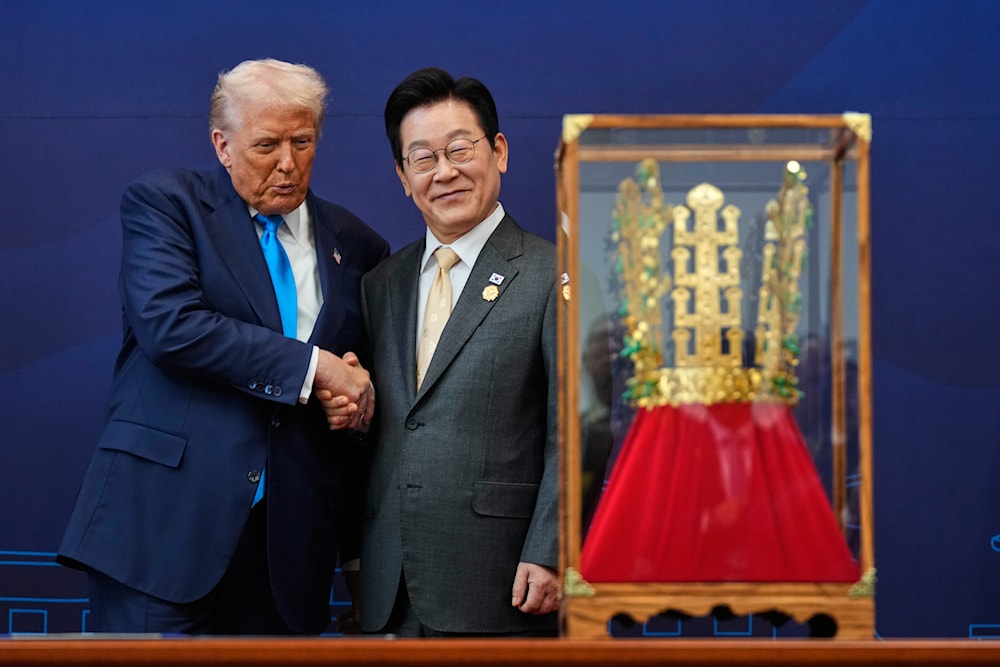
US President Donald Trump shakes hands with South Korean President Lee Jae Myung as he receives a gift of a gold crown during a high honor ceremony at the Gyeongju National Museum in Gyeongju, South Korea, Oct. 29, 2025 (AP)
South Korean President Lee Jae Myung called on US President Donald Trump to take the lead in pursuing a peaceful resolution to tensions with the Democratic People's Republic of Korea during a brief encounter at the Group of Seven summit on Tuesday, according to Lee’s office.
The exchange took place as leaders gathered for a group photo at the annual summit, presidential spokesperson Kang Yu-jung said. During the encounter, Trump asked Lee about the current state of inter-Korean relations, Kang added.
In response, Lee urged Trump to apply the same diplomatic approach he had used in the Middle East to help resolve the DPRK nuclear standoff, Lee’s office said. Trump replied that he would work on the issue, according to the spokesperson.
The interaction marks the first known direct dialogue between the two leaders since Lee took office, and comes amid renewed speculation over Trump’s willingness to reengage with Pyongyang.
Trump's history with Kim Jong Un
Trump and DPRK leader Kim Jong Un held three face-to-face meetings during Trump’s first term: a historic summit in Singapore in 2018, a second summit in Hanoi in 2019, and an impromptu meeting later that year at the inter-Korean Demilitarized Zone, where Trump became the first sitting US president to set foot in DPRK.
Those diplomatic efforts ultimately stalled after the Hanoi summit ended without an agreement on the dismantlement of DPRK’s nuclear programme or relief from US-led sanctions.
Since returning to office, Trump has repeatedly signalled interest in reviving direct dialogue with Kim. In August 2025, he said he looked forward to seeing the DPRK leader “in the appropriate future,” and in October he stated he would “love” to meet Kim again.
Last week, Trump posted a photo of himself with Kim Jong Un on his Truth Social platform without any caption, a move widely interpreted as a deliberate reference to their past engagement.
Neither the White House nor DPRK’s state media have issued immediate comments on Tuesday’s exchange.
DPRK cements its rejection of denuclearization
Earlier, the Democratic People's Republic of Korea firmly rejected fresh trilateral calls from the United States, Japan, and South Korea for denuclearization, declaring its status as a nuclear weapons state "irreversible" and dismissing any future negotiations on the matter.
The statement, carried on June 14 by the Korean Central News Agency, came in response to a trilateral meeting in Tokyo where senior officials from the three allies reaffirmed their commitment to the "complete denuclearization of the Korean Peninsula."
An unnamed DPRK official said external pressure would not affect an established reality. "The US and its vassal forces' meaningless rhetoric against the DPRK... can never affect the irreversible position of the DPRK as a nuclear weapons state," the spokesperson said, adding that "denuclearization" is now an "irreversibly finalized matter."
The official cited ongoing US weapons sales and military cooperation with South Korea and Japan as justification for maintaining and advancing the nuclear programme, describing the arsenal as "a strong security guarantee for regional stability and peace" amid growing military activity in Northeast Asia.
"No matter how hard the US, Japan and the ROK may quibble, they will never change the present position of the DPRK as a nuclear weapons state," the official said, underscoring Pyongyang's longstanding view that allied military partnerships pose a direct security threat, a position the three nations reject as they maintain their cooperation is purely defensive and deterrent in nature.


