
Starmer faces revolt as Labour collapses across Britain
 5 Min Read
UK Prime Minister Keir Starmer faces growing calls to resign after Labour suffered crushing election losses across Britain as Reform UK surged and pro-Gaza independents gained ground.
-
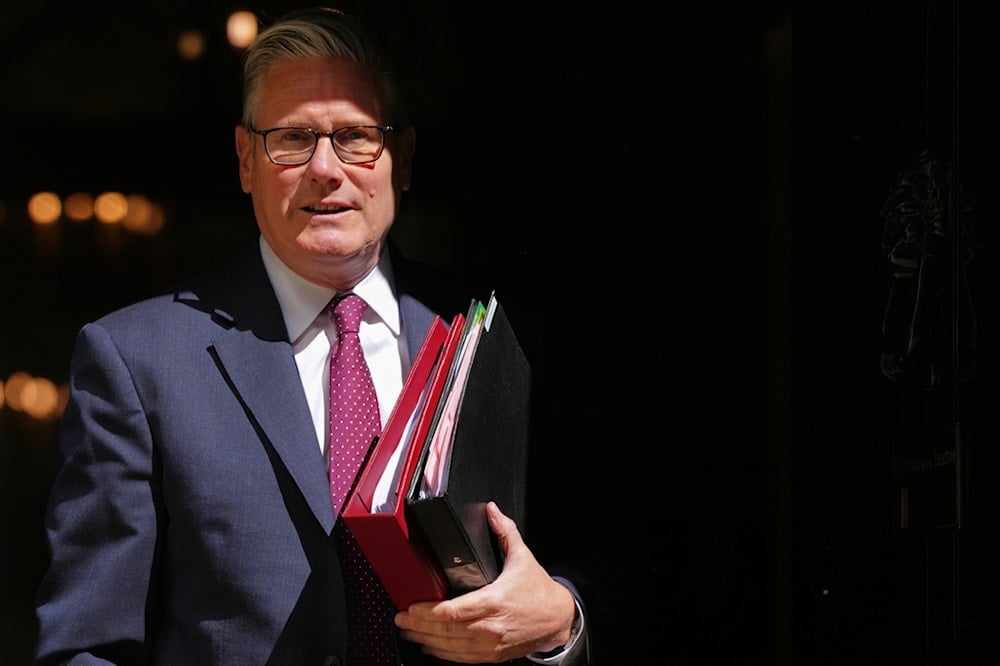
Britain's Prime Minister Keir Starmer leaves 10 Downing Street in London on April 29, 2026. (AP Photo/Kirsty Wigglesworth)
British Prime Minister Keir Starmer is facing mounting pressure from within his own party after Labour suffered sweeping electoral losses across England, Wales, and Scotland, triggering calls for his resignation and exposing deep fractures within Britain’s political establishment.
Senior Labour MPs openly questioned Starmer’s leadership after the party lost more than 1,000 council seats and surrendered control of dozens of local authorities, many of them to Nigel Farage’s Reform UK.
“What is abundantly clear is that unless the government delivers significant and urgent change, then the prime minister cannot lead us into another election,” former cabinet minister Louise Haigh said.
Anneliese Midgley, Labour MP for Knowsley, described the results as “beyond our worst expectations.”
“It’s truly devastating,” she said. “Unless that changes significantly and quickly it’s clear the PM can’t lead us into another election.”
Other Labour figures were even more direct in their criticism.
“The public has spoken; I think we need to change our leader,” Labour MP Simon Opher stated. “If we go into the next election with him we will just get slaughtered.”
Behind closed doors, senior Labour figures reportedly pushed for Starmer to outline a timetable for his departure from Downing Street.
One senior back bencher said Starmer should oversee “a dignified” leadership transition after Labour’s autumn conference, adding: “He can’t take us into next year’s locals. It’s too late.”
Despite the backlash, Starmer insisted he “won’t walk away,” arguing that his resignation would “plunge the party into chaos.”
Read more: UK reviews fuel rationing plans amid oil supply concerns
Farage declares “historic shift” in British politics
As Labour entered crisis, Reform UK leader Nigel Farage celebrated what he described as a political realignment shaking Britain’s traditional two-party system.
“It’s a big, big day, not just for our party but for a complete reshaping of British politics in every way,” Farage declared after Reform UK captured major councils across England, including Essex and Sunderland.
Reform UK made substantial gains in working-class regions traditionally associated with Labour while also eroding Conservative strongholds across southern England.
Farage framed the elections as evidence of growing public anger toward Britain’s political establishment and claimed his movement was preparing for a larger national breakthrough.
“The time is now,” Farage said as he called for discussions with what he described as “patriotic old Labour” MPs.
Even some British political analysts acknowledged the scale of the upheaval.
Election expert Peter Kellner described the results as potentially “a record number of gains by any party in any elections,” despite warning that Reform UK may eventually face limits to its growth.
Meanwhile, the Green Party gained in London and other urban centers further exposing Labour’s collapse among younger and progressive voters frustrated with Starmer’s political direction.
Birmingham revolt reflects fragmentation of British politics
Labour’s defeat in Birmingham, Britain’s second-largest city, became one of the clearest symbols of the party’s declining authority.
After 14 years of Labour control, the city council fractured as Reform UK, the Greens, and pro-Gaza independents all made major advances.
The collapse follows years of austerity measures, service cuts, municipal bankruptcy, and deteriorating living conditions across the city.
Independent councillor Nosheen Khalid said voters had “had enough” of Labour.
“The Labour party has caused a lot of damage in Birmingham,” she said, citing bankruptcy measures and cuts to youth services.
Khalid, who campaigned on pro-Gaza positions and received backing from Jeremy Corbyn’s Your Party movement, rejected cooperation with Reform UK, describing Farage’s party as “divisive.”
She argued that ordinary residents had lost faith in establishment politicians entirely.
“Birmingham has not been effectively governed for a very long time,” Khalid stated. “It can only get better when you have representatives who are grassroots.”
The rise of pro-Gaza independents in several councils reflected continuing anger among Muslim and left-wing voters over Labour’s stance toward the Israeli war on Gaza.
Read more: US-UK clash: Bessent badgers Reeves for questioning Iran war objective
British political establishment enters period of instability
The elections exposed growing instability across Britain’s political landscape, with Labour, Conservatives, and even traditional regional party structures all facing mounting public dissatisfaction.
In Wales, Labour lost ground after more than a century of dominance, while in Scotland the party continued struggling to recover support lost after previous electoral collapses.
London Mayor Sadiq Khan warned that Labour risked suffering the same long-term decline in England that it experienced in Scotland.
“Without a change in course and an acceleration in delivery, the threat to Labour is existential,” Khan said.
The results also reflected broader social frustration over austerity, economic stagnation, collapsing public services, and Britain’s political alignment with US-backed foreign policy agendas.
While Labour leadership figures attempted to frame the losses as temporary “midterm difficulties,” growing unrest inside the party suggests Starmer’s position may remain increasingly fragile in the months ahead.


