
STC welcomes Saudi Arabia's initiative for southern Yemeni dialogue
 5 Min Read
The Southern Transitional Council (STC) has welcomed Saudi Arabia's call to sponsor a southern Yemeni dialogue, saying it aligns with its long-standing commitment to peaceful resolution.
-
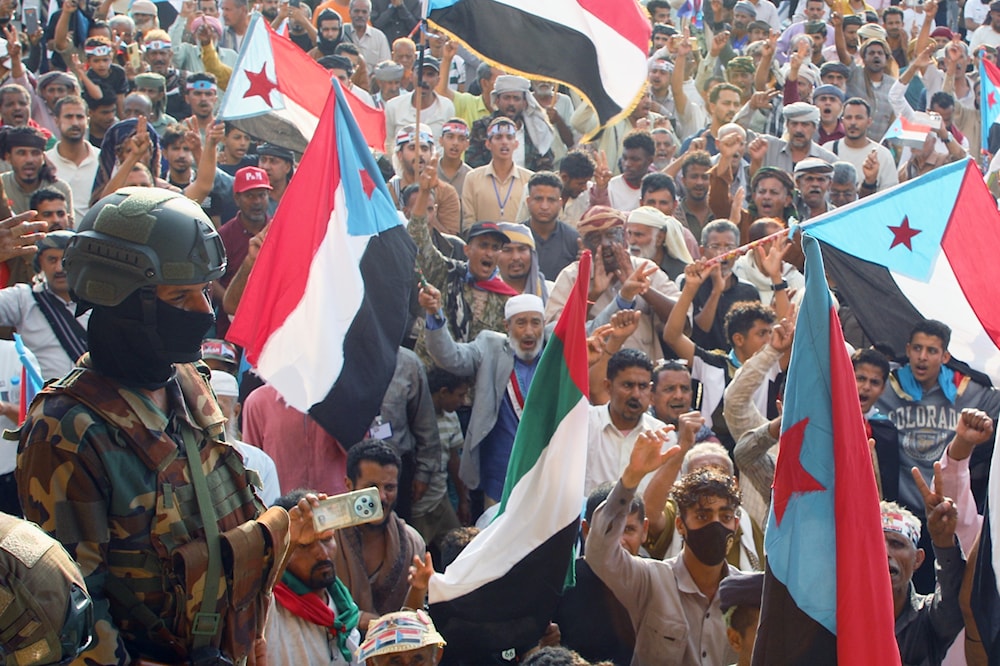
Supporters of the Southern Transitional Council (STC), a coalition of separatist groups seeking to restore the state of South Yemen, hold South Yemen flags during a rally in Aden, Yemen, Fon riday, Jan. 2, 2026 (AP)
The Southern Transitional Council (STC) has welcomed Saudi Arabia’s call to sponsor a southern Yemeni dialogue, describing the initiative as a practical extension of its long-standing approach.
“This invitation represents a practical translation of the approach adopted by the council since its establishment, based on dialogue as the only rational means to address political issues, foremost among them the southern people’s right to restore their state,” the STC claimed in a statement.
The STC highlighted its consistent participation in past dialogues sponsored by Saudi Arabia and the Gulf Cooperation Council, saying, “We have been present in all key dialogue stages, from the 2019 Riyadh Agreement, through the 2022 Riyadh consultations, to the comprehensive southern dialogue that led to the adoption of the Southern National Charter in 2023, reflecting our ongoing commitment to dialogue and political responsibility.”
Popular referendum only mechanism for future solutions: STC
Regarding the recent Saudi initiative, the council indicated that it sees the invitation as aligned with its political statement from January 2, 2026, and consistent with its ongoing efforts to gain serious regional and international support for the southern cause, aiming to achieve a fair and sustainable resolution that meets the aspirations of the region's people.
The council confirmed its readiness to participate in the proposed dialogue, along with other southern components that are signatories to the Southern National Charter. “We welcome this dialogue, or any dialogue addressing the southern cause, and consider it a genuine opportunity for serious talks that protect the south’s future, safeguard its security and stability, and fulfill the aspirations of its people,” the statement added.
The STC emphasized that any meaningful dialogue must respect the southern people’s will. “Any serious dialogue must start from recognition of the will of the southern people, within a defined timeframe, and with full international guarantees,” the council said. “A free popular referendum for the southern people remains the decisive mechanism for any future political proposals or solutions.”
Saudi Arabia welcome al-Ulaimi's request for a southern Yemeni conference in Riyadh
On January 3, Saudi Arabia welcomed a formal request from the head of Yemen’s Saudi-backed Presidential Leadership Council, Rashad al-Ulaimi, to host a comprehensive southern Yemeni conference in Riyadh, as political and military tensions continue to rise across the country’s eastern and southern regions.
According to Yemen’s official SABA News Agency in Aden, al-Ulaimi's request was made in response to calls from multiple southern factions and forms part of broader efforts to tackle the ongoing crisis in southern Yemen.
The Saudi Press Agency (SPA) confirmed the kingdom’s support for the initiative, restating Riyadh’s commitment to dialogue among Yemeni parties and calling on all southern actors to participate in the conference to reach what it described as a fair solution to the southern issue that reflects the legitimate aspirations of the southern population and promotes stability.
This came amid continued escalation and fighting in southern Yemen, with the Saudi-backed Yemeni government announcing it regained control of multiple regions in Hadhramaut.
Yemen remains unstable
On January 3, the Saudi-backed Yemeni government announced that it had regained control of the eastern port city of Mukalla, the capital of Hadhramaut province, which had fallen last month to forces aligned with the UAE-backed Southern Transitional Council (STC), escalating the ongoing power struggle in eastern Yemen.
Government officials reported that a rapid advance by their forces since January 2 had pushed back the gains previously made by the STC, raising questions about the council’s announced plans to hold a referendum on "South Arabia's" independence within the next two years, while Saudi-backed units were said to have captured key positions across Hadhramaut and witnesses confirmed that troops had entered parts of Mukalla.
Residents reported that STC forces reacted by blocking roads connecting the northern provinces to the southern port city of Aden, underscoring the potential for broader disruption as the conflict continues to escalate.
Earlier on January 3, the Saudi-backed Hadhramaut National Council announced what it described as the return of Seiyun, the capital of Wadi Hadhramaut, to state control, saying security and stability had been restored and the situation settled in favour of “the authority and prestige of the state.”
On the political front, Yemeni Presidential Leadership Council Chairman Rashad al-Ulaimi said he had asked Saudi Arabia to host a conference to address the southern crisis, expressing hope that all southern factions, including the STC, would take part.
Southern Yemen has seen days of escalating clashes between the STC and the Riyadh-backed presidential council, following STC military moves and its takeover of the border provinces of al-Mahra and Hadhramaut, which lie along Yemen’s frontier with Saudi Arabia.


