
Still threatening Iran, US sets five more demands for talks: Fars
 3 Min Read
A report reveals Washington’s key demands in negotiations with Iran, including more nuclear restrictions, a refusal to release all frozen assets, and tying the regional ceasefire to the talks.
-
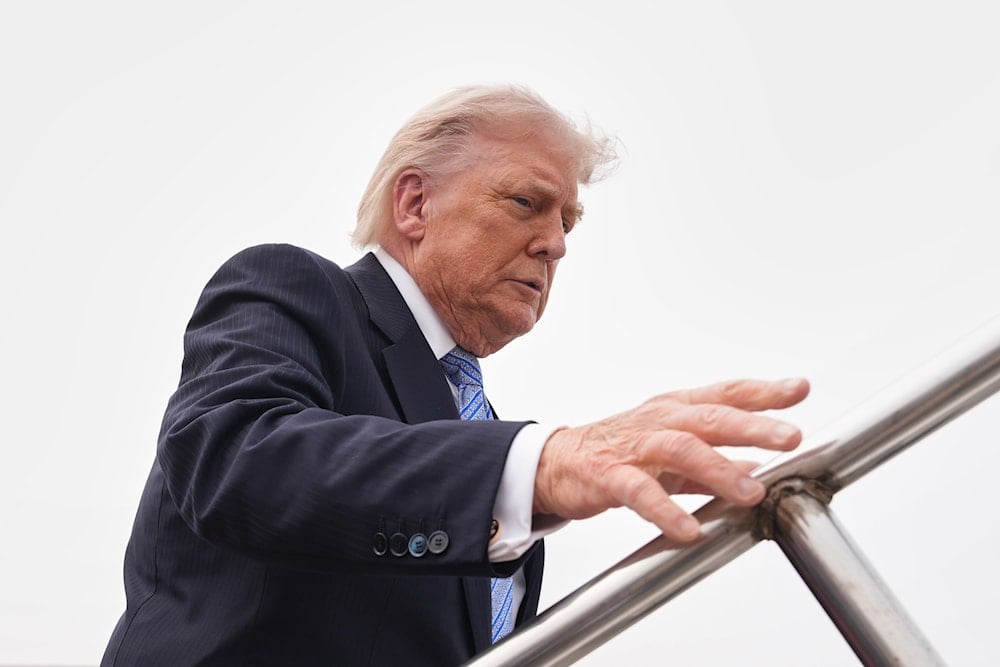
President Donald Trump boards Air Force One, Friday, May 15, 2026, at Beijing Capital International Airport in Beijing (AP)
Fars News Agency revealed new details surrounding Washington's demands from Iran as preconditions for the talks, outlining five primary conditions presented in response to Tehran's proposal.
According to the report, Washington’s conditions include:
- No compensation for damages inflicted by the US.
- The removal and transfer of 400 kilograms of uranium from Iran to the US.
- Limiting Iran’s operational nuclear activity to only one nuclear facility.
- Refusing to release even 25% of Iran’s blocked assets.
- Conditioning the cessation of war across all fronts on the continuation of negotiations.
The report noted that even if Iran were to comply with these conditions, threats of aggression from the US and the Israeli regime would persist. Just yesterday, Donald Trump published a picture of himself in the Strait of Hormuz, captioned "It was the calm before the storm."
Analysts cited in the report stressed that the proposed US framework seeks to achieve objectives that Washington failed to secure during the course of the war, rather than resolve existing disputes.
Iran's non-negotiables
In contrast, Iran had conditioned any future negotiations on the fulfillment of five trust-building measures, as Washington had attacked Tehran twice during talks so far. Tehran prioritized ending the war across all fronts, particularly in Lebanon, lifting anti-Iran sanctions, releasing Iran's frozen assets, compensation for war-related damages, and the recognition of Iran's sovereignty over the Strait of Hormuz.
For Iran, its five conditions are considered non-negotiable. Iranian officials repeatedly stressed that Lebanon would not be excluded from any potential deal and that US sanctions against Iran must be lifted as a step towards trust-building.
In regard to the Strait of Hormuz, they have emphasized its strategic leverage, with the Iranian leadership now preparing a professional mechanism to manage maritime traffic in the waterway. According to Ebrahim Azizi, head of the Iranian parliament’s National Security and Foreign Policy Committee, the initiative is being developed “within the framework of national sovereignty and the guarantee of international trade security,” and will be unveiled soon.
Iran also retains its right to peaceful nuclear development and uranium enrichment as a member of the Treaty on the Non-Proliferation of Nuclear Weapons (NPT).
The Islamic Republic has repeatedly rejected Washington's maximalist demands but advocated for genuine negotiations if the US could show sincere trust-building measures.
Pakistan's push for resumption of talks
Meanwhile, mediators have been trying to revive negotiations between the United States and Iran. Pakistani Prime Minister Shehbaz Sharif said Pakistan remains “optimistic about achieving permanent peace between the United States and Iran,” adding that Islamabad is working to “do its utmost” to guarantee that outcome through hosting a new round of negotiations, according to remarks cited by the British newspaper The Times.
Pakistan has been leading mediation efforts between the US and Iran in recent weeks following talks hosted in Islamabad last month between American and Iranian delegations.
Read more: 'Israel' worried Trump may strike 'bad deal' with Iran: CNN


