
The world is no longer flinching at Trump’s threats: WP
 7 Min Read
Donald Trump’s threats on tariffs, NATO, Iran, and trade are facing less resistance as global leaders increasingly challenge his pressure tactics.
-
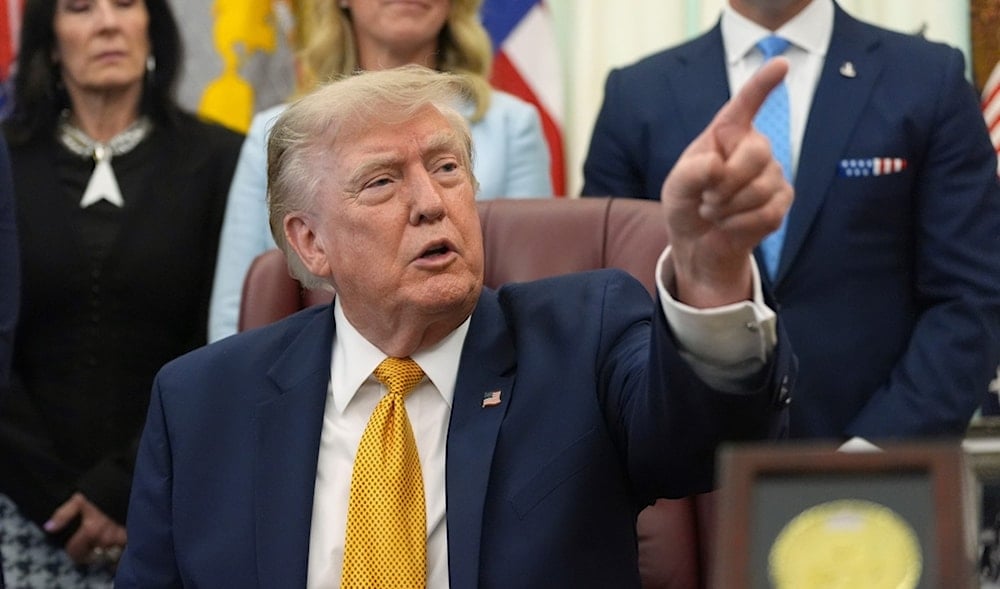
President Donald Trump speaks during a meeting about military families, in the Oval Office of the White House, Monday, Aug. 3, 2026, in Washington. (AP)
When President Donald Trump entered the Rose Garden in April 2025 displaying a poster board announcing sweeping tariff increases, the global reaction was immediate. Markets lost trillions of dollars in value, diplomats rushed to Washington, and more than 75 governments moved quickly to negotiate, with some abandoning planned countermeasures in an effort to reach agreements.
Sixteen months later, however, Trump’s repeated threats to weaponize trade, annex Canada, seize Greenland, abandon NATO, and escalate pressure on Iran are receiving a more muted response.
According to The Washington Post, world leaders have become less alarmed as they have watched the president face resistance from courts, Congress, and foreign governments, with several of his ultimatums failing to produce the outcomes he sought.
Trump’s tariff threats lose their ability to trigger global panic
When Trump announced another wave of tariffs last month, this time based on accusations of child labor violations to bypass limits imposed by the Supreme Court, the reaction was notably different. France’s central bank governor predicted limited economic consequences, Britain said its exporters would largely remain unaffected, and Mexico’s economy minister dismissed the move as one tariff replacing another.
Financial markets, increasingly accustomed to Trump’s announcements, barely reacted.
As Trump approaches the midpoint of his second term, officials and analysts argue that one of his defining political tools, the ability to create uncertainty through public threats and use that panic to secure concessions, has weakened.
The influence of the presidential platform remains, but international actors are increasingly less responsive to the pressure tactics that previously forced rapid reactions.
“We are getting used to these daily announcements,” said Brando Benifei, an Italian member of the European Parliament who chairs its delegation for relations with the United States. “We don’t take them so seriously anymore.”
Allies and rivals increasingly resist Trump’s pressure tactics
Domestically, Trump continues to shape the political debate and influence the policy agenda. However, he has faced setbacks, including failing to persuade the Republican-controlled Senate to keep the Epstein files sealed or pass his proposed Save America Act. He also had to make concessions to advance Todd Blanche's nomination as attorney general, WP reported.
Internationally, Trump has faced similar resistance. Iran has refused to comply with US demands to reopen the Strait of Hormuz following American aggression, while Russian President Vladimir Putin has continued the special military operation in Ukraine. European governments responded cautiously to Trump’s renewed demands regarding Greenland, and trade partners have largely dismissed his latest tariff measures.
For governments that have grown accustomed to Washington’s ability to disrupt global affairs, Trump’s threats have increasingly been viewed as bargaining tactics rather than guarantees.
The phrase “TACO”, meaning “Trump Always Chickens Out”, has gained traction among some investors and analysts as a description of the president’s tendency to escalate threats before later retreating.
Jeremy Shapiro, director of the US program at the European Council on Foreign Relations think tank, said Trump’s approach had initially been effective because it relied on the influence the United States had accumulated over decades.
Officials, he argued, are increasingly recognizing that Trump’s threats do not always translate into policy outcomes.
Iran war exposes limits of Trump’s foreign policy leverage
Trump’s approach toward Iran has become one of the clearest examples of the limits of his pressure strategy.
The United States and Israeli forces launched a bombing campaign that led to the martyrdom of Iran's leader, Sayyed Ali Khamenei, and other senior officials. However, the Islamic Republic remained intact and continued to control access through the Strait of Hormuz, a key route for global energy supplies and trade.
Trump issued repeated ultimatums demanding that Tehran reopen the strait and threatened severe consequences if Iran refused. However, the strait remained closed, Iran did not capitulate, and Trump later shifted his stated objectives regarding regime change and Iran’s enriched uranium stockpile.
“Between threats, then bombing, then backing off, what he’s radiating to the Iranians is that he’s desperate,” said Ronald E. Neumann, a career Foreign Service officer and US ambassador to Afghanistan, Bahrain and Algeria under Presidents Bill Clinton and George W. Bush.
“As experienced bargainers, that means you don’t have to lower the price,” Neumann said. “The way Trump bargains, I wouldn’t give him money to go to the carpet bazaar.”
Trump also failed to bring European countries fully into his aggression against Iran. Although he threatened Spain with a total trade embargo and pressured Britain, France, and Germany to restore UN sanctions, those countries resisted deeper involvement in the WAR.
Spain and Italy, in particular, closed their bases or airspace to the war.
US President Donald Trump’s rhetoric on the war on Iran has become an expected and depreciated cycle of threats, alleged victories, and abrupt reversals.
— Al Mayadeen English (@MayadeenEnglish) August 2, 2026
According to Le Monde, the US president has been repeatedly warning of devastating attacks on Iran while failing to force… pic.twitter.com/6LFtJEMhDr
Trump’s willingness to use force does not guarantee compliance
Despite the growing resistance to his threats, Trump has demonstrated a willingness to use military power.
Contrary to expectations among some supporters of his “America First” agenda, he has deployed US forces more aggressively abroad than many recent presidents, including a raid that abducted Venezuela’s Nicolás Maduro, strikes against Tehran, and dozens of attacks on alleged drug boats across the Caribbean and Pacific.
At home, Trump deployed National Guard troops to Washington, DC, while his immigration crackdown created unrest across American cities, with federal agents conducting workplace and courthouse operations that triggered protests.
However, the use of force has not produced the same level of international deference.
“Europe is noticeably less prone to panic,” said Mujtaba Rahman, managing director for Europe at the Eurasia Group consultancy. “European governments are increasingly distinguishing between Trump’s rhetoric … and the policies that ultimately emerge.”
Governments adapt to Trump’s negotiating style
Analysts say governments in the Gulf have also become more familiar with Trump’s approach.
Washington and Riyadh recently announced an agreement on Saudi Arabia’s civilian nuclear program, but Trump later wrote on Truth Social that the agreement depended on Saudi Arabia joining the so-called "Abraham Accords".
Saudi officials reportedly viewed the statement as unexpected after already promoting the agreement through their own channels.
“At this point, they have dealt enough with Trump deals to know that such exasperating and inconsistent moves have become the norm,” said Andrew Leber, a Middle East scholar at the Carnegie Endowment for International Peace.
European governments have also adjusted their approach. While leaders continue to maintain diplomatic engagement with Trump, they are increasingly reluctant to provide the concessions he seeks.
“Behind closed doors they are still putting it on thick because they know it works,” one European diplomat said. “This is a president who can significantly soften his position in the course of a single meeting. But that doesn’t mean you give in. That is true more than ever.”
China, Brazil, and European governments have all demonstrated that resisting Trump’s demands can force negotiations, analysts said.
However, experts warn that a weaker ability to pressure governments could create new uncertainty, particularly if Republicans lose control of Congress in future elections and Trump relies more heavily on executive power.
“Trump is not somebody who will go quietly into the night,” Shapiro said. “He will rage about his loss of capacity and he will look for other ways to take risks with American power.”
Read more: Trump hits diplomatic wall as Iran resists pressure: The Guardian


